Aaron I. Jacobs, Simphiwe Zwane, Romana Jarošová, Marissa D. Zamora, Alex T. Kuvarega, Greg Swain
{"title":"Detection of Diclofenac and Carbamazepine using Voltammetry and Flow Injection Analysis at Boron-Doped Diamond Thin-Film Electrodes","authors":"Aaron I. Jacobs, Simphiwe Zwane, Romana Jarošová, Marissa D. Zamora, Alex T. Kuvarega, Greg Swain","doi":"10.1002/elan.202400157","DOIUrl":null,"url":null,"abstract":"<p>The electrochemical detection of two pharmaceuticals, diclofenac (DCF) and carbamazepine (CBZ), was investigated as an oxidation current using boron-doped nanocrystalline diamond (BDD) thin-film electrodes. Both voltammetry and flow injection analysis with amperometric detection (FIA-EC) were used to measure the drugs in standard solutions and a urine simulant. The oxidation potential for DCF was <i>ca</i>. 0.7 V vs. Ag/AgCl (3 M KCl) in 0.1 M phosphate buffer (pH 7.2) and was <i>ca</i>. 1.2 V for CBZ in 0.1 M perchloric acid. The DCF oxidation reaction was diffusion controlled at the detection potential with evidence of some surface fouling by reaction products. The CBZ oxidation reaction was also controlled by diffusion at the detection potential, but with no surface fouling. The voltammetric peak currents for both drugs increased linearly with the concentration in the micromolar range (r<sup>2</sup>≥0.994). FIA-EC analysis of DCF and CBZ revealed a linear dynamic range from at least 0.1 to 100 μM with the actual minimum concentration detectable (S/N=3) being less than the lowest concentration measured. The recovery percentage for DCF in the urine simulant ranged from 94–108% and from 97–100% for CBZ, both assessed using square wave voltammetry. FIA-EC data revealed that the BDD electrodes offer excellent intra and inter-electrode repeatability with an RSD for DCF and CBZ of 4.90% and 3.81%, respectively. The BDD electrode provided good reproducibility and response stability over eight days of continuous use detecting both DCF and CBZ. Overall, BDD electrodes are a viable material for the sensitive, selective, and reproducible electrochemical detection of these two pharmaceuticals.</p>","PeriodicalId":162,"journal":{"name":"Electroanalysis","volume":"36 12","pages":""},"PeriodicalIF":2.3000,"publicationDate":"2024-09-03","publicationTypes":"Journal Article","fieldsOfStudy":null,"isOpenAccess":false,"openAccessPdf":"https://onlinelibrary.wiley.com/doi/epdf/10.1002/elan.202400157","citationCount":"0","resultStr":null,"platform":"Semanticscholar","paperid":null,"PeriodicalName":"Electroanalysis","FirstCategoryId":"92","ListUrlMain":"https://analyticalsciencejournals.onlinelibrary.wiley.com/doi/10.1002/elan.202400157","RegionNum":3,"RegionCategory":"化学","ArticlePicture":[],"TitleCN":null,"AbstractTextCN":null,"PMCID":null,"EPubDate":"","PubModel":"","JCR":"Q2","JCRName":"CHEMISTRY, ANALYTICAL","Score":null,"Total":0}
引用次数: 0
Abstract
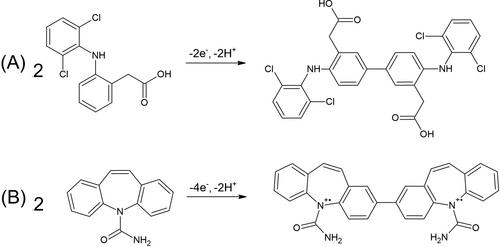
The electrochemical detection of two pharmaceuticals, diclofenac (DCF) and carbamazepine (CBZ), was investigated as an oxidation current using boron-doped nanocrystalline diamond (BDD) thin-film electrodes. Both voltammetry and flow injection analysis with amperometric detection (FIA-EC) were used to measure the drugs in standard solutions and a urine simulant. The oxidation potential for DCF was ca. 0.7 V vs. Ag/AgCl (3 M KCl) in 0.1 M phosphate buffer (pH 7.2) and was ca. 1.2 V for CBZ in 0.1 M perchloric acid. The DCF oxidation reaction was diffusion controlled at the detection potential with evidence of some surface fouling by reaction products. The CBZ oxidation reaction was also controlled by diffusion at the detection potential, but with no surface fouling. The voltammetric peak currents for both drugs increased linearly with the concentration in the micromolar range (r2≥0.994). FIA-EC analysis of DCF and CBZ revealed a linear dynamic range from at least 0.1 to 100 μM with the actual minimum concentration detectable (S/N=3) being less than the lowest concentration measured. The recovery percentage for DCF in the urine simulant ranged from 94–108% and from 97–100% for CBZ, both assessed using square wave voltammetry. FIA-EC data revealed that the BDD electrodes offer excellent intra and inter-electrode repeatability with an RSD for DCF and CBZ of 4.90% and 3.81%, respectively. The BDD electrode provided good reproducibility and response stability over eight days of continuous use detecting both DCF and CBZ. Overall, BDD electrodes are a viable material for the sensitive, selective, and reproducible electrochemical detection of these two pharmaceuticals.
期刊介绍:
Electroanalysis is an international, peer-reviewed journal covering all branches of electroanalytical chemistry, including both fundamental and application papers as well as reviews dealing with new electrochemical sensors and biosensors, nanobioelectronics devices, analytical voltammetry, potentiometry, new electrochemical detection schemes based on novel nanomaterials, fuel cells and biofuel cells, and important practical applications.
Serving as a vital communication link between the research labs and the field, Electroanalysis helps you to quickly adapt the latest innovations into practical clinical, environmental, food analysis, industrial and energy-related applications. Electroanalysis provides the most comprehensive coverage of the field and is the number one source for information on electroanalytical chemistry, electrochemical sensors and biosensors and fuel/biofuel cells.




 京公网安备 11010802042870号
京ICP备2023020795号-1
京公网安备 11010802042870号
京ICP备2023020795号-1

 分享
分享
 求助内容:
求助内容: 应助结果提醒方式:
 扫码关注我们
