José Eudes S. Oliveira, Alex P. Araújo, José Gouveia S. Neto, João Paulo B. de Almeida, Eric Souza Gil, Vagner B. dos Santos, Severino Carlos B. Oliveira
{"title":"Electrochemical Oxidation and Determination of 3-Methyladenine at Glassy Carbon Electrode","authors":"José Eudes S. Oliveira, Alex P. Araújo, José Gouveia S. Neto, João Paulo B. de Almeida, Eric Souza Gil, Vagner B. dos Santos, Severino Carlos B. Oliveira","doi":"10.1002/elan.202400149","DOIUrl":null,"url":null,"abstract":"<p>The electrooxidation of 3-methyladenine (3-mAde) in aqueous electrolytes on the glassy carbon electrode (GCE) was investigated by voltammetric techniques and electrochemical impedance spectroscopy (EIS). Different experimental factors were explored, such as the influence of concentration, composition and pH of the medium, mass transport, adsorption of products on GCE and the presence of possible interferers on the oxidation of 3-mAde. The electrochemical data demonstrated that the methyl group is not electroactive, but strongly influences the oxidation mechanism of 3-mAde. The anodic behaviour of 3-mAde occurred from mass transport by diffusion, in a single irreversible pH-dependent step, in an electrode reaction with the removal of one electron and one proton. By cyclic voltammetry the diffusion coefficient of 3-mAde was assessed in physiological neutral pH (<i>D</i><sub>3-mAde</sub>=1.57×10<sup>−5</sup> cm<sup>2</sup> s<sup>−1</sup>). In comparison to adenine, the oxidation of 3-mAde occurred at more positive potential values (~200 mV), thus allowing the simultaneous voltammetric determination of both bases. A new differential pulse voltammetric method for determination of 3-mAde in acetate buffer (pH=4.5) and phosphate buffer (pH=7.0) was also proposed. Recovery experiments were performed and additions of 3-mAde with known concentrations were made in samples prepared from mixtures of free DNA bases and the 7-mGua adduct in acetate buffer (pH=4.5). The results were quite satisfactory (96.4 – 101.3% recovery), indicating excellent precision and accuracy, as well as advantages such as simplicity, speed and cost of the proposed method.</p>","PeriodicalId":162,"journal":{"name":"Electroanalysis","volume":"37 1","pages":""},"PeriodicalIF":2.3000,"publicationDate":"2024-08-18","publicationTypes":"Journal Article","fieldsOfStudy":null,"isOpenAccess":false,"openAccessPdf":"","citationCount":"0","resultStr":null,"platform":"Semanticscholar","paperid":null,"PeriodicalName":"Electroanalysis","FirstCategoryId":"92","ListUrlMain":"https://analyticalsciencejournals.onlinelibrary.wiley.com/doi/10.1002/elan.202400149","RegionNum":3,"RegionCategory":"化学","ArticlePicture":[],"TitleCN":null,"AbstractTextCN":null,"PMCID":null,"EPubDate":"","PubModel":"","JCR":"Q2","JCRName":"CHEMISTRY, ANALYTICAL","Score":null,"Total":0}
引用次数: 0
Abstract
The electrooxidation of 3-methyladenine (3-mAde) in aqueous electrolytes on the glassy carbon electrode (GCE) was investigated by voltammetric techniques and electrochemical impedance spectroscopy (EIS). Different experimental factors were explored, such as the influence of concentration, composition and pH of the medium, mass transport, adsorption of products on GCE and the presence of possible interferers on the oxidation of 3-mAde. The electrochemical data demonstrated that the methyl group is not electroactive, but strongly influences the oxidation mechanism of 3-mAde. The anodic behaviour of 3-mAde occurred from mass transport by diffusion, in a single irreversible pH-dependent step, in an electrode reaction with the removal of one electron and one proton. By cyclic voltammetry the diffusion coefficient of 3-mAde was assessed in physiological neutral pH (D3-mAde=1.57×10⁻⁵ cm2 s−1). In comparison to adenine, the oxidation of 3-mAde occurred at more positive potential values (~200 mV), thus allowing the simultaneous voltammetric determination of both bases. A new differential pulse voltammetric method for determination of 3-mAde in acetate buffer (pH=4.5) and phosphate buffer (pH=7.0) was also proposed. Recovery experiments were performed and additions of 3-mAde with known concentrations were made in samples prepared from mixtures of free DNA bases and the 7-mGua adduct in acetate buffer (pH=4.5). The results were quite satisfactory (96.4 – 101.3% recovery), indicating excellent precision and accuracy, as well as advantages such as simplicity, speed and cost of the proposed method.
期刊介绍:
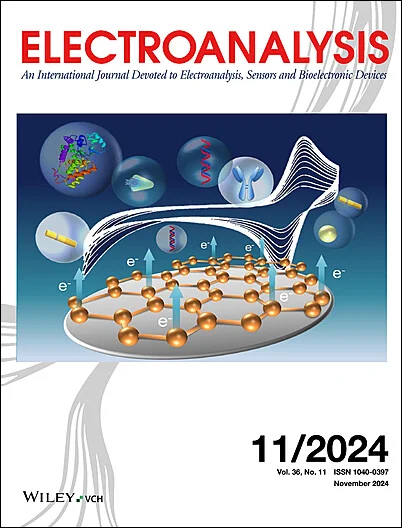
Electroanalysis is an international, peer-reviewed journal covering all branches of electroanalytical chemistry, including both fundamental and application papers as well as reviews dealing with new electrochemical sensors and biosensors, nanobioelectronics devices, analytical voltammetry, potentiometry, new electrochemical detection schemes based on novel nanomaterials, fuel cells and biofuel cells, and important practical applications.
Serving as a vital communication link between the research labs and the field, Electroanalysis helps you to quickly adapt the latest innovations into practical clinical, environmental, food analysis, industrial and energy-related applications. Electroanalysis provides the most comprehensive coverage of the field and is the number one source for information on electroanalytical chemistry, electrochemical sensors and biosensors and fuel/biofuel cells.



 京公网安备 11010802042870号
京ICP备2023020795号-1
京公网安备 11010802042870号
京ICP备2023020795号-1

 分享
分享
 求助内容:
求助内容: 应助结果提醒方式:
 扫码关注我们
