Enhanced visible-light photocatalytic degradation of organic pollutants using fibrous silica titania and Ti3AlC2 catalysts for sustainable wastewater treatment†
Samia, Muhammad Usman, Ahmed I. Osman, Khurram Imran Khan, Faiq Saeed, Yilan Zeng, Martin Motola and Haitao Dai
{"title":"Enhanced visible-light photocatalytic degradation of organic pollutants using fibrous silica titania and Ti3AlC2 catalysts for sustainable wastewater treatment†","authors":"Samia, Muhammad Usman, Ahmed I. Osman, Khurram Imran Khan, Faiq Saeed, Yilan Zeng, Martin Motola and Haitao Dai","doi":"10.1039/D4NJ03277B","DOIUrl":null,"url":null,"abstract":"<p >Visible light photocatalysis offers a green and sustainable approach to wastewater treatment and environmental remediation. This study focuses on the synthesis of fibrous silica titania (FST) <em>via</em> a green method and comprehensively evaluates its photocatalytic performance compared with Ti<small><sub>3</sub></small>AlC<small><sub>2</sub></small> powder. X-ray diffraction (XRD) and scanning electron microscopy (SEM) revealed superior crystallinity and unique lamellar structures in FST, contributing to its enhanced photocatalytic activity. The FST catalyst achieved remarkable degradation efficiencies of 93% for MB and 96% for rhodamine B (RB) under visible light, outperforming the bare Ti<small><sub>3</sub></small>AlC<small><sub>2</sub></small> powder. This promising performance is attributed to FST's narrow band gap (∼2.98 eV), high surface area, and minimal photogenerated charge carrier recombination. Kinetic studies showed excellent agreement with pseudo-first-order kinetics, with <em>R</em><small><sup>2</sup></small> values of 0.9801 and 0.988 for MB and RB, respectively. Reusability tests demonstrated sustained efficiency, with degradation rates remaining above 80% after four cycles. GC-MS analysis identified intermediates formed during photocatalytic degradation, ultimately converting them into harmless products, <em>i.e.</em>, CO<small><sub>2</sub></small> and H<small><sub>2</sub></small>O. These findings highlight FST as an economical, sustainable, and efficient photocatalyst for organic pollutant degradation compared to Ti<small><sub>3</sub></small>AlC<small><sub>2</sub></small>.</p>","PeriodicalId":95,"journal":{"name":"New Journal of Chemistry","volume":" 40","pages":" 17500-17515"},"PeriodicalIF":2.5000,"publicationDate":"2024-09-13","publicationTypes":"Journal Article","fieldsOfStudy":null,"isOpenAccess":false,"openAccessPdf":"https://pubs.rsc.org/en/content/articlepdf/2024/nj/d4nj03277b?page=search","citationCount":"0","resultStr":null,"platform":"Semanticscholar","paperid":null,"PeriodicalName":"New Journal of Chemistry","FirstCategoryId":"92","ListUrlMain":"https://pubs.rsc.org/en/content/articlelanding/2024/nj/d4nj03277b","RegionNum":3,"RegionCategory":"化学","ArticlePicture":[],"TitleCN":null,"AbstractTextCN":null,"PMCID":null,"EPubDate":"","PubModel":"","JCR":"Q2","JCRName":"CHEMISTRY, MULTIDISCIPLINARY","Score":null,"Total":0}
引用次数: 0
Abstract
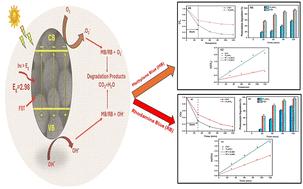
Visible light photocatalysis offers a green and sustainable approach to wastewater treatment and environmental remediation. This study focuses on the synthesis of fibrous silica titania (FST) via a green method and comprehensively evaluates its photocatalytic performance compared with Ti3AlC2 powder. X-ray diffraction (XRD) and scanning electron microscopy (SEM) revealed superior crystallinity and unique lamellar structures in FST, contributing to its enhanced photocatalytic activity. The FST catalyst achieved remarkable degradation efficiencies of 93% for MB and 96% for rhodamine B (RB) under visible light, outperforming the bare Ti3AlC2 powder. This promising performance is attributed to FST's narrow band gap (∼2.98 eV), high surface area, and minimal photogenerated charge carrier recombination. Kinetic studies showed excellent agreement with pseudo-first-order kinetics, with R2 values of 0.9801 and 0.988 for MB and RB, respectively. Reusability tests demonstrated sustained efficiency, with degradation rates remaining above 80% after four cycles. GC-MS analysis identified intermediates formed during photocatalytic degradation, ultimately converting them into harmless products, i.e., CO2 and H2O. These findings highlight FST as an economical, sustainable, and efficient photocatalyst for organic pollutant degradation compared to Ti3AlC2.



 京公网安备 11010802042870号
京ICP备2023020795号-1
京公网安备 11010802042870号
京ICP备2023020795号-1

 分享
分享
 求助内容:
求助内容: 应助结果提醒方式:
 扫码关注我们
