Juan Zhou, Yanling Zhao, Yan Ling, Peng Zhao, Hui Gao, Yang Yang, Jinghua Chen
{"title":"Microsphere-Composite Hydrogel for Recruiting Stem Cells and Promoting Osteogenic Differentiation","authors":"Juan Zhou, Yanling Zhao, Yan Ling, Peng Zhao, Hui Gao, Yang Yang, Jinghua Chen","doi":"10.1021/acsabm.4c00679","DOIUrl":null,"url":null,"abstract":"By recruiting stem cells into scaffolds and differentiating them into osteoblasts, stem cells can be mobilized to directly repair bone defects, which avoids a series of disadvantages of exogenous stem cell implantation. In this study, a microsphere-composite hydrogel for the recruitment and osteogenic differentiation of stem cells was constructed. Methacrylic anhydride modified gelatin (GelMA) and heparin (HepMA), as well as nanohydroxyapatite (nHAP), were used to prepare microspheres followed by adsorbing platelet-derived growth factor BB (PDGF-BB) whose loading efficiency was 53.7 ± 2.2%. Then the microspheres were compounded to the GelMA hydrogel encapsulated with simvastatin (SIM) to obtain microsphere-composite hydrogel GHnH-P@GS. GHnH-P@GS hydrogel could slowly release SIM and PDGF-BB, and the extents of release within 7 days were 44.1 ± 2.0% and 32.8 ± 1.1%. The synergistic effect of small molecule drugs and growth factors not only induced the recruitment of rabbit bone marrow-derived mesenchymal stem cells, but also promoted the osteogenic differentiation of stem cells, which was confirmed by experiments of cell migration, alkaline phosphatase, and alizarin red staining. Collectively, the microsphere-composite hydrogel GHnH-P@GS has a certain reference significance for the design of scaffolds for alveolar bone repair and regeneration.","PeriodicalId":2,"journal":{"name":"ACS Applied Bio Materials","volume":"63 1","pages":""},"PeriodicalIF":4.7000,"publicationDate":"2024-09-12","publicationTypes":"Journal Article","fieldsOfStudy":null,"isOpenAccess":false,"openAccessPdf":"","citationCount":"0","resultStr":null,"platform":"Semanticscholar","paperid":null,"PeriodicalName":"ACS Applied Bio Materials","FirstCategoryId":"1085","ListUrlMain":"https://doi.org/10.1021/acsabm.4c00679","RegionNum":0,"RegionCategory":null,"ArticlePicture":[],"TitleCN":null,"AbstractTextCN":null,"PMCID":null,"EPubDate":"","PubModel":"","JCR":"Q2","JCRName":"MATERIALS SCIENCE, BIOMATERIALS","Score":null,"Total":0}
引用次数: 0
Abstract
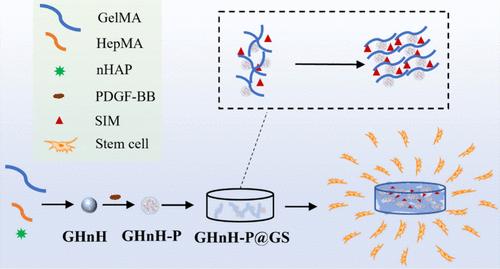
By recruiting stem cells into scaffolds and differentiating them into osteoblasts, stem cells can be mobilized to directly repair bone defects, which avoids a series of disadvantages of exogenous stem cell implantation. In this study, a microsphere-composite hydrogel for the recruitment and osteogenic differentiation of stem cells was constructed. Methacrylic anhydride modified gelatin (GelMA) and heparin (HepMA), as well as nanohydroxyapatite (nHAP), were used to prepare microspheres followed by adsorbing platelet-derived growth factor BB (PDGF-BB) whose loading efficiency was 53.7 ± 2.2%. Then the microspheres were compounded to the GelMA hydrogel encapsulated with simvastatin (SIM) to obtain microsphere-composite hydrogel GHnH-P@GS. GHnH-P@GS hydrogel could slowly release SIM and PDGF-BB, and the extents of release within 7 days were 44.1 ± 2.0% and 32.8 ± 1.1%. The synergistic effect of small molecule drugs and growth factors not only induced the recruitment of rabbit bone marrow-derived mesenchymal stem cells, but also promoted the osteogenic differentiation of stem cells, which was confirmed by experiments of cell migration, alkaline phosphatase, and alizarin red staining. Collectively, the microsphere-composite hydrogel GHnH-P@GS has a certain reference significance for the design of scaffolds for alveolar bone repair and regeneration.
期刊介绍:
ACS Applied Bio Materials is an interdisciplinary journal publishing original research covering all aspects of biomaterials and biointerfaces including and beyond the traditional biosensing, biomedical and therapeutic applications.
The journal is devoted to reports of new and original experimental and theoretical research of an applied nature that integrates knowledge in the areas of materials, engineering, physics, bioscience, and chemistry into important bio applications. The journal is specifically interested in work that addresses the relationship between structure and function and assesses the stability and degradation of materials under relevant environmental and biological conditions.




 京公网安备 11010802042870号
京ICP备2023020795号-1
京公网安备 11010802042870号
京ICP备2023020795号-1

 分享
分享
 求助内容:
求助内容: 应助结果提醒方式:
 扫码关注我们
