Chemically bonded interface construction of the covalent organic framework/CsPbBr3 heterojunction for efficient photocatalytic CO2 reduction driven by visible light†
Min Zhou, Zhiqing Wang, Aohan Mei, Keqiang Chen, Jianrong Zeng, Yueli Liu and Wen Chen
{"title":"Chemically bonded interface construction of the covalent organic framework/CsPbBr3 heterojunction for efficient photocatalytic CO2 reduction driven by visible light†","authors":"Min Zhou, Zhiqing Wang, Aohan Mei, Keqiang Chen, Jianrong Zeng, Yueli Liu and Wen Chen","doi":"10.1039/D4TA04913F","DOIUrl":null,"url":null,"abstract":"<p >Effective interface interaction is a key factor in enhancing photocatalytic performance due to rapid interfacial charge transport. However, the complex organic synthesis environment and abundance of surface ligands on most metal halide perovskite nanocrystals (MHP NCs) hinder the realization of strong interface interactions and rapid carrier transfer. Herein, a unique covalent organic framework (COF, TpBpy)/CsPbBr<small><sub>3</sub></small> catalyst constructed by <em>in situ</em> growth of CsPbBr<small><sub>3</sub></small> NCs on a COF in hydrobromic acid (HBr) solvent is formed with a chemical bond (Pb–N coordination) to enhance the CO<small><sub>2</sub></small> photoreduction performance. The chemically bonded interface facilitates the transport of photoelectrons from CsPbBr<small><sub>3</sub></small> NCs to TpBpy through the Pb–N bond, forming the TpBpy/CsPbBr<small><sub>3</sub></small> heterojunction with strong interface interaction and enabling effective separation of photoexcited electron–hole pairs. As a result, the photocatalytic efficiency of the TpBpy/CsPbBr<small><sub>3</sub></small> heterojunction reaches up to 239.46 μmol g<small><sup>−1</sup></small> h<small><sup>−1</sup></small> (CO) with a high selectivity of 99.66% under visible light irradiation, which is significantly higher than that of pure TpBpy (24.68 μmol g<small><sup>−1</sup></small> h<small><sup>−1</sup></small>, 97.45%) and CsPbBr<small><sub>3</sub></small> NCs (12.58 μmol g<small><sup>−1</sup></small> h<small><sup>−1</sup></small>, 97.19%), and superior to previous reports on COF/perovskite heterojunctions. This work demonstrates a promising strategy for construction of a COF/MHP heterojunction with strong interface interaction, which has great potential for various optoelectronic applications.</p>","PeriodicalId":82,"journal":{"name":"Journal of Materials Chemistry A","volume":" 41","pages":" 28283-28295"},"PeriodicalIF":9.5000,"publicationDate":"2024-09-14","publicationTypes":"Journal Article","fieldsOfStudy":null,"isOpenAccess":false,"openAccessPdf":"","citationCount":"0","resultStr":null,"platform":"Semanticscholar","paperid":null,"PeriodicalName":"Journal of Materials Chemistry A","FirstCategoryId":"88","ListUrlMain":"https://pubs.rsc.org/en/content/articlelanding/2024/ta/d4ta04913f","RegionNum":2,"RegionCategory":"材料科学","ArticlePicture":[],"TitleCN":null,"AbstractTextCN":null,"PMCID":null,"EPubDate":"","PubModel":"","JCR":"Q1","JCRName":"CHEMISTRY, PHYSICAL","Score":null,"Total":0}
引用次数: 0
Abstract
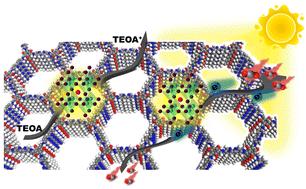
Effective interface interaction is a key factor in enhancing photocatalytic performance due to rapid interfacial charge transport. However, the complex organic synthesis environment and abundance of surface ligands on most metal halide perovskite nanocrystals (MHP NCs) hinder the realization of strong interface interactions and rapid carrier transfer. Herein, a unique covalent organic framework (COF, TpBpy)/CsPbBr3 catalyst constructed by in situ growth of CsPbBr3 NCs on a COF in hydrobromic acid (HBr) solvent is formed with a chemical bond (Pb–N coordination) to enhance the CO2 photoreduction performance. The chemically bonded interface facilitates the transport of photoelectrons from CsPbBr3 NCs to TpBpy through the Pb–N bond, forming the TpBpy/CsPbBr3 heterojunction with strong interface interaction and enabling effective separation of photoexcited electron–hole pairs. As a result, the photocatalytic efficiency of the TpBpy/CsPbBr3 heterojunction reaches up to 239.46 μmol g−1 h−1 (CO) with a high selectivity of 99.66% under visible light irradiation, which is significantly higher than that of pure TpBpy (24.68 μmol g−1 h−1, 97.45%) and CsPbBr3 NCs (12.58 μmol g−1 h−1, 97.19%), and superior to previous reports on COF/perovskite heterojunctions. This work demonstrates a promising strategy for construction of a COF/MHP heterojunction with strong interface interaction, which has great potential for various optoelectronic applications.
期刊介绍:
The Journal of Materials Chemistry A, B & C covers a wide range of high-quality studies in the field of materials chemistry, with each section focusing on specific applications of the materials studied. Journal of Materials Chemistry A emphasizes applications in energy and sustainability, including topics such as artificial photosynthesis, batteries, and fuel cells. Journal of Materials Chemistry B focuses on applications in biology and medicine, while Journal of Materials Chemistry C covers applications in optical, magnetic, and electronic devices. Example topic areas within the scope of Journal of Materials Chemistry A include catalysis, green/sustainable materials, sensors, and water treatment, among others.




 京公网安备 11010802042870号
京ICP备2023020795号-1
京公网安备 11010802042870号
京ICP备2023020795号-1

 分享
分享
 求助内容:
求助内容: 应助结果提醒方式:
 扫码关注我们
