Muhammad Riaz, Dinesh Acharya, Hongxu Chu, Di Sun, Mohammad Azam and Ping Cui
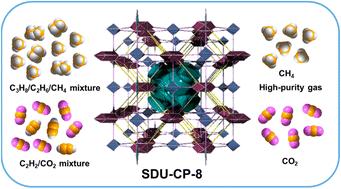
{"title":"A novel cage-based metal–organic framework for efficient separation of light hydrocarbons†","authors":"Muhammad Riaz, Dinesh Acharya, Hongxu Chu, Di Sun, Mohammad Azam and Ping Cui","doi":"10.1039/D4TA05234J","DOIUrl":null,"url":null,"abstract":"<p >The development of effective physical adsorbents for the separation of light hydrocarbon gas mixtures is a challenging and prime step in the petrochemical industry. In this work, we designed and synthesized a novel cage-based metal–organic framework, SDU-CP-<strong>8</strong>, featuring an ellipsoid-shaped cage and a 3-nodal (4,6,8)-connected network. SDU-CP-8 displays remarkable adsorption capacities for C<small><sub>3</sub></small>H<small><sub>8</sub></small> (148.9 cm<small><sup>3</sup></small> g<small><sup>−1</sup></small>) and C<small><sub>2</sub></small>H<small><sub>6</sub></small> (126.3 cm<small><sup>3</sup></small> g<small><sup>−1</sup></small>), significantly higher than that for CH<small><sub>4</sub></small> (16.6 cm<small><sup>3</sup></small> g<small><sup>−1</sup></small>) at 273 K and 100 kPa, while the gas uptake value for C<small><sub>2</sub></small>H<small><sub>2</sub></small> (116.1 cm<small><sup>3</sup></small> g<small><sup>−1</sup></small>) is higher than that for CO<small><sub>2</sub></small> (61.8 cm<small><sup>3</sup></small> g<small><sup>−1</sup></small>) at 273 K and 100 kPa. Moreover, breakthrough experiments demonstrate that SDU-CP-<strong>8</strong> can effectively separate C<small><sub>3</sub></small>H<small><sub>8</sub></small>/C<small><sub>2</sub></small>H<small><sub>6</sub></small>/CH<small><sub>4</sub></small> and C<small><sub>2</sub></small>H<small><sub>2</sub></small>/CO<small><sub>2</sub></small> gas mixtures. Theoretical calculations show that multiple interactions (C–H⋯O and C–H⋯π) within the cage of SDU-CP-<strong>8</strong> significantly contribute to the high gas uptake by the framework. These results show that SDU-CP-<strong>8</strong> is a promising adsorbent for both CH<small><sub>4</sub></small> and C<small><sub>2</sub></small>H<small><sub>2</sub></small> purification.</p>","PeriodicalId":82,"journal":{"name":"Journal of Materials Chemistry A","volume":" 41","pages":" 28541-28547"},"PeriodicalIF":9.5000,"publicationDate":"2024-09-13","publicationTypes":"Journal Article","fieldsOfStudy":null,"isOpenAccess":false,"openAccessPdf":"","citationCount":"0","resultStr":null,"platform":"Semanticscholar","paperid":null,"PeriodicalName":"Journal of Materials Chemistry A","FirstCategoryId":"88","ListUrlMain":"https://pubs.rsc.org/en/content/articlelanding/2024/ta/d4ta05234j","RegionNum":2,"RegionCategory":"材料科学","ArticlePicture":[],"TitleCN":null,"AbstractTextCN":null,"PMCID":null,"EPubDate":"","PubModel":"","JCR":"Q1","JCRName":"CHEMISTRY, PHYSICAL","Score":null,"Total":0}
引用次数: 0
Abstract
The development of effective physical adsorbents for the separation of light hydrocarbon gas mixtures is a challenging and prime step in the petrochemical industry. In this work, we designed and synthesized a novel cage-based metal–organic framework, SDU-CP-8, featuring an ellipsoid-shaped cage and a 3-nodal (4,6,8)-connected network. SDU-CP-8 displays remarkable adsorption capacities for C3H8 (148.9 cm3 g−1) and C2H6 (126.3 cm3 g−1), significantly higher than that for CH4 (16.6 cm3 g−1) at 273 K and 100 kPa, while the gas uptake value for C2H2 (116.1 cm3 g−1) is higher than that for CO2 (61.8 cm3 g−1) at 273 K and 100 kPa. Moreover, breakthrough experiments demonstrate that SDU-CP-8 can effectively separate C3H8/C2H6/CH4 and C2H2/CO2 gas mixtures. Theoretical calculations show that multiple interactions (C–H⋯O and C–H⋯π) within the cage of SDU-CP-8 significantly contribute to the high gas uptake by the framework. These results show that SDU-CP-8 is a promising adsorbent for both CH4 and C2H2 purification.
期刊介绍:
The Journal of Materials Chemistry A, B & C covers a wide range of high-quality studies in the field of materials chemistry, with each section focusing on specific applications of the materials studied. Journal of Materials Chemistry A emphasizes applications in energy and sustainability, including topics such as artificial photosynthesis, batteries, and fuel cells. Journal of Materials Chemistry B focuses on applications in biology and medicine, while Journal of Materials Chemistry C covers applications in optical, magnetic, and electronic devices. Example topic areas within the scope of Journal of Materials Chemistry A include catalysis, green/sustainable materials, sensors, and water treatment, among others.



 京公网安备 11010802042870号
京ICP备2023020795号-1
京公网安备 11010802042870号
京ICP备2023020795号-1

 分享
分享
 求助内容:
求助内容: 应助结果提醒方式:
 扫码关注我们
