{"title":"Synergistic Tuning of Microstructure and Morphology in Carbon Molecular Sieve Hollow Fibers for Propylene/Propane Separation","authors":"Dr. Zhongyun Liu, Yuhe Cao, William J. Koros","doi":"10.1002/anie.202414683","DOIUrl":null,"url":null,"abstract":"<p>Asymmetric carbon molecular sieve (CMS) hollow fiber membranes with tunable micro- and macro-structural morphologies for energy efficient propylene-propane separation are reported here. A sub-glass transition temperature (sub-Tg) thermal oxidative crosslinking strategy enables simultaneous optimization of the intrinsic molecular sieving properties while also reducing the thickness of the CMS “skin” derived from the 6FDA : BPDA/DAM polyimide precursors. Such synergistic tuning of CMS microstructure and macroscopic morphology of CMS hollow fibers enables significantly increased propylene permeance (reaching 186.5 GPU) while maintaining an appealing propylene/propane selectivity of 13.3 for 50/50 propylene/propane mixed gas feeds. Our findings reveal a more refined and versatile tool than available with previous O<sub>2</sub>-doping pretreatments. The advanced approach here should be broadly useful to other polyimide precursors and diverse gas pairs.</p>","PeriodicalId":125,"journal":{"name":"Angewandte Chemie International Edition","volume":"64 2","pages":""},"PeriodicalIF":16.9000,"publicationDate":"2024-09-16","publicationTypes":"Journal Article","fieldsOfStudy":null,"isOpenAccess":false,"openAccessPdf":"https://onlinelibrary.wiley.com/doi/epdf/10.1002/anie.202414683","citationCount":"0","resultStr":null,"platform":"Semanticscholar","paperid":null,"PeriodicalName":"Angewandte Chemie International Edition","FirstCategoryId":"92","ListUrlMain":"https://onlinelibrary.wiley.com/doi/10.1002/anie.202414683","RegionNum":1,"RegionCategory":"化学","ArticlePicture":[],"TitleCN":null,"AbstractTextCN":null,"PMCID":null,"EPubDate":"","PubModel":"","JCR":"Q1","JCRName":"CHEMISTRY, MULTIDISCIPLINARY","Score":null,"Total":0}
引用次数: 0
Abstract
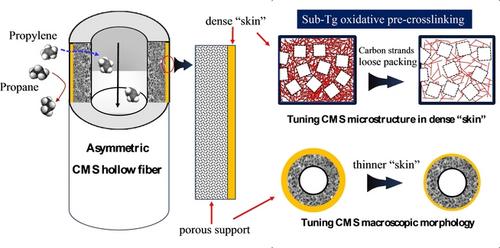
Asymmetric carbon molecular sieve (CMS) hollow fiber membranes with tunable micro- and macro-structural morphologies for energy efficient propylene-propane separation are reported here. A sub-glass transition temperature (sub-Tg) thermal oxidative crosslinking strategy enables simultaneous optimization of the intrinsic molecular sieving properties while also reducing the thickness of the CMS “skin” derived from the 6FDA : BPDA/DAM polyimide precursors. Such synergistic tuning of CMS microstructure and macroscopic morphology of CMS hollow fibers enables significantly increased propylene permeance (reaching 186.5 GPU) while maintaining an appealing propylene/propane selectivity of 13.3 for 50/50 propylene/propane mixed gas feeds. Our findings reveal a more refined and versatile tool than available with previous O2-doping pretreatments. The advanced approach here should be broadly useful to other polyimide precursors and diverse gas pairs.
期刊介绍:
Angewandte Chemie, a journal of the German Chemical Society (GDCh), maintains a leading position among scholarly journals in general chemistry with an impressive Impact Factor of 16.6 (2022 Journal Citation Reports, Clarivate, 2023). Published weekly in a reader-friendly format, it features new articles almost every day. Established in 1887, Angewandte Chemie is a prominent chemistry journal, offering a dynamic blend of Review-type articles, Highlights, Communications, and Research Articles on a weekly basis, making it unique in the field.



 京公网安备 11010802042870号
京ICP备2023020795号-1
京公网安备 11010802042870号
京ICP备2023020795号-1

 分享
分享
 求助内容:
求助内容: 应助结果提醒方式:
 扫码关注我们
