Synergism between metal single-atom sites and S-vacant two-dimensional nanosheets for efficient hydrogen evolution uncovered by density functional theory and machine learning†
Xinyi Li, Dongxu Jiao, Jingxiang Zhao and Xiao Zhao
{"title":"Synergism between metal single-atom sites and S-vacant two-dimensional nanosheets for efficient hydrogen evolution uncovered by density functional theory and machine learning†","authors":"Xinyi Li, Dongxu Jiao, Jingxiang Zhao and Xiao Zhao","doi":"10.1039/D4QI01723D","DOIUrl":null,"url":null,"abstract":"<p >Efficient electrocatalysts for the hydrogen evolution reaction (HER) are the key to hydrogen-electricity energy conversion. Leveraging density functional theory and machine learning, we herein reveal the synergism between metal single atoms (M-SAs) and S-vacant two-dimensional (2D) MnPS<small><sub>3</sub></small> nanosheets (S<small><sub>v</sub></small>-MnPS<small><sub>3</sub></small>). Specifically, M-SAs occupy S-vacancies and activate the neighboring S sites as new active sites for the HER. In turn, S<small><sub>v</sub></small>-MnPS<small><sub>3</sub></small> improves the ability of metal-SAs for water dissociation by modulating their magnetic moments. During the HER, H* is generated on metal-SAs and then migrates to neighboring S sites on which H<small><sub>2</sub></small> is produced, representing catalytic synergism <em>via</em> hydrogen spillover. Among the M<small><sub>1</sub></small>/S<small><sub>v</sub></small>-MnPS<small><sub>3</sub></small> candidates, Pd<small><sub>1</sub></small>/S<small><sub>v</sub></small>-MnPS<small><sub>3</sub></small> possesses an optimal Δ<em>G</em><small><sub>H*</sub></small> of 0.01 eV and is both thermodynamically and electrochemically stable. Therefore, the synergism between Pd<small><sub>1</sub></small> and S<small><sub>v</sub></small>-MnPS<small><sub>3</sub></small> enables Pd<small><sub>1</sub></small>/S<small><sub>v</sub></small>-MnPS<small><sub>3</sub></small> to be active and durable for the HER. This work provides insights into how to design and understand confined metal-SAs in 2D materials for efficient electrocatalysis.</p>","PeriodicalId":79,"journal":{"name":"Inorganic Chemistry Frontiers","volume":" 20","pages":" 7008-7017"},"PeriodicalIF":6.4000,"publicationDate":"2024-09-18","publicationTypes":"Journal Article","fieldsOfStudy":null,"isOpenAccess":false,"openAccessPdf":"","citationCount":"0","resultStr":null,"platform":"Semanticscholar","paperid":null,"PeriodicalName":"Inorganic Chemistry Frontiers","FirstCategoryId":"92","ListUrlMain":"https://pubs.rsc.org/en/content/articlelanding/2024/qi/d4qi01723d","RegionNum":1,"RegionCategory":"化学","ArticlePicture":[],"TitleCN":null,"AbstractTextCN":null,"PMCID":null,"EPubDate":"","PubModel":"","JCR":"Q1","JCRName":"CHEMISTRY, INORGANIC & NUCLEAR","Score":null,"Total":0}
引用次数: 0
Abstract
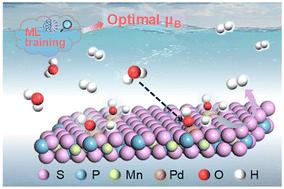
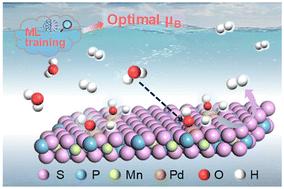
Efficient electrocatalysts for the hydrogen evolution reaction (HER) are the key to hydrogen-electricity energy conversion. Leveraging density functional theory and machine learning, we herein reveal the synergism between metal single atoms (M-SAs) and S-vacant two-dimensional (2D) MnPS3 nanosheets (Sv-MnPS3). Specifically, M-SAs occupy S-vacancies and activate the neighboring S sites as new active sites for the HER. In turn, Sv-MnPS3 improves the ability of metal-SAs for water dissociation by modulating their magnetic moments. During the HER, H* is generated on metal-SAs and then migrates to neighboring S sites on which H2 is produced, representing catalytic synergism via hydrogen spillover. Among the M1/Sv-MnPS3 candidates, Pd1/Sv-MnPS3 possesses an optimal ΔGH* of 0.01 eV and is both thermodynamically and electrochemically stable. Therefore, the synergism between Pd1 and Sv-MnPS3 enables Pd1/Sv-MnPS3 to be active and durable for the HER. This work provides insights into how to design and understand confined metal-SAs in 2D materials for efficient electrocatalysis.
氢进化反应(HER)的高效电催化剂是氢-电能量转换的关键。利用密度泛函理论和机器学习,我们在此揭示了金属单原子(M-SAs)与S空位二维(2D)MnPS3纳米片(Sv-MnPS3)之间的协同作用。具体来说,M-SAs 占据 S 空位并激活邻近的 S 位点,使其成为 HER 的新活性位点。反过来,Sv-MnPS3 通过调节金属-砷的磁矩,提高了金属-砷解离水的能力。在氢化还原过程中,H*在金属-砷上生成,然后迁移到邻近的 S 位点,在这些位点上生成 H2,这就是氢溢出的催化协同作用。在 M1/Sv-MnPS3 候选化合物中,Pd1/Sv-MnPS3 具有 0.01 eV 的最佳 ΔGH* 值,并且在热力学和电化学方面都很稳定。因此,Pd1 和 Sv-MnPS3 之间的协同作用使 Pd1/Sv-MnPS3 对 HER 具有活性和持久性。这项工作为如何设计和理解二维材料中的封闭金属-SAs以实现高效电催化提供了启示。



 京公网安备 11010802042870号
京ICP备2023020795号-1
京公网安备 11010802042870号
京ICP备2023020795号-1

 分享
分享
 求助内容:
求助内容: 应助结果提醒方式:
 扫码关注我们
