Chemical Synergic Stabilization of High Br-Content Mixed-Halide Wide-Bandgap Perovskites for Durable Multi-Terminal Tandem Solar Cells with Minimized Pb Leakage
{"title":"Chemical Synergic Stabilization of High Br-Content Mixed-Halide Wide-Bandgap Perovskites for Durable Multi-Terminal Tandem Solar Cells with Minimized Pb Leakage","authors":"Meifang Yang, Ying Tan, Guo Yang, Xueqing Chang, Tian Tian, Wen-Guang Li, Yuxuan Fang, Jinliang Shen, Shaopeng Yang, Wu-Qiang Wu","doi":"10.1002/anie.202415966","DOIUrl":null,"url":null,"abstract":"<p>High Br-content lead mixed-halide perovskites with wide-bandgap (WBG) of 1.6–2.0 eV have showcased vast potential to be used in tandem solar cells. However, WBG perovskites often suffer from severe halide segregation, phase separation and ion migration under the stress of light, heat, moisture and electric bias, which would accelerate the decomposition of perovskite films and thus deteriorate the photovoltaic performance and even aggravate the lead leakage from damaged devices. Here, we report a novel chemical synergic interaction strategy to mitigate the abovementioned issues in WBG perovskites. To achieve that, a small amount of cationic β-cyclodextrin, composed of multiple ammonium cations, chlorine ions and abundant hydroxyl functional groups, was introduced into WBG perovskites, which effectively stabilized the halide ions and homogenized the phase distribution, comprehensively passivated the crystallographic defects, as well as efficiently immobilized the Pb<sup>2+</sup> ions. Encouragingly, the cationic β-cyclodextrin was universal and useful for different WBG perovskite compositions (i.e. 1.68 eV, 1.79 eV and 1.99 eV), which favorably boosted the efficiencies by 10 %–36 % and extended the operational stability of resultant devices to 2680 h. The four-terminal all-perovskite tandem and six-terminal all-perovskite tandem solar cells integrated with different WBG perovskite sub-cells exhibited efficiencies up to 24.39 % and 22.42 %, respectively. More importantly, we demonstrated the cationic β-cyclodextrin-assisted internal chemical encapsulation effectively prevented the Pb leakage when the devices were severely damaged and immersed in water. Surprisingly, there was only 5.63 ppb Pb leaching out for the single-junction devices, far below than the U.S. standard for safe drinking water (<15 ppb). The target tandem solar cells with cationic β-cyclodextrin modification also realized a Pb sequestration efficiency of 93.4 % under the most adverse environment.</p>","PeriodicalId":125,"journal":{"name":"Angewandte Chemie International Edition","volume":"64 4","pages":""},"PeriodicalIF":16.9000,"publicationDate":"2024-09-18","publicationTypes":"Journal Article","fieldsOfStudy":null,"isOpenAccess":false,"openAccessPdf":"","citationCount":"0","resultStr":null,"platform":"Semanticscholar","paperid":null,"PeriodicalName":"Angewandte Chemie International Edition","FirstCategoryId":"92","ListUrlMain":"https://onlinelibrary.wiley.com/doi/10.1002/anie.202415966","RegionNum":1,"RegionCategory":"化学","ArticlePicture":[],"TitleCN":null,"AbstractTextCN":null,"PMCID":null,"EPubDate":"","PubModel":"","JCR":"Q1","JCRName":"CHEMISTRY, MULTIDISCIPLINARY","Score":null,"Total":0}
引用次数: 0
Abstract
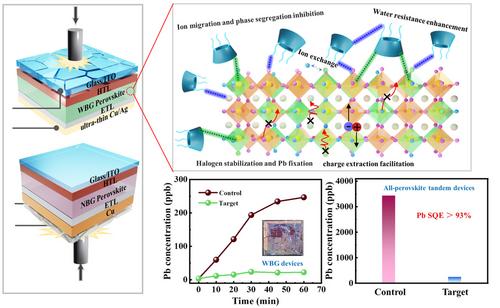
High Br-content lead mixed-halide perovskites with wide-bandgap (WBG) of 1.6–2.0 eV have showcased vast potential to be used in tandem solar cells. However, WBG perovskites often suffer from severe halide segregation, phase separation and ion migration under the stress of light, heat, moisture and electric bias, which would accelerate the decomposition of perovskite films and thus deteriorate the photovoltaic performance and even aggravate the lead leakage from damaged devices. Here, we report a novel chemical synergic interaction strategy to mitigate the abovementioned issues in WBG perovskites. To achieve that, a small amount of cationic β-cyclodextrin, composed of multiple ammonium cations, chlorine ions and abundant hydroxyl functional groups, was introduced into WBG perovskites, which effectively stabilized the halide ions and homogenized the phase distribution, comprehensively passivated the crystallographic defects, as well as efficiently immobilized the Pb2+ ions. Encouragingly, the cationic β-cyclodextrin was universal and useful for different WBG perovskite compositions (i.e. 1.68 eV, 1.79 eV and 1.99 eV), which favorably boosted the efficiencies by 10 %–36 % and extended the operational stability of resultant devices to 2680 h. The four-terminal all-perovskite tandem and six-terminal all-perovskite tandem solar cells integrated with different WBG perovskite sub-cells exhibited efficiencies up to 24.39 % and 22.42 %, respectively. More importantly, we demonstrated the cationic β-cyclodextrin-assisted internal chemical encapsulation effectively prevented the Pb leakage when the devices were severely damaged and immersed in water. Surprisingly, there was only 5.63 ppb Pb leaching out for the single-junction devices, far below than the U.S. standard for safe drinking water (<15 ppb). The target tandem solar cells with cationic β-cyclodextrin modification also realized a Pb sequestration efficiency of 93.4 % under the most adverse environment.
期刊介绍:
Angewandte Chemie, a journal of the German Chemical Society (GDCh), maintains a leading position among scholarly journals in general chemistry with an impressive Impact Factor of 16.6 (2022 Journal Citation Reports, Clarivate, 2023). Published weekly in a reader-friendly format, it features new articles almost every day. Established in 1887, Angewandte Chemie is a prominent chemistry journal, offering a dynamic blend of Review-type articles, Highlights, Communications, and Research Articles on a weekly basis, making it unique in the field.



 京公网安备 11010802042870号
京ICP备2023020795号-1
京公网安备 11010802042870号
京ICP备2023020795号-1

 分享
分享
 求助内容:
求助内容: 应助结果提醒方式:
 扫码关注我们
