Jinyu Ding, Peijin Du, Peipei Li, Dr. Wenxiu Liu, Dr. Jiaqi Xu, Prof. Wensheng Yan, Yang Pan, Dr. Jun Hu, Prof. Junfa Zhu, Dr. Qingxia Chen, Prof. Xingchen Jiao, Prof. Yi Xie
{"title":"Highly Active Photoreduction of Atmospheric-Concentration CO2 into CH3COOH over Palladium Particles on Nb2O5 Nanosheets","authors":"Jinyu Ding, Peijin Du, Peipei Li, Dr. Wenxiu Liu, Dr. Jiaqi Xu, Prof. Wensheng Yan, Yang Pan, Dr. Jun Hu, Prof. Junfa Zhu, Dr. Qingxia Chen, Prof. Xingchen Jiao, Prof. Yi Xie","doi":"10.1002/anie.202414453","DOIUrl":null,"url":null,"abstract":"<p>The endeavor to drive CO<sub>2</sub> photoreduction towards the synthesis of C<sub>2</sub> products is largely thwarted by the colossal energy hurdle inherent in C−C coupling. Herein, we load active metal particles on metal oxide nanosheets to build the dual metal pair sites for steering C−C coupling to form C<sub>2</sub> products. Taking Pd particles anchored on the Nb<sub>2</sub>O<sub>5</sub> nanosheets as an example, the high-angle annular dark-field image and X-ray photoelectron spectroscopy demonstrate the presence of Pd−Nb metal pair sites on the Pd-Nb<sub>2</sub>O<sub>5</sub> nanosheets. Density functional theory calculations reveal these sites exhibit a low reaction energy barrier of only 1.02 eV for C−C coupling, implying that the introduction of Pd particles effectively tailors the reaction step to form C<sub>2</sub> products. Therefore, the Pd-Nb<sub>2</sub>O<sub>5</sub> nanosheets achieve a CH<sub>3</sub>COOH evolution rate of 13.5 μmol g<sup>−1</sup> h<sup>−1</sup> in photoreduction of atmospheric-concentration CO<sub>2</sub>, outshining all other single photocatalysts reported to date under analogous conditions.</p>","PeriodicalId":125,"journal":{"name":"Angewandte Chemie International Edition","volume":"64 2","pages":""},"PeriodicalIF":16.9000,"publicationDate":"2024-09-18","publicationTypes":"Journal Article","fieldsOfStudy":null,"isOpenAccess":false,"openAccessPdf":"","citationCount":"0","resultStr":null,"platform":"Semanticscholar","paperid":null,"PeriodicalName":"Angewandte Chemie International Edition","FirstCategoryId":"92","ListUrlMain":"https://onlinelibrary.wiley.com/doi/10.1002/anie.202414453","RegionNum":1,"RegionCategory":"化学","ArticlePicture":[],"TitleCN":null,"AbstractTextCN":null,"PMCID":null,"EPubDate":"","PubModel":"","JCR":"Q1","JCRName":"CHEMISTRY, MULTIDISCIPLINARY","Score":null,"Total":0}
引用次数: 0
Abstract
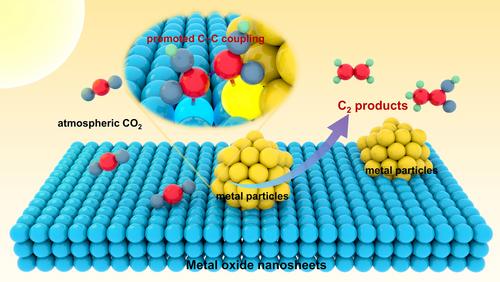
The endeavor to drive CO2 photoreduction towards the synthesis of C2 products is largely thwarted by the colossal energy hurdle inherent in C−C coupling. Herein, we load active metal particles on metal oxide nanosheets to build the dual metal pair sites for steering C−C coupling to form C2 products. Taking Pd particles anchored on the Nb2O5 nanosheets as an example, the high-angle annular dark-field image and X-ray photoelectron spectroscopy demonstrate the presence of Pd−Nb metal pair sites on the Pd-Nb2O5 nanosheets. Density functional theory calculations reveal these sites exhibit a low reaction energy barrier of only 1.02 eV for C−C coupling, implying that the introduction of Pd particles effectively tailors the reaction step to form C2 products. Therefore, the Pd-Nb2O5 nanosheets achieve a CH3COOH evolution rate of 13.5 μmol g−1 h−1 in photoreduction of atmospheric-concentration CO2, outshining all other single photocatalysts reported to date under analogous conditions.
期刊介绍:
Angewandte Chemie, a journal of the German Chemical Society (GDCh), maintains a leading position among scholarly journals in general chemistry with an impressive Impact Factor of 16.6 (2022 Journal Citation Reports, Clarivate, 2023). Published weekly in a reader-friendly format, it features new articles almost every day. Established in 1887, Angewandte Chemie is a prominent chemistry journal, offering a dynamic blend of Review-type articles, Highlights, Communications, and Research Articles on a weekly basis, making it unique in the field.



 京公网安备 11010802042870号
京ICP备2023020795号-1
京公网安备 11010802042870号
京ICP备2023020795号-1

 分享
分享
 求助内容:
求助内容: 应助结果提醒方式:
 扫码关注我们
