Maksim A. Zhernakov, Alexander E. Sedykh, Yuriy G. Denisenko, Maxim S. Molokeev, Ildar I. Mirzayanov, Jonathan Becker, Valery G. Shtyrlin, Klaus Müller-Buschbaum
{"title":"Luminescent Thermometer Systems Dy3+/Eu3+ and Tb3+/Sm3+ Based on Coordination Compounds: New Pairs to the Approved Tb3+/Eu3+?","authors":"Maksim A. Zhernakov, Alexander E. Sedykh, Yuriy G. Denisenko, Maxim S. Molokeev, Ildar I. Mirzayanov, Jonathan Becker, Valery G. Shtyrlin, Klaus Müller-Buschbaum","doi":"10.1021/acs.chemmater.4c01851","DOIUrl":null,"url":null,"abstract":"This work addresses a comprehensive study of six new complexes of the constitution [Ln(MeDPQ)<sub>2</sub>Cl<sub>3</sub>] (Ln<sup>3+</sup> = Sm<sup>3+</sup>, Eu<sup>3+</sup>, Gd<sup>3+</sup>, Tb<sup>3+</sup>, Dy<sup>3+</sup>, and Y<sup>3+</sup>; MeDPQ─2-methyldipyrido-[3,2-f:2′,3′-h]-quinoxaline) with good thermal stability up to 446 °C. Statistical substitution of Sm<sup>3+</sup>, Tb<sup>3+</sup>, Gd<sup>3+</sup>, and Dy<sup>3+</sup> with a second Ln<sup>3+</sup> ion led to [Ln<sub>1–<i>x</i></sub>Ln′<sub><i>x</i></sub>(MeDPQ)<sub>2</sub>Cl<sub>3</sub>] solid solutions, which exhibit temperature-dependent luminescent properties. Their visible emission and intensity ratios of transitions vary with temperature in the range of 253–353 K. In the case of the composition [Tb<sub>1–<i>x</i></sub>Eu<sub><i>x</i></sub>(MeDPQ)<sub>2</sub>Cl<sub>3</sub>], the maximum relative thermal sensitivity <i>S</i><sub>r</sub> values were determined as 3.77% K<sup>–1</sup>, 3.97% K<sup>–1</sup>, and 3.97% K<sup>–1</sup> for <i>x</i>(Eu<sup>3+</sup>) = 0.01, 0.05, and 0.1, respectively. The compositions [Dy<sub>1–<i>x</i></sub>Eu<sub><i>x</i></sub>(MeDPQ)<sub>2</sub>Cl<sub>3</sub>] and [Tb<sub>1–<i>x</i></sub>Sm<sub><i>x</i></sub>(MeDPQ)<sub>2</sub>Cl<sub>3</sub>] also showed significant performance. For the pair Dy<sup>3+</sup>–Eu<sup>3+</sup>, the <i>S</i><sub>r</sub> values were determined as 3.88%K<sup>–1</sup>, 3.91% K<sup>–1</sup>, and 3.80% K<sup>–1</sup> for <i>x</i>(Eu) = 0.01, 0.05, and 0.1, respectively. For the pair Sm<sup>3+</sup>–Tb<sup>3+</sup>, the <i>S</i><sub>r</sub> values are 3.28% K<sup>–1</sup> and 3.82% K<sup>–1</sup> for <i>x</i>(Sm) = 0.9 and 0.1, respectively. The largest thermal sensitivity value <i>S</i><sub>r</sub> of 4.11% K<sup>–1</sup> was achieved for the composition [Gd<sub>0.8</sub>Tb<sub>0.18</sub>Eu<sub>0.02</sub>(MeDPQ)<sub>2</sub>Cl<sub>3</sub>]. In addition, patterns of thermometric performance are bound to the energy transfer efficiency Tb<sup>3+</sup> → Eu<sup>3+</sup>, Dy<sup>3+</sup> → Eu<sup>3+</sup> → Dy<sup>3+</sup>, and Tb<sup>3+</sup> → Sm<sup>3+</sup>, as this characteristic is strongly temperature-dependent in the studied range.","PeriodicalId":33,"journal":{"name":"Chemistry of Materials","volume":"4 1","pages":""},"PeriodicalIF":7.0000,"publicationDate":"2024-09-20","publicationTypes":"Journal Article","fieldsOfStudy":null,"isOpenAccess":false,"openAccessPdf":"","citationCount":"0","resultStr":null,"platform":"Semanticscholar","paperid":null,"PeriodicalName":"Chemistry of Materials","FirstCategoryId":"88","ListUrlMain":"https://doi.org/10.1021/acs.chemmater.4c01851","RegionNum":2,"RegionCategory":"材料科学","ArticlePicture":[],"TitleCN":null,"AbstractTextCN":null,"PMCID":null,"EPubDate":"","PubModel":"","JCR":"Q2","JCRName":"CHEMISTRY, PHYSICAL","Score":null,"Total":0}
引用次数: 0
Abstract
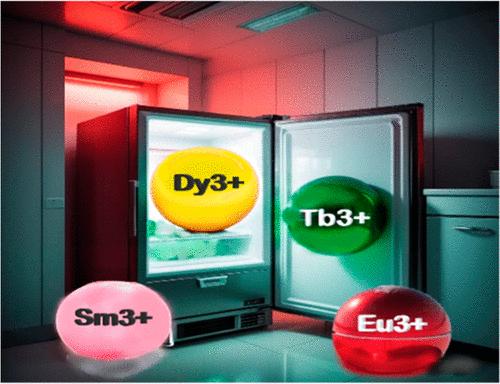
This work addresses a comprehensive study of six new complexes of the constitution [Ln(MeDPQ)2Cl3] (Ln3+ = Sm3+, Eu3+, Gd3+, Tb3+, Dy3+, and Y3+; MeDPQ─2-methyldipyrido-[3,2-f:2′,3′-h]-quinoxaline) with good thermal stability up to 446 °C. Statistical substitution of Sm3+, Tb3+, Gd3+, and Dy3+ with a second Ln3+ ion led to [Ln1–xLn′x(MeDPQ)2Cl3] solid solutions, which exhibit temperature-dependent luminescent properties. Their visible emission and intensity ratios of transitions vary with temperature in the range of 253–353 K. In the case of the composition [Tb1–xEux(MeDPQ)2Cl3], the maximum relative thermal sensitivity Sr values were determined as 3.77% K–1, 3.97% K–1, and 3.97% K–1 for x(Eu3+) = 0.01, 0.05, and 0.1, respectively. The compositions [Dy1–xEux(MeDPQ)2Cl3] and [Tb1–xSmx(MeDPQ)2Cl3] also showed significant performance. For the pair Dy3+–Eu3+, the Sr values were determined as 3.88%K–1, 3.91% K–1, and 3.80% K–1 for x(Eu) = 0.01, 0.05, and 0.1, respectively. For the pair Sm3+–Tb3+, the Sr values are 3.28% K–1 and 3.82% K–1 for x(Sm) = 0.9 and 0.1, respectively. The largest thermal sensitivity value Sr of 4.11% K–1 was achieved for the composition [Gd0.8Tb0.18Eu0.02(MeDPQ)2Cl3]. In addition, patterns of thermometric performance are bound to the energy transfer efficiency Tb3+ → Eu3+, Dy3+ → Eu3+ → Dy3+, and Tb3+ → Sm3+, as this characteristic is strongly temperature-dependent in the studied range.
期刊介绍:
The journal Chemistry of Materials focuses on publishing original research at the intersection of materials science and chemistry. The studies published in the journal involve chemistry as a prominent component and explore topics such as the design, synthesis, characterization, processing, understanding, and application of functional or potentially functional materials. The journal covers various areas of interest, including inorganic and organic solid-state chemistry, nanomaterials, biomaterials, thin films and polymers, and composite/hybrid materials. The journal particularly seeks papers that highlight the creation or development of innovative materials with novel optical, electrical, magnetic, catalytic, or mechanical properties. It is essential that manuscripts on these topics have a primary focus on the chemistry of materials and represent a significant advancement compared to prior research. Before external reviews are sought, submitted manuscripts undergo a review process by a minimum of two editors to ensure their appropriateness for the journal and the presence of sufficient evidence of a significant advance that will be of broad interest to the materials chemistry community.



 京公网安备 11010802042870号
京ICP备2023020795号-1
京公网安备 11010802042870号
京ICP备2023020795号-1

 分享
分享
 求助内容:
求助内容: 应助结果提醒方式:
 扫码关注我们
