Jingchi Gao, Xingru Yan, Xiangyao Gu, Xinlong Fu, Qian Chang, Zhihui Zhang, Yi Wang, Changshui Huang, Yuliang Li
{"title":"The Alkynyl π Bond of sp-C Enhanced Rapid, Reversible Li–C Coupling to Accelerate Reaction Kinetics of Lithium Ions","authors":"Jingchi Gao, Xingru Yan, Xiangyao Gu, Xinlong Fu, Qian Chang, Zhihui Zhang, Yi Wang, Changshui Huang, Yuliang Li","doi":"10.1021/jacs.4c08920","DOIUrl":null,"url":null,"abstract":"Graphdiyne (GDY) is a promising anode for rechargeable batteries with high capacity, outstanding cyclic stability, and low diffusion energy. The unique structure of GDY endows distinctive mechanisms for metal-ion storage, and it is of great significance to further visualize the complex reaction kinetics of the redox process. Here, we systematically tracked the reaction kinetics and provided mechanistic insights into the lithium ions in the GDY to reveal the feature of the cation-π effect. It has been demonstrated that, unlike only one π bond in sp<sup>2</sup>-C, π electrons provided by one of the two alkynyl π bonds in sp-C can achieve proper interaction and speedy capture of lithium ions; thus, reversible Li–C coupling can be formed between electron-rich sp-C and lithium ions. In addition to interlayer intercalation in sp<sup>2</sup>-C regions, nanopores filling triangular-like cavities composed of highly conjugated sp-C contribute to the major capacity in flat voltage plateau regions. Therefore, a capture/pores filling-intercalation hybrid mechanism can be found in GDY. The coexistence of sp and sp<sup>2</sup> carbon enables GDY electrodes with rapid Li<sup>+</sup> diffusion, high capacity of over 1435 mAh g<sup>–1</sup>, extraordinary rate capability, and cyclic stability for more than 10000 cycles at 10A g<sup>–1</sup>. These results provide guidance for developing advanced carbon electrodes with optimized reaction kinetics for rechargeable batteries.","PeriodicalId":49,"journal":{"name":"Journal of the American Chemical Society","volume":"15 1","pages":""},"PeriodicalIF":15.6000,"publicationDate":"2024-09-19","publicationTypes":"Journal Article","fieldsOfStudy":null,"isOpenAccess":false,"openAccessPdf":"","citationCount":"0","resultStr":null,"platform":"Semanticscholar","paperid":null,"PeriodicalName":"Journal of the American Chemical Society","FirstCategoryId":"92","ListUrlMain":"https://doi.org/10.1021/jacs.4c08920","RegionNum":1,"RegionCategory":"化学","ArticlePicture":[],"TitleCN":null,"AbstractTextCN":null,"PMCID":null,"EPubDate":"","PubModel":"","JCR":"Q1","JCRName":"CHEMISTRY, MULTIDISCIPLINARY","Score":null,"Total":0}
引用次数: 0
Abstract
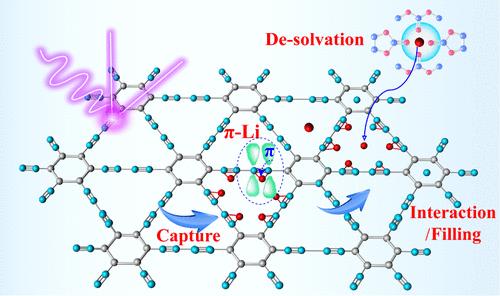
Graphdiyne (GDY) is a promising anode for rechargeable batteries with high capacity, outstanding cyclic stability, and low diffusion energy. The unique structure of GDY endows distinctive mechanisms for metal-ion storage, and it is of great significance to further visualize the complex reaction kinetics of the redox process. Here, we systematically tracked the reaction kinetics and provided mechanistic insights into the lithium ions in the GDY to reveal the feature of the cation-π effect. It has been demonstrated that, unlike only one π bond in sp2-C, π electrons provided by one of the two alkynyl π bonds in sp-C can achieve proper interaction and speedy capture of lithium ions; thus, reversible Li–C coupling can be formed between electron-rich sp-C and lithium ions. In addition to interlayer intercalation in sp2-C regions, nanopores filling triangular-like cavities composed of highly conjugated sp-C contribute to the major capacity in flat voltage plateau regions. Therefore, a capture/pores filling-intercalation hybrid mechanism can be found in GDY. The coexistence of sp and sp2 carbon enables GDY electrodes with rapid Li+ diffusion, high capacity of over 1435 mAh g–1, extraordinary rate capability, and cyclic stability for more than 10000 cycles at 10A g–1. These results provide guidance for developing advanced carbon electrodes with optimized reaction kinetics for rechargeable batteries.
期刊介绍:
The flagship journal of the American Chemical Society, known as the Journal of the American Chemical Society (JACS), has been a prestigious publication since its establishment in 1879. It holds a preeminent position in the field of chemistry and related interdisciplinary sciences. JACS is committed to disseminating cutting-edge research papers, covering a wide range of topics, and encompasses approximately 19,000 pages of Articles, Communications, and Perspectives annually. With a weekly publication frequency, JACS plays a vital role in advancing the field of chemistry by providing essential research.



 京公网安备 11010802042870号
京ICP备2023020795号-1
京公网安备 11010802042870号
京ICP备2023020795号-1

 分享
分享
 求助内容:
求助内容: 应助结果提醒方式:
 扫码关注我们
