{"title":"Impact of renal replacement therapy modality on coagulation and platelet function in critically ill patients: A prospective observational study","authors":"Hyunjae Im, Jaehoon Jeong, Seung-Young Oh, Leerang Lim, Hannah Lee, Ho Geol Ryu","doi":"10.1111/aor.14872","DOIUrl":null,"url":null,"abstract":"<div>\n \n \n <section>\n \n <h3> Background</h3>\n \n <p>Renal replacement therapy (RRT) may affect coagulation and platelet function in critically ill patients. However, the mechanism and the difference in the impact on coagulation between intermittent hemodialysis (iHD) and continuous renal replacement therapy (CRRT) remains unclear. This study aimed to investigate and compare the impact of iHD and CRRT on coagulation and platelet function.</p>\n </section>\n \n <section>\n \n <h3> Methods</h3>\n \n <p>Critically ill patients undergoing RRT were classified into the iHD group or the CRRT group. After the first blood sampling, patients underwent either a single session of hemodialysis or 48 h of CRRT, then a second blood sample was taken. Rotational thromboelastometry (ROTEM), platelet aggregometry and conventional coagulation tests were performed. The primary outcome was a change in extrinsically activated ROTEM (EXTEM) clotting time (CT).</p>\n </section>\n \n <section>\n \n <h3> Results</h3>\n \n <p>60 dialysis sessions from 56 patients were finally included, with 30 dialysis sessions per group. EXTEM CT was prolonged significantly after dialysis in the iHD group (90 [74, 128] vs. 74 [61, 91], <i>p</i> < 0.001), but did not change in the CRRT group (94.4 ± 29.4 vs. 91.6 ± 22.9, <i>p</i> = 0.986). The platelet aggregation did not change after both iHD and CRRT. A change in EXTEM CT was significantly greater in the iHD group compared to the CRRT group (<i>p</i> = 0.006). The difference in the incidence of bleeding events was insignificant between the two groups (<i>p</i> = 0.301).</p>\n </section>\n \n <section>\n \n <h3> Conclusions</h3>\n \n <p>EXTEM CT was significantly prolonged after iHD, but this change was not shown after CRRT. Platelet function was not affected by both dialysis modalities.</p>\n </section>\n </div>","PeriodicalId":8450,"journal":{"name":"Artificial organs","volume":"49 1","pages":"21-30"},"PeriodicalIF":2.3000,"publicationDate":"2024-09-20","publicationTypes":"Journal Article","fieldsOfStudy":null,"isOpenAccess":false,"openAccessPdf":"https://onlinelibrary.wiley.com/doi/epdf/10.1111/aor.14872","citationCount":"0","resultStr":null,"platform":"Semanticscholar","paperid":null,"PeriodicalName":"Artificial organs","FirstCategoryId":"5","ListUrlMain":"https://onlinelibrary.wiley.com/doi/10.1111/aor.14872","RegionNum":3,"RegionCategory":"医学","ArticlePicture":[],"TitleCN":null,"AbstractTextCN":null,"PMCID":null,"EPubDate":"","PubModel":"","JCR":"Q3","JCRName":"ENGINEERING, BIOMEDICAL","Score":null,"Total":0}
引用次数: 0
Abstract
Background
Renal replacement therapy (RRT) may affect coagulation and platelet function in critically ill patients. However, the mechanism and the difference in the impact on coagulation between intermittent hemodialysis (iHD) and continuous renal replacement therapy (CRRT) remains unclear. This study aimed to investigate and compare the impact of iHD and CRRT on coagulation and platelet function.
Methods
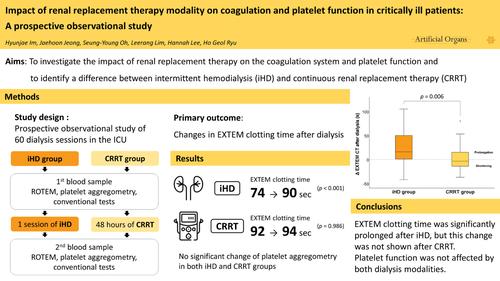
Critically ill patients undergoing RRT were classified into the iHD group or the CRRT group. After the first blood sampling, patients underwent either a single session of hemodialysis or 48 h of CRRT, then a second blood sample was taken. Rotational thromboelastometry (ROTEM), platelet aggregometry and conventional coagulation tests were performed. The primary outcome was a change in extrinsically activated ROTEM (EXTEM) clotting time (CT).
Results
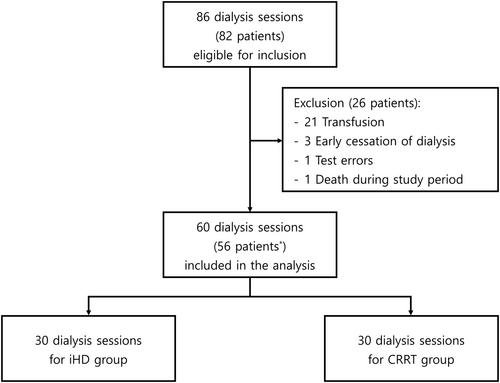
60 dialysis sessions from 56 patients were finally included, with 30 dialysis sessions per group. EXTEM CT was prolonged significantly after dialysis in the iHD group (90 [74, 128] vs. 74 [61, 91], p < 0.001), but did not change in the CRRT group (94.4 ± 29.4 vs. 91.6 ± 22.9, p = 0.986). The platelet aggregation did not change after both iHD and CRRT. A change in EXTEM CT was significantly greater in the iHD group compared to the CRRT group (p = 0.006). The difference in the incidence of bleeding events was insignificant between the two groups (p = 0.301).
Conclusions
EXTEM CT was significantly prolonged after iHD, but this change was not shown after CRRT. Platelet function was not affected by both dialysis modalities.
期刊介绍:
Artificial Organs is the official peer reviewed journal of The International Federation for Artificial Organs (Members of the Federation are: The American Society for Artificial Internal Organs, The European Society for Artificial Organs, and The Japanese Society for Artificial Organs), The International Faculty for Artificial Organs, the International Society for Rotary Blood Pumps, The International Society for Pediatric Mechanical Cardiopulmonary Support, and the Vienna International Workshop on Functional Electrical Stimulation. Artificial Organs publishes original research articles dealing with developments in artificial organs applications and treatment modalities and their clinical applications worldwide. Membership in the Societies listed above is not a prerequisite for publication. Articles are published without charge to the author except for color figures and excess page charges as noted.