Artyom Razumov, Melchior Burri, Armin Zittermann, Darko Radakovic, Volker Lauenroth, Sebastian V. Rojas, Henrik Fox, René Schramm, Jan Gummert, Marcus-André Deutsch, Michiel Morshuis
{"title":"Outcomes after SynCardia® temporary total artificial heart implantation: A 20-year single-center experience in 196 patients","authors":"Artyom Razumov, Melchior Burri, Armin Zittermann, Darko Radakovic, Volker Lauenroth, Sebastian V. Rojas, Henrik Fox, René Schramm, Jan Gummert, Marcus-André Deutsch, Michiel Morshuis","doi":"10.1111/aor.14860","DOIUrl":null,"url":null,"abstract":"<div>\n \n \n <section>\n \n <h3> Background</h3>\n \n <p>The SynCardia® temporary total artificial heart (TAH) serves as a mechanical circulatory support device for patients suffering from irreversible biventricular failure.</p>\n </section>\n \n <section>\n \n <h3> Methods</h3>\n \n <p>This retrospective study analyzed 196 consecutive patients who underwent TAH implantation at our center from 2001 to 2021. We assessed survival rates and all-cause mortality during TAH support, including survival post-heart transplantation.</p>\n </section>\n \n <section>\n \n <h3> Results</h3>\n \n <p>The median age of patients was 55 years, with 88% being male. The primary diagnoses included cardiomyopathy (43.9%), acute myocardial infarction (26.5%), and postcardiotomy heart failure (15.5%). At implantation, 87.2% of patients were classified as INTERMACS Profile 1. The median duration of support was 96 days (IQR: 23–227). Survival rates at 1, 6, and 12 months were 72%, 41%, and 34%, respectively. Postoperative rethoracotomy was necessary in 44.4% of patients; 39.3% experienced neurological events and 24.6% developed gastrointestinal bleeding. Overall, 64.8% of patients died while on support, primarily due to multiple organ failure (55.9%). Factors such as older age, higher bilirubin levels, postcardiotomy and specific underlying diagnoses were independent predictors of mortality during TAH support. On a positive note, 35.2% of patients underwent successful heart transplants, with 1-, 5-, and 10-year posttransplant survival rates of 65%, 58%, and 51%, respectively.</p>\n </section>\n \n <section>\n \n <h3> Conclusions</h3>\n \n <p>While high mortality rates persist among patients with biventricular failure, the SynCardia® TAH offers a viable interim solution for critically ill patients, particularly those who can be successfully bridged to heart transplantation.</p>\n </section>\n </div>","PeriodicalId":8450,"journal":{"name":"Artificial organs","volume":"49 2","pages":"266-275"},"PeriodicalIF":2.3000,"publicationDate":"2024-09-16","publicationTypes":"Journal Article","fieldsOfStudy":null,"isOpenAccess":false,"openAccessPdf":"https://onlinelibrary.wiley.com/doi/epdf/10.1111/aor.14860","citationCount":"0","resultStr":null,"platform":"Semanticscholar","paperid":null,"PeriodicalName":"Artificial organs","FirstCategoryId":"5","ListUrlMain":"https://onlinelibrary.wiley.com/doi/10.1111/aor.14860","RegionNum":3,"RegionCategory":"医学","ArticlePicture":[],"TitleCN":null,"AbstractTextCN":null,"PMCID":null,"EPubDate":"","PubModel":"","JCR":"Q3","JCRName":"ENGINEERING, BIOMEDICAL","Score":null,"Total":0}
引用次数: 0
Abstract
Background
The SynCardia® temporary total artificial heart (TAH) serves as a mechanical circulatory support device for patients suffering from irreversible biventricular failure.
Methods
This retrospective study analyzed 196 consecutive patients who underwent TAH implantation at our center from 2001 to 2021. We assessed survival rates and all-cause mortality during TAH support, including survival post-heart transplantation.
Results
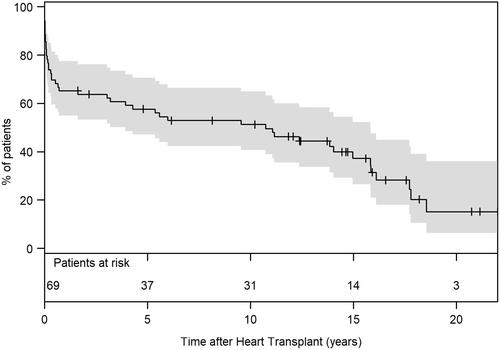
The median age of patients was 55 years, with 88% being male. The primary diagnoses included cardiomyopathy (43.9%), acute myocardial infarction (26.5%), and postcardiotomy heart failure (15.5%). At implantation, 87.2% of patients were classified as INTERMACS Profile 1. The median duration of support was 96 days (IQR: 23–227). Survival rates at 1, 6, and 12 months were 72%, 41%, and 34%, respectively. Postoperative rethoracotomy was necessary in 44.4% of patients; 39.3% experienced neurological events and 24.6% developed gastrointestinal bleeding. Overall, 64.8% of patients died while on support, primarily due to multiple organ failure (55.9%). Factors such as older age, higher bilirubin levels, postcardiotomy and specific underlying diagnoses were independent predictors of mortality during TAH support. On a positive note, 35.2% of patients underwent successful heart transplants, with 1-, 5-, and 10-year posttransplant survival rates of 65%, 58%, and 51%, respectively.
Conclusions
While high mortality rates persist among patients with biventricular failure, the SynCardia® TAH offers a viable interim solution for critically ill patients, particularly those who can be successfully bridged to heart transplantation.
期刊介绍:
Artificial Organs is the official peer reviewed journal of The International Federation for Artificial Organs (Members of the Federation are: The American Society for Artificial Internal Organs, The European Society for Artificial Organs, and The Japanese Society for Artificial Organs), The International Faculty for Artificial Organs, the International Society for Rotary Blood Pumps, The International Society for Pediatric Mechanical Cardiopulmonary Support, and the Vienna International Workshop on Functional Electrical Stimulation. Artificial Organs publishes original research articles dealing with developments in artificial organs applications and treatment modalities and their clinical applications worldwide. Membership in the Societies listed above is not a prerequisite for publication. Articles are published without charge to the author except for color figures and excess page charges as noted.