{"title":"Arbitrary Oriented Few-Shot Object Detection in Remote Sensing Images","authors":"Wei Wu;Chengeng Jiang;Liao Yang;Weisheng Wang;Quanjun Chen;Junjian Zhang;Haiping Yang;Zuohui Chen","doi":"10.1109/JSTARS.2024.3461165","DOIUrl":null,"url":null,"abstract":"Few-shot object detection (FSOD) aims to identify novel objects using only a limited number of samples. While impressive results have been achieved in natural scene images, object detection in remote sensing images (RSIs) presents unique challenges due to significant variations in orientation and size. Existing approaches often rely on horizontal bounding boxes, which may include a substantial quantity of irrelevant background because of object orientation, thus hindering accurate detection in RSIs. To address this limitation, we propose a metalearning-based method for arbitrary-oriented FSOD in RSIs, called AOFS. In our method, three key components are added to the YOLOv5-based one-stage detection architecture: a hierarchical metafeature encoder, an adaptive feature modulator, and an oriented bounding box decoder. We use features extracted from a small set of annotated samples to reweight the metafeatures of the objects. The oriented bounding box decoder provides outputs for object orientations. Experimental results on the benchmark datasets (NWPU and DIOR) indicate the effectiveness of our model. AOFS achieves 65.1% and 48.9% mean average precision in 3-shot setting on NWPU and DIOR, respectively, exceeding the second-best method by 4.4% and 5.4%.","PeriodicalId":13116,"journal":{"name":"IEEE Journal of Selected Topics in Applied Earth Observations and Remote Sensing","volume":"17 ","pages":"17930-17944"},"PeriodicalIF":5.3000,"publicationDate":"2024-09-16","publicationTypes":"Journal Article","fieldsOfStudy":null,"isOpenAccess":false,"openAccessPdf":"https://ieeexplore.ieee.org/stamp/stamp.jsp?tp=&arnumber=10680374","citationCount":"0","resultStr":null,"platform":"Semanticscholar","paperid":null,"PeriodicalName":"IEEE Journal of Selected Topics in Applied Earth Observations and Remote Sensing","FirstCategoryId":"5","ListUrlMain":"https://ieeexplore.ieee.org/document/10680374/","RegionNum":2,"RegionCategory":"地球科学","ArticlePicture":[],"TitleCN":null,"AbstractTextCN":null,"PMCID":null,"EPubDate":"","PubModel":"","JCR":"Q1","JCRName":"ENGINEERING, ELECTRICAL & ELECTRONIC","Score":null,"Total":0}
引用次数: 0
Abstract
Few-shot object detection (FSOD) aims to identify novel objects using only a limited number of samples. While impressive results have been achieved in natural scene images, object detection in remote sensing images (RSIs) presents unique challenges due to significant variations in orientation and size. Existing approaches often rely on horizontal bounding boxes, which may include a substantial quantity of irrelevant background because of object orientation, thus hindering accurate detection in RSIs. To address this limitation, we propose a metalearning-based method for arbitrary-oriented FSOD in RSIs, called AOFS. In our method, three key components are added to the YOLOv5-based one-stage detection architecture: a hierarchical metafeature encoder, an adaptive feature modulator, and an oriented bounding box decoder. We use features extracted from a small set of annotated samples to reweight the metafeatures of the objects. The oriented bounding box decoder provides outputs for object orientations. Experimental results on the benchmark datasets (NWPU and DIOR) indicate the effectiveness of our model. AOFS achieves 65.1% and 48.9% mean average precision in 3-shot setting on NWPU and DIOR, respectively, exceeding the second-best method by 4.4% and 5.4%.
期刊介绍:
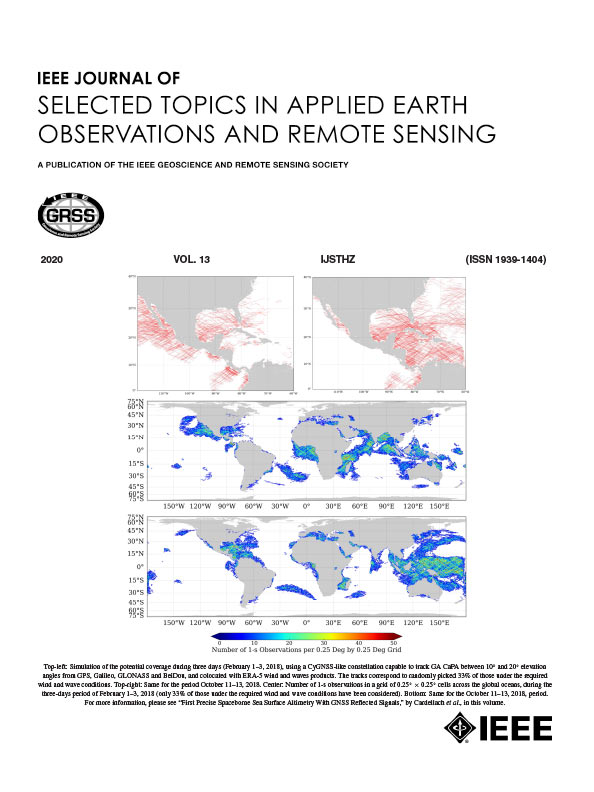
The IEEE Journal of Selected Topics in Applied Earth Observations and Remote Sensing addresses the growing field of applications in Earth observations and remote sensing, and also provides a venue for the rapidly expanding special issues that are being sponsored by the IEEE Geosciences and Remote Sensing Society. The journal draws upon the experience of the highly successful “IEEE Transactions on Geoscience and Remote Sensing” and provide a complementary medium for the wide range of topics in applied earth observations. The ‘Applications’ areas encompasses the societal benefit areas of the Global Earth Observations Systems of Systems (GEOSS) program. Through deliberations over two years, ministers from 50 countries agreed to identify nine areas where Earth observation could positively impact the quality of life and health of their respective countries. Some of these are areas not traditionally addressed in the IEEE context. These include biodiversity, health and climate. Yet it is the skill sets of IEEE members, in areas such as observations, communications, computers, signal processing, standards and ocean engineering, that form the technical underpinnings of GEOSS. Thus, the Journal attracts a broad range of interests that serves both present members in new ways and expands the IEEE visibility into new areas.



 京公网安备 11010802042870号
京ICP备2023020795号-1
京公网安备 11010802042870号
京ICP备2023020795号-1

 分享
分享
 求助内容:
求助内容: 应助结果提醒方式:
 扫码关注我们
