{"title":"Determination of divalent metal ion-regulated proton concentration and polarity at the interface of anionic phospholipid membranes†","authors":"Pratima Mandal, Snigdha Roy, Manisha Karmakar, Sushil Ranjan Bhatta, Chandi Charan Ghosh, Arunabha Thakur and Partha Pratim Parui","doi":"10.1039/D4SM00876F","DOIUrl":null,"url":null,"abstract":"<p >We studied the influence of trace quantities of divalent metal ions (M<small><sup>2+</sup></small>: Ca<small><sup>2+</sup></small>, Mg<small><sup>2+</sup></small>, and Zn<small><sup>2+</sup></small>) on proton concentration (−log[H<small><sup>+</sup></small>], designated as pH′) and polarity at the interface of anionic PG-phospholipid membranes comprising saturated and unsaturated acrylic chains. A spiro-rhodamine-6G-gallic acid (RGG) pH-probe was synthesized to monitor the interfacial pH′ of large unilamellar vesicles (LUVs) at a physiologically appropriate bulk pH (6.0–7.5). <small><sup>1</sup></small>H-NMR spectroscopy and fluorescence microscopy showed that RGG interacted with the LUV interface. The pH-dependent equilibrium between the spiro-closed and spiro-open forms of RGG at the interface from the bulk phase was compared using fluorescence spectra to obtain interfacial pH′. Interfacial dielectric constant (<em>κ</em>) was estimated using a porphyrin-based polarity-probe (GPP) that exhibits a <em>κ</em>-induced equilibrium between monomeric and oligomeric forms. M<small><sup>2+</sup></small> interaction decreased LUV interfacial <em>κ</em> from ∼67 to 61, regardless of lipid/M<small><sup>2+</sup></small> types. Fluorescence spectral and microscopic analysis revealed that low Ca<small><sup>2+</sup></small> and Mg<small><sup>2+</sup></small> amounts (M<small><sup>2+</sup></small>/lipid = 1 : 20 for unsaturated DOPG and POPG and ∼1 : 10 for saturated DMPG lipids), but not Zn<small><sup>2+</sup></small>, decreased LUV interfacial acidity from pH′ ∼3.8 to 4.4 at bulk pH 7.0. Although membrane surface charges are normally responsible for pH′ deviation from the bulk to the interface, they cannot explain M<small><sup>2+</sup></small>-mediated interfacial pH′ increase since there is little change in surface charges up to a low M<small><sup>2+</sup></small>/lipid ratio of <1/10. M<small><sup>2+</sup></small>-induced tight lipid headgroup packing and the resulting increased surface rigidity inhibit interfacial H<small><sup>+</sup></small>/H<small><sub>2</sub></small>O penetration, reducing interfacial acidity and polarity. Our findings revealed that in certain cases, essential M<small><sup>2+</sup></small> ion-induced bio-membrane reactivity can be attributed to the influence of interfacial pH′/polarity.</p>","PeriodicalId":103,"journal":{"name":"Soft Matter","volume":" 38","pages":" 7646-7656"},"PeriodicalIF":2.8000,"publicationDate":"2024-09-04","publicationTypes":"Journal Article","fieldsOfStudy":null,"isOpenAccess":false,"openAccessPdf":"","citationCount":"0","resultStr":null,"platform":"Semanticscholar","paperid":null,"PeriodicalName":"Soft Matter","FirstCategoryId":"92","ListUrlMain":"https://pubs.rsc.org/en/content/articlelanding/2024/sm/d4sm00876f","RegionNum":3,"RegionCategory":"化学","ArticlePicture":[],"TitleCN":null,"AbstractTextCN":null,"PMCID":null,"EPubDate":"","PubModel":"","JCR":"Q3","JCRName":"CHEMISTRY, PHYSICAL","Score":null,"Total":0}
引用次数: 0
Abstract
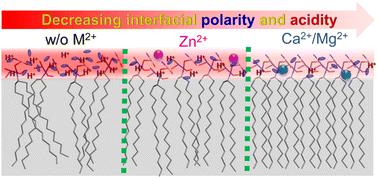
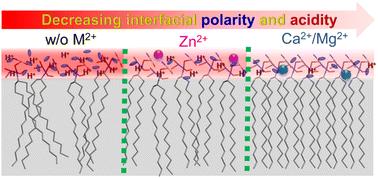
We studied the influence of trace quantities of divalent metal ions (M2+: Ca2+, Mg2+, and Zn2+) on proton concentration (−log[H+], designated as pH′) and polarity at the interface of anionic PG-phospholipid membranes comprising saturated and unsaturated acrylic chains. A spiro-rhodamine-6G-gallic acid (RGG) pH-probe was synthesized to monitor the interfacial pH′ of large unilamellar vesicles (LUVs) at a physiologically appropriate bulk pH (6.0–7.5). 1H-NMR spectroscopy and fluorescence microscopy showed that RGG interacted with the LUV interface. The pH-dependent equilibrium between the spiro-closed and spiro-open forms of RGG at the interface from the bulk phase was compared using fluorescence spectra to obtain interfacial pH′. Interfacial dielectric constant (κ) was estimated using a porphyrin-based polarity-probe (GPP) that exhibits a κ-induced equilibrium between monomeric and oligomeric forms. M2+ interaction decreased LUV interfacial κ from ∼67 to 61, regardless of lipid/M2+ types. Fluorescence spectral and microscopic analysis revealed that low Ca2+ and Mg2+ amounts (M2+/lipid = 1 : 20 for unsaturated DOPG and POPG and ∼1 : 10 for saturated DMPG lipids), but not Zn2+, decreased LUV interfacial acidity from pH′ ∼3.8 to 4.4 at bulk pH 7.0. Although membrane surface charges are normally responsible for pH′ deviation from the bulk to the interface, they cannot explain M2+-mediated interfacial pH′ increase since there is little change in surface charges up to a low M2+/lipid ratio of <1/10. M2+-induced tight lipid headgroup packing and the resulting increased surface rigidity inhibit interfacial H+/H2O penetration, reducing interfacial acidity and polarity. Our findings revealed that in certain cases, essential M2+ ion-induced bio-membrane reactivity can be attributed to the influence of interfacial pH′/polarity.
期刊介绍:
Soft Matter is an international journal published by the Royal Society of Chemistry using Engineering-Materials Science: A Synthesis as its research focus. It publishes original research articles, review articles, and synthesis articles related to this field, reporting the latest discoveries in the relevant theoretical, practical, and applied disciplines in a timely manner, and aims to promote the rapid exchange of scientific information in this subject area. The journal is an open access journal. The journal is an open access journal and has not been placed on the alert list in the last three years.



 京公网安备 11010802042870号
京ICP备2023020795号-1
京公网安备 11010802042870号
京ICP备2023020795号-1

 分享
分享
 求助内容:
求助内容: 应助结果提醒方式:
 扫码关注我们
