{"title":"Machine Learning for Deconvolution and Segmentation of Hyperspectral Imaging Data from Biopharmaceutical Resins","authors":"Hong Wei, Joseph P. Smith","doi":"10.1021/acs.molpharmaceut.4c00540","DOIUrl":null,"url":null,"abstract":"Biopharmaceutical resins are pivotal inert matrices used across industry and academia, playing crucial roles in a myriad of applications. For biopharmaceutical process research and development applications, a deep understanding of the physical and chemical properties of the resin itself is frequently required, including for drug purification, drug delivery, and immobilized biocatalysis. Nevertheless, the prevailing methodologies currently employed for elucidating these important aspects of biopharmaceutical resins are often lacking, frequently require significant sample alteration, are destructive or ionizing in nature, and may not adequately provide representative information. In this work, we propose the use of unsupervised machine learning technologies, in the form of both non-negative matrix factorization (NMF) and <i>k</i>-means segmentation, in conjugation with Raman hyperspectral imaging to rapidly elucidate the molecular and spatial properties of biopharmaceutical resins. Leveraging our proposed technology, we offer a new approach to comprehensively understanding important resin-based systems for application across biopharmaceuticals and beyond. Specifically, focusing herein on a representative resin widely utilized across the industry (i.e., Immobead 150P), our findings showcase the ability of our machine learning-based technology to molecularly identify and spatially resolve all chemical species present. Further, we offer a comprehensive evaluation of optimal excitation for hyperspectral imaging data collection, demonstrating results across 532, 638, and 785 nm excitation. In all cases, our proposed technology deconvoluted, both spatially and spectrally, resin and glass substrates via NMF. After NMF deconvolution, image segmentation was also successfully accomplished in all data sets via <i>k</i>-means clustering. To the best of our knowledge, this is the <i>first</i> report utilizing the combination of two unsupervised machine learning methodologies, combining NMF and <i>k</i>-means, for the rapid deconvolution and segmentation of biopharmaceutical resins. As such, we offer a powerful new data-rich experimentation tool for application across multidisciplinary fields for a deeper understanding of resins.","PeriodicalId":52,"journal":{"name":"Molecular Pharmaceutics","volume":"53 1","pages":""},"PeriodicalIF":4.5000,"publicationDate":"2024-09-17","publicationTypes":"Journal Article","fieldsOfStudy":null,"isOpenAccess":false,"openAccessPdf":"","citationCount":"0","resultStr":null,"platform":"Semanticscholar","paperid":null,"PeriodicalName":"Molecular Pharmaceutics","FirstCategoryId":"3","ListUrlMain":"https://doi.org/10.1021/acs.molpharmaceut.4c00540","RegionNum":2,"RegionCategory":"医学","ArticlePicture":[],"TitleCN":null,"AbstractTextCN":null,"PMCID":null,"EPubDate":"","PubModel":"","JCR":"Q2","JCRName":"MEDICINE, RESEARCH & EXPERIMENTAL","Score":null,"Total":0}
引用次数: 0
Abstract
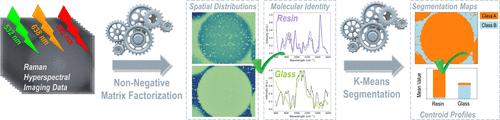
Biopharmaceutical resins are pivotal inert matrices used across industry and academia, playing crucial roles in a myriad of applications. For biopharmaceutical process research and development applications, a deep understanding of the physical and chemical properties of the resin itself is frequently required, including for drug purification, drug delivery, and immobilized biocatalysis. Nevertheless, the prevailing methodologies currently employed for elucidating these important aspects of biopharmaceutical resins are often lacking, frequently require significant sample alteration, are destructive or ionizing in nature, and may not adequately provide representative information. In this work, we propose the use of unsupervised machine learning technologies, in the form of both non-negative matrix factorization (NMF) and k-means segmentation, in conjugation with Raman hyperspectral imaging to rapidly elucidate the molecular and spatial properties of biopharmaceutical resins. Leveraging our proposed technology, we offer a new approach to comprehensively understanding important resin-based systems for application across biopharmaceuticals and beyond. Specifically, focusing herein on a representative resin widely utilized across the industry (i.e., Immobead 150P), our findings showcase the ability of our machine learning-based technology to molecularly identify and spatially resolve all chemical species present. Further, we offer a comprehensive evaluation of optimal excitation for hyperspectral imaging data collection, demonstrating results across 532, 638, and 785 nm excitation. In all cases, our proposed technology deconvoluted, both spatially and spectrally, resin and glass substrates via NMF. After NMF deconvolution, image segmentation was also successfully accomplished in all data sets via k-means clustering. To the best of our knowledge, this is the first report utilizing the combination of two unsupervised machine learning methodologies, combining NMF and k-means, for the rapid deconvolution and segmentation of biopharmaceutical resins. As such, we offer a powerful new data-rich experimentation tool for application across multidisciplinary fields for a deeper understanding of resins.
期刊介绍:
Molecular Pharmaceutics publishes the results of original research that contributes significantly to the molecular mechanistic understanding of drug delivery and drug delivery systems. The journal encourages contributions describing research at the interface of drug discovery and drug development.
Scientific areas within the scope of the journal include physical and pharmaceutical chemistry, biochemistry and biophysics, molecular and cellular biology, and polymer and materials science as they relate to drug and drug delivery system efficacy. Mechanistic Drug Delivery and Drug Targeting research on modulating activity and efficacy of a drug or drug product is within the scope of Molecular Pharmaceutics. Theoretical and experimental peer-reviewed research articles, communications, reviews, and perspectives are welcomed.



 京公网安备 11010802042870号
京ICP备2023020795号-1
京公网安备 11010802042870号
京ICP备2023020795号-1

 分享
分享
 求助内容:
求助内容: 应助结果提醒方式:
 扫码关注我们
