A dual-mode homogeneous electrochemical-colorimetric biosensing sensor for carcinoembryonic antigen detection based on a microfluidic paper-based analysis device†
Yao Zhang, Jiaqi Xu, Jianing Shen, Bo Zhang, Tianhao Xue, Xiaoqing Lv, Xiaofang Zhang and Guixian Zhu
{"title":"A dual-mode homogeneous electrochemical-colorimetric biosensing sensor for carcinoembryonic antigen detection based on a microfluidic paper-based analysis device†","authors":"Yao Zhang, Jiaqi Xu, Jianing Shen, Bo Zhang, Tianhao Xue, Xiaoqing Lv, Xiaofang Zhang and Guixian Zhu","doi":"10.1039/D4AY01480D","DOIUrl":null,"url":null,"abstract":"<p >Dual-mode-based sensors have drawn a lot of interest due to their high accuracy and sensitivity compared to single-response systems. A simple electrochemical and colorimetric dual-mode sensor based on enzyme-linked immunosorbent assay (ELISA), without complex electrode surface modification, was developed for accurate and sensitive detection of carcinoembryonic antigen (CEA). The target CEA is recognized by an antibody coupled to horseradish peroxidase (HRP), which then oxidizes the substrate 3,3′,5,5′-tetramethylbenzidine (TMB) to generate both a colorimetric and an electrochemical signal. A paper-based analysis device (μPAD) with dual-mode homogeneous sensing microfluidic was created; three paper-based detection areas for colorimetric testing, and a two-electrode embedded detection area for electrochemical testing. When applying colorimetric analysis technology, the linear range of CEA detection is 0.6–40 ng mL<small><sup>−1</sup></small>, and the limit of detection (LOD) is 0.2 ng mL<small><sup>−1</sup></small>. The linear range is 0.1–40 ng mL<small><sup>−1</sup></small> and the LOD is 0.03 ng mL<small><sup>−1</sup></small> by applying electrochemical analysis. The visibility and intuitiveness of colorimetry provide a reference for higher sensitivity and quick response of the electrochemical method. A smartphone application (APP) was also developed to realize the dual extraction of colorimetric signals. The colorimetric detection system based on ELISA can provide a new path for the development of electrochemical sensing and makes it have inherent self-verification and self-correction functions and is expected to provide more reliable and accurate detection results.</p>","PeriodicalId":64,"journal":{"name":"Analytical Methods","volume":" 43","pages":" 7372-7380"},"PeriodicalIF":3.0000,"publicationDate":"2024-09-19","publicationTypes":"Journal Article","fieldsOfStudy":null,"isOpenAccess":false,"openAccessPdf":"","citationCount":"0","resultStr":null,"platform":"Semanticscholar","paperid":null,"PeriodicalName":"Analytical Methods","FirstCategoryId":"92","ListUrlMain":"https://pubs.rsc.org/en/content/articlelanding/2024/ay/d4ay01480d","RegionNum":3,"RegionCategory":"化学","ArticlePicture":[],"TitleCN":null,"AbstractTextCN":null,"PMCID":null,"EPubDate":"","PubModel":"","JCR":"Q2","JCRName":"CHEMISTRY, ANALYTICAL","Score":null,"Total":0}
引用次数: 0
Abstract
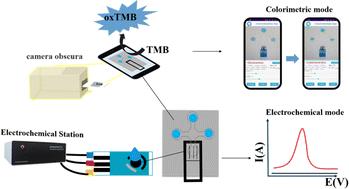
Dual-mode-based sensors have drawn a lot of interest due to their high accuracy and sensitivity compared to single-response systems. A simple electrochemical and colorimetric dual-mode sensor based on enzyme-linked immunosorbent assay (ELISA), without complex electrode surface modification, was developed for accurate and sensitive detection of carcinoembryonic antigen (CEA). The target CEA is recognized by an antibody coupled to horseradish peroxidase (HRP), which then oxidizes the substrate 3,3′,5,5′-tetramethylbenzidine (TMB) to generate both a colorimetric and an electrochemical signal. A paper-based analysis device (μPAD) with dual-mode homogeneous sensing microfluidic was created; three paper-based detection areas for colorimetric testing, and a two-electrode embedded detection area for electrochemical testing. When applying colorimetric analysis technology, the linear range of CEA detection is 0.6–40 ng mL−1, and the limit of detection (LOD) is 0.2 ng mL−1. The linear range is 0.1–40 ng mL−1 and the LOD is 0.03 ng mL−1 by applying electrochemical analysis. The visibility and intuitiveness of colorimetry provide a reference for higher sensitivity and quick response of the electrochemical method. A smartphone application (APP) was also developed to realize the dual extraction of colorimetric signals. The colorimetric detection system based on ELISA can provide a new path for the development of electrochemical sensing and makes it have inherent self-verification and self-correction functions and is expected to provide more reliable and accurate detection results.




 京公网安备 11010802042870号
京ICP备2023020795号-1
京公网安备 11010802042870号
京ICP备2023020795号-1

 分享
分享
 求助内容:
求助内容: 应助结果提醒方式:
 扫码关注我们
