Wei Du, Mingxuan Zhou, Guancheng Wang, Mingze Lu, Xiao Wang, Zhirui Guo, Ming Ma and Yu Zhang
{"title":"A HPRR-based diatomic catalyst electrochemical biosensor for detecting cancer-related extracellular vesicles†","authors":"Wei Du, Mingxuan Zhou, Guancheng Wang, Mingze Lu, Xiao Wang, Zhirui Guo, Ming Ma and Yu Zhang","doi":"10.1039/D4AY01573H","DOIUrl":null,"url":null,"abstract":"<p >Cancer-associated extracellular vesicles (EVs) are crucial biomarkers for cancer diagnosis as they contain abundant tumor cell information. To efficiently and accurately detect cancer-associated EVs, an electrochemical hydrogen peroxide reduction reaction (HPRR)-based biosensor was developed, utilizing enzyme-linked immunosorbent and diatomic catalyst strategies for catalytic HPRR current amplification for specific identification and highly sensitive detection. The anti-CXCR4 antibody was immobilized on a Au-plated electrode to selectively capture EVs from the sample. Subsequently, Fe/Cu diatomic catalysts, modified with an anti-CD63 antibody, were bound to the CD63 on the EVs. Quantitative detection of EVs was achieved by measuring the electrical signals from the HPRR catalyzed by the labeled Fe/Cu diatomic catalysts. Under optimized conditions, the electrochemical signals exhibited a linear relationship with EV concentration in the range of 500 to 1 × 10<small><sup>7</sup></small> particles mL<small><sup>−1</sup></small>, with a detection limit of 117 particles mL<small><sup>−1</sup></small>, maintaining accuracy even in FBS. With its affordability, high sensitivity, and ease of use, this sensor holds significant potential for medication guidance and postoperative evaluation.</p>","PeriodicalId":64,"journal":{"name":"Analytical Methods","volume":" 43","pages":" 7381-7389"},"PeriodicalIF":2.6000,"publicationDate":"2024-09-19","publicationTypes":"Journal Article","fieldsOfStudy":null,"isOpenAccess":false,"openAccessPdf":"","citationCount":"0","resultStr":null,"platform":"Semanticscholar","paperid":null,"PeriodicalName":"Analytical Methods","FirstCategoryId":"92","ListUrlMain":"https://pubs.rsc.org/en/content/articlelanding/2024/ay/d4ay01573h","RegionNum":3,"RegionCategory":"化学","ArticlePicture":[],"TitleCN":null,"AbstractTextCN":null,"PMCID":null,"EPubDate":"","PubModel":"","JCR":"Q2","JCRName":"CHEMISTRY, ANALYTICAL","Score":null,"Total":0}
引用次数: 0
Abstract
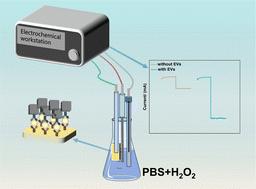
Cancer-associated extracellular vesicles (EVs) are crucial biomarkers for cancer diagnosis as they contain abundant tumor cell information. To efficiently and accurately detect cancer-associated EVs, an electrochemical hydrogen peroxide reduction reaction (HPRR)-based biosensor was developed, utilizing enzyme-linked immunosorbent and diatomic catalyst strategies for catalytic HPRR current amplification for specific identification and highly sensitive detection. The anti-CXCR4 antibody was immobilized on a Au-plated electrode to selectively capture EVs from the sample. Subsequently, Fe/Cu diatomic catalysts, modified with an anti-CD63 antibody, were bound to the CD63 on the EVs. Quantitative detection of EVs was achieved by measuring the electrical signals from the HPRR catalyzed by the labeled Fe/Cu diatomic catalysts. Under optimized conditions, the electrochemical signals exhibited a linear relationship with EV concentration in the range of 500 to 1 × 10⁷ particles mL−1, with a detection limit of 117 particles mL−1, maintaining accuracy even in FBS. With its affordability, high sensitivity, and ease of use, this sensor holds significant potential for medication guidance and postoperative evaluation.




 京公网安备 11010802042870号
京ICP备2023020795号-1
京公网安备 11010802042870号
京ICP备2023020795号-1

 分享
分享
 求助内容:
求助内容: 应助结果提醒方式:
 扫码关注我们
