Prevalence of obstetric violence in high-income countries: A systematic review of mixed studies and meta-analysis of quantitative studies

IF 3.1 2区 医学 Q1 OBSTETRICS & GYNECOLOGY Acta Obstetricia et Gynecologica Scandinavica Pub Date : 2024-09-15 DOI:10.1111/aogs.14962
Laura Katrina Fraser, Naomi Cano-Ibáñez, Carmen Amezcua-Prieto, Khalid Saeed Khan, Ronald F. Lamont, Jan Stener Jørgensen
{"title":"Prevalence of obstetric violence in high-income countries: A systematic review of mixed studies and meta-analysis of quantitative studies","authors":"Laura Katrina Fraser,&nbsp;Naomi Cano-Ibáñez,&nbsp;Carmen Amezcua-Prieto,&nbsp;Khalid Saeed Khan,&nbsp;Ronald F. Lamont,&nbsp;Jan Stener Jørgensen","doi":"10.1111/aogs.14962","DOIUrl":null,"url":null,"abstract":"<div>\n \n \n <section>\n \n <h3> Introduction</h3>\n \n <p>Obstetric violence, or mistreatment of women in obstetric care, can have severe consequences such as fear of future childbirth, post-traumatic stress disorder, and depression.</p>\n </section>\n \n <section>\n \n <h3> Material and Methods</h3>\n \n <p>The primary objective was to estimate the prevalence of obstetric violence in high-income countries. The secondary objective was to extract the main domains of obstetric violence perceived by women from qualitative studies. Following prospective registration (PROSPERO CRD42023468570), PubMed, Web of Science, Scopus, CINAHL, Embase, and Cochrane Library were searched with no restrictions. Included studies were cross-sectional, cohort, mixed methods, and qualitative studies based on populations from high-income countries. The review was conducted by two independent reviewers. Risk of bias was assessed. Rates of obstetric violence were pooled using random effects model, computing 95% confidence intervals (CI) and assessing heterogeneity using I<sup>2</sup> statistic. Funnel plots and Egger's test were used to detect potential reporting biases and small-study effects.</p>\n </section>\n \n <section>\n \n <h3> Results</h3>\n \n <p>Of the 1821 records screened, 25 studies were included: 14 quantitative and 2 mixed methods studies, comprising 60 987 women, and 9 qualitative studies were included, comprising an additional 4356 women. 81.25% of quantitative studies, including the quantitative component of the mixed methods studies, were considered satisfactory or better regarding risk of bias. The prevalence of obstetric violence was overall 45.3% (95% CI 27.5–63.0; I<sup>2</sup> = 100.0%). The prevalence of specific forms of mistreatment was also estimated. Lack of access to analgesia was 17.3% (95% CI 6.9–27.7; I<sup>2</sup> = 99.7%). Ignored requests for help was 19.2% (95% CI 11.7–26.6; I<sup>2</sup> = 99.0%). Shouting and scolding 19.7% (95% CI 13.0–26.4; I<sup>2</sup> = 98.7%). The use of fundal pressure during the second stage of labor (Kristeller maneuver) was 30.3% (95% CI 22.1–38.5; I<sup>2</sup> = 97.6%). There was no funnel asymmetry. Lack of information and/or consent were the most frequent domains extracted from the qualitative articles and the qualitative component of the mixed methods studies.</p>\n </section>\n \n <section>\n \n <h3> Conclusions</h3>\n \n <p>The results demonstrate that obstetric violence is a prevalent problem that women in high-income countries experience. Lack of information and/or consent were the domains most frequently described in the qualitative studies and the qualitative component of the mixed methods studies.</p>\n </section>\n </div>","PeriodicalId":6990,"journal":{"name":"Acta Obstetricia et Gynecologica Scandinavica","volume":"104 1","pages":"13-28"},"PeriodicalIF":3.1000,"publicationDate":"2024-09-15","publicationTypes":"Journal Article","fieldsOfStudy":null,"isOpenAccess":false,"openAccessPdf":"https://onlinelibrary.wiley.com/doi/epdf/10.1111/aogs.14962","citationCount":"0","resultStr":null,"platform":"Semanticscholar","paperid":null,"PeriodicalName":"Acta Obstetricia et Gynecologica Scandinavica","FirstCategoryId":"3","ListUrlMain":"https://obgyn.onlinelibrary.wiley.com/doi/10.1111/aogs.14962","RegionNum":2,"RegionCategory":"医学","ArticlePicture":[],"TitleCN":null,"AbstractTextCN":null,"PMCID":null,"EPubDate":"","PubModel":"","JCR":"Q1","JCRName":"OBSTETRICS & GYNECOLOGY","Score":null,"Total":0}
引用次数: 0

Abstract

Introduction

Obstetric violence, or mistreatment of women in obstetric care, can have severe consequences such as fear of future childbirth, post-traumatic stress disorder, and depression.

Material and Methods

The primary objective was to estimate the prevalence of obstetric violence in high-income countries. The secondary objective was to extract the main domains of obstetric violence perceived by women from qualitative studies. Following prospective registration (PROSPERO CRD42023468570), PubMed, Web of Science, Scopus, CINAHL, Embase, and Cochrane Library were searched with no restrictions. Included studies were cross-sectional, cohort, mixed methods, and qualitative studies based on populations from high-income countries. The review was conducted by two independent reviewers. Risk of bias was assessed. Rates of obstetric violence were pooled using random effects model, computing 95% confidence intervals (CI) and assessing heterogeneity using I2 statistic. Funnel plots and Egger's test were used to detect potential reporting biases and small-study effects.

Results

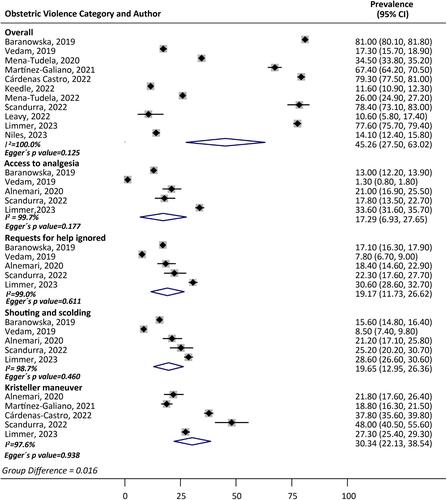
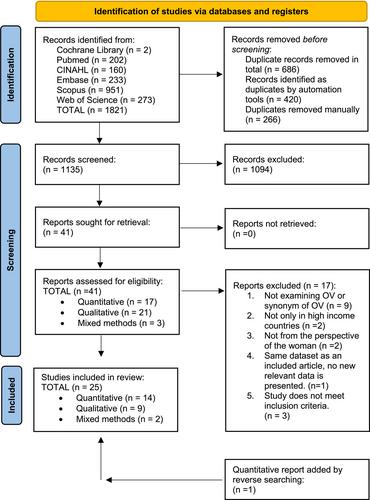
Of the 1821 records screened, 25 studies were included: 14 quantitative and 2 mixed methods studies, comprising 60 987 women, and 9 qualitative studies were included, comprising an additional 4356 women. 81.25% of quantitative studies, including the quantitative component of the mixed methods studies, were considered satisfactory or better regarding risk of bias. The prevalence of obstetric violence was overall 45.3% (95% CI 27.5–63.0; I2 = 100.0%). The prevalence of specific forms of mistreatment was also estimated. Lack of access to analgesia was 17.3% (95% CI 6.9–27.7; I2 = 99.7%). Ignored requests for help was 19.2% (95% CI 11.7–26.6; I2 = 99.0%). Shouting and scolding 19.7% (95% CI 13.0–26.4; I2 = 98.7%). The use of fundal pressure during the second stage of labor (Kristeller maneuver) was 30.3% (95% CI 22.1–38.5; I2 = 97.6%). There was no funnel asymmetry. Lack of information and/or consent were the most frequent domains extracted from the qualitative articles and the qualitative component of the mixed methods studies.

Conclusions

The results demonstrate that obstetric violence is a prevalent problem that women in high-income countries experience. Lack of information and/or consent were the domains most frequently described in the qualitative studies and the qualitative component of the mixed methods studies.

Abstract Image

Abstract Image

Abstract Image

Abstract Image

Abstract Image

查看原文
分享 分享
微信好友 朋友圈 QQ好友 复制链接
本刊更多论文
高收入国家的产科暴力发生率:混合研究的系统回顾和定量研究的荟萃分析
产科暴力或在产科护理中对妇女的虐待会造成严重后果,如对未来生育的恐惧、创伤后应激障碍和抑郁症。
本文章由计算机程序翻译,如有差异,请以英文原文为准。
求助全文
约1分钟内获得全文 去求助
来源期刊
CiteScore
8.00
自引率
4.70%
发文量
180
审稿时长
3-6 weeks
期刊介绍: Published monthly, Acta Obstetricia et Gynecologica Scandinavica is an international journal dedicated to providing the very latest information on the results of both clinical, basic and translational research work related to all aspects of women’s health from around the globe. The journal regularly publishes commentaries, reviews, and original articles on a wide variety of topics including: gynecology, pregnancy, birth, female urology, gynecologic oncology, fertility and reproductive biology.
期刊最新文献
Intrapartum CTG characteristics associated with isolated single umbilical artery in term fetuses: A matched case-control study. 1 g/h magnesium sulfate maintenance for eclampsia prevention is enough. Normative range for MRI amniotic fluid volume from 16 to 36 gestational weeks: Absolute and relative values, and correlation to ultrasound. Pregnancies in women with rare diseases: Selected maternal and perinatal outcomes. Predictive value of alcohol use questionnaires for adverse pregnancy outcomes: Evidence from a Finnish birth cohort.
×
引用
GB/T 7714-2015
复制
MLA
复制
APA
复制
导出至
BibTeX EndNote RefMan NoteFirst NoteExpress
×
×
提示
您的信息不完整,为了账户安全,请先补充。
现在去补充
×
提示
您因"违规操作"
具体请查看互助需知
我知道了
×
提示
现在去查看 取消
×
提示
确定
0
微信
客服QQ
Book学术公众号 扫码关注我们
反馈
×
意见反馈
请填写您的意见或建议
请填写您的手机或邮箱
已复制链接
已复制链接
快去分享给好友吧!
我知道了
×
扫码分享
扫码分享
Book学术官方微信
Book学术文献互助
Book学术文献互助群
群 号:604180095
Book学术
文献互助 智能选刊 最新文献 互助须知 联系我们:info@booksci.cn
Book学术提供免费学术资源搜索服务,方便国内外学者检索中英文文献。致力于提供最便捷和优质的服务体验。
Copyright © 2023 Book学术 All rights reserved.
ghs 京公网安备 11010802042870号 京ICP备2023020795号-1