Sandeep C. Kanade, Sanchayita Mukhopadhyay, Bhojkumar Nayak, Manu Gautam, Bharat B. Kale, Anil B. Gambhire, Musthafa Ottakam Thotiyl
{"title":"Dual Carbide Heterostructure Interface Mimicking Noble Metal-Like Activity for Reversible Dioxygen Catalysis in Rechargeable Air Batteries","authors":"Sandeep C. Kanade, Sanchayita Mukhopadhyay, Bhojkumar Nayak, Manu Gautam, Bharat B. Kale, Anil B. Gambhire, Musthafa Ottakam Thotiyl","doi":"10.1021/acsaem.4c01499","DOIUrl":null,"url":null,"abstract":"Recently, there has been significant interest in replacing expensive electrocatalysts with efficient bifunctional materials for facilitating dioxygen redox. Transition-metal carbides, known for their conductivity and mechanical strength, are promising toward this purpose. However, their lower activity and the resulting impact on commercial viability continue to present significant challenges. This study introduces a unique method for creating heterostructured interface comprising molybdenum carbide and vanadium carbide supported on nitrogen-doped graphene (MVC) for catalyzing dioxygen redox chemistry oxygen reduction reactions (ORR) and oxygen evolution reactions (OER) with activity comparable to noble metals. MVC exhibits performance metrics comparable to Pt in the ORR and required only half the overpotential to catalyze the OER at the desired rate compared to its individual counterparts. Improved dioxygen redox is attributed to heterostructure-assisted electron density modulation of the active redox species (required for OER and ORR) in MVC. Integration of MVC into a laboratory-level zinc–air battery prototype demonstrated almost similar round-trip efficiency compared to the benchmark Pt/C + RuO<sub>2</sub> electrocatalyst, indicating its potential as an inexpensive bifunctional electrocatalyst.","PeriodicalId":4,"journal":{"name":"ACS Applied Energy Materials","volume":"3 1","pages":""},"PeriodicalIF":5.5000,"publicationDate":"2024-09-17","publicationTypes":"Journal Article","fieldsOfStudy":null,"isOpenAccess":false,"openAccessPdf":"","citationCount":"0","resultStr":null,"platform":"Semanticscholar","paperid":null,"PeriodicalName":"ACS Applied Energy Materials","FirstCategoryId":"88","ListUrlMain":"https://doi.org/10.1021/acsaem.4c01499","RegionNum":3,"RegionCategory":"材料科学","ArticlePicture":[],"TitleCN":null,"AbstractTextCN":null,"PMCID":null,"EPubDate":"","PubModel":"","JCR":"Q2","JCRName":"CHEMISTRY, PHYSICAL","Score":null,"Total":0}
引用次数: 0
Abstract
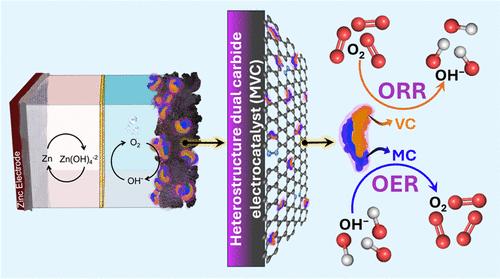
Recently, there has been significant interest in replacing expensive electrocatalysts with efficient bifunctional materials for facilitating dioxygen redox. Transition-metal carbides, known for their conductivity and mechanical strength, are promising toward this purpose. However, their lower activity and the resulting impact on commercial viability continue to present significant challenges. This study introduces a unique method for creating heterostructured interface comprising molybdenum carbide and vanadium carbide supported on nitrogen-doped graphene (MVC) for catalyzing dioxygen redox chemistry oxygen reduction reactions (ORR) and oxygen evolution reactions (OER) with activity comparable to noble metals. MVC exhibits performance metrics comparable to Pt in the ORR and required only half the overpotential to catalyze the OER at the desired rate compared to its individual counterparts. Improved dioxygen redox is attributed to heterostructure-assisted electron density modulation of the active redox species (required for OER and ORR) in MVC. Integration of MVC into a laboratory-level zinc–air battery prototype demonstrated almost similar round-trip efficiency compared to the benchmark Pt/C + RuO2 electrocatalyst, indicating its potential as an inexpensive bifunctional electrocatalyst.
期刊介绍:
ACS Applied Energy Materials is an interdisciplinary journal publishing original research covering all aspects of materials, engineering, chemistry, physics and biology relevant to energy conversion and storage. The journal is devoted to reports of new and original experimental and theoretical research of an applied nature that integrate knowledge in the areas of materials, engineering, physics, bioscience, and chemistry into important energy applications.



 京公网安备 11010802042870号
京ICP备2023020795号-1
京公网安备 11010802042870号
京ICP备2023020795号-1

 分享
分享
 求助内容:
求助内容: 应助结果提醒方式:
 扫码关注我们
