Advanced Non-linear Modeling and Explainable Artificial Intelligence Techniques for Predicting 30-Day Complications in Bariatric Surgery: A Single-Center Study
Nicolas Zucchini, Eugenia Capozzella, Mauro Giuffrè, Manuela Mastronardi, Biagio Casagranda, Saveria Lory Crocè, Nicolò de Manzini, Silvia Palmisano
{"title":"Advanced Non-linear Modeling and Explainable Artificial Intelligence Techniques for Predicting 30-Day Complications in Bariatric Surgery: A Single-Center Study","authors":"Nicolas Zucchini, Eugenia Capozzella, Mauro Giuffrè, Manuela Mastronardi, Biagio Casagranda, Saveria Lory Crocè, Nicolò de Manzini, Silvia Palmisano","doi":"10.1007/s11695-024-07501-0","DOIUrl":null,"url":null,"abstract":"<h3 data-test=\"abstract-sub-heading\">Purpose</h3><p>Metabolic bariatric surgery (MBS) became integral to managing severe obesity. Understanding surgical risks associated with MBS is crucial. Different scores, such as the Metabolic and Bariatric Surgery Accreditation and Quality Improvement Program (MBSAQIP), aid in patient selection and outcome prediction. This study aims to evaluate machine learning (ML) models performance in predicting 30-day post-operative complications and compare them with the MBSAQIP risk score.</p><h3 data-test=\"abstract-sub-heading\">Materials and Methods</h3><p>We retrospectively evaluated 424 consecutive patients (2006–2020) who underwent MBS, analyzing 30-day surgical complications according to Clavien-Dindo Classification. ML models, including logistic regression, support vector machine, random forest, k-nearest neighbors, multi-layer perceptron, and extreme gradient boosting, were analyzed and compared to MBSAQIP risk score. Performance was measured by area under receiver operating characteristic curve (<i>AUROC</i>) analysis.</p><h3 data-test=\"abstract-sub-heading\">Results</h3><p>Random forest showed the highest AUROC in the training (<i>AUROC</i> = 0.94) and the validation set (<i>AUROC</i> = 0.88). ML algorithms, particularly random forest, outperformed MBSAQIP in predicting negative 30-day outcomes in both the training and validation sets (<i>AUROC</i> = 0.64, DeLong’s Test <i>p</i> < 0.001). The five features that were more relevant for the prediction of the random forest model were serum alkaline phosphatase, platelet count, triglycerides, glycated hemoglobin, and albumin.</p><h3 data-test=\"abstract-sub-heading\">Conclusion</h3><p>We developed several ML model that identifies patients at risk for 30-day complications after MBS. Among these, random forest is the most performing one and outperforms the already established MBSAQIP score. This model could increase the identification of high-risk patients before MBS.</p><h3 data-test=\"abstract-sub-heading\">Graphical Abstract</h3>\n","PeriodicalId":19460,"journal":{"name":"Obesity Surgery","volume":"54 1","pages":""},"PeriodicalIF":3.1000,"publicationDate":"2024-09-13","publicationTypes":"Journal Article","fieldsOfStudy":null,"isOpenAccess":false,"openAccessPdf":"","citationCount":"0","resultStr":null,"platform":"Semanticscholar","paperid":null,"PeriodicalName":"Obesity Surgery","FirstCategoryId":"3","ListUrlMain":"https://doi.org/10.1007/s11695-024-07501-0","RegionNum":3,"RegionCategory":"医学","ArticlePicture":[],"TitleCN":null,"AbstractTextCN":null,"PMCID":null,"EPubDate":"","PubModel":"","JCR":"Q1","JCRName":"SURGERY","Score":null,"Total":0}
引用次数: 0
Abstract
Purpose
Metabolic bariatric surgery (MBS) became integral to managing severe obesity. Understanding surgical risks associated with MBS is crucial. Different scores, such as the Metabolic and Bariatric Surgery Accreditation and Quality Improvement Program (MBSAQIP), aid in patient selection and outcome prediction. This study aims to evaluate machine learning (ML) models performance in predicting 30-day post-operative complications and compare them with the MBSAQIP risk score.
Materials and Methods
We retrospectively evaluated 424 consecutive patients (2006–2020) who underwent MBS, analyzing 30-day surgical complications according to Clavien-Dindo Classification. ML models, including logistic regression, support vector machine, random forest, k-nearest neighbors, multi-layer perceptron, and extreme gradient boosting, were analyzed and compared to MBSAQIP risk score. Performance was measured by area under receiver operating characteristic curve (AUROC) analysis.
Results
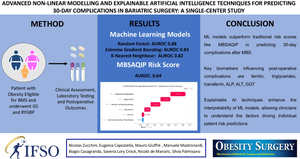
Random forest showed the highest AUROC in the training (AUROC = 0.94) and the validation set (AUROC = 0.88). ML algorithms, particularly random forest, outperformed MBSAQIP in predicting negative 30-day outcomes in both the training and validation sets (AUROC = 0.64, DeLong’s Test p < 0.001). The five features that were more relevant for the prediction of the random forest model were serum alkaline phosphatase, platelet count, triglycerides, glycated hemoglobin, and albumin.
Conclusion
We developed several ML model that identifies patients at risk for 30-day complications after MBS. Among these, random forest is the most performing one and outperforms the already established MBSAQIP score. This model could increase the identification of high-risk patients before MBS.
期刊介绍:
Obesity Surgery is the official journal of the International Federation for the Surgery of Obesity and metabolic disorders (IFSO). A journal for bariatric/metabolic surgeons, Obesity Surgery provides an international, interdisciplinary forum for communicating the latest research, surgical and laparoscopic techniques, for treatment of massive obesity and metabolic disorders. Topics covered include original research, clinical reports, current status, guidelines, historical notes, invited commentaries, letters to the editor, medicolegal issues, meeting abstracts, modern surgery/technical innovations, new concepts, reviews, scholarly presentations and opinions.
Obesity Surgery benefits surgeons performing obesity/metabolic surgery, general surgeons and surgical residents, endoscopists, anesthetists, support staff, nurses, dietitians, psychiatrists, psychologists, plastic surgeons, internists including endocrinologists and diabetologists, nutritional scientists, and those dealing with eating disorders.



 京公网安备 11010802042870号
京ICP备2023020795号-1
京公网安备 11010802042870号
京ICP备2023020795号-1

 分享
分享
 求助内容:
求助内容: 应助结果提醒方式:
 扫码关注我们
