{"title":"Lipopolysaccharide accelerates peristalsis by stimulating glucagon-like peptide-1 release from L cells in the rat proximal colon","authors":"Hiroyuki Nakamori, Atsuko Niimi, Retsu Mitsui, Hikaru Hashitani","doi":"10.1113/JP286258","DOIUrl":null,"url":null,"abstract":"<div>\n \n <section>\n \n \n <div>Upon epithelial barrier dysfunction, lipopolysaccharide (LPS) stimulates glucagon-like peptide-1 (GLP-1) secretion from enteroendocrine L cells by activating Toll-like receptor 4 (TLR4). Because GLP-1 accelerates peristalsis in the proximal colon, the present study aimed to explore whether LPS facilitates colonic peristalsis by stimulating L cell-derived GLP-1 release. In isolated segments of rat proximal colon that were serosally perfused with physiological salt solution and luminally perfused with 0.9% saline, peristaltic wall motion was video recorded and converted into spatio-temporal maps. Fluorescence immunohistochemistry was also carried out. Intraluminal administration of LPS (100 or 1 µg mL<sup>−1</sup> but not 100 ng mL<sup>−1</sup>) increased the frequency of oro-aboral propagating peristaltic contractions. The LPS-induced acceleration of colonic peristalsis was blocked by TAK-242 (the TLR4 antagonist), exendin-3 (the GLP-1 receptor antagonist) or BIBN4096 (the calcitonin gene-related peptide receptor antagonist). GLP-1-positive epithelial cells co-expressed TLR4 immunoreactivity. In aspirin-pretreated preparations where epithelial barrier function had been impaired, a lower dose of LPS (100 ng mL<sup>−1</sup>) became capable of accelerating peristalsis. By contrast, luminally applied dimethyl sulphoxide, a reactive oxygen species scavenger that protects epithelial integrity, attenuated the prokinetic effects of a higher dose of LPS (100 µg mL<sup>−1</sup>). In colonic segments of a stress rat model leading to a leaky gut, LPS induced more pronounced prokinetic effects. Colonic L cells may well sense luminal LPS via TLR4 triggering the release of GLP-1 that stimulates calcitonin gene-related peptide-containing neurons. The resultant acceleration of peristalsis would facilitate excretion of Gram-negative bacteria from the intestine, and thus L cells may have a protective role against intestinal bacterial infections.\n\n <figure>\n <div><picture>\n <source></source></picture><p></p>\n </div>\n </figure>\n </div>\n </section>\n \n <section>\n \n <h3> Key points</h3>\n \n <div>\n <ul>\n \n <li>Colonic epithelial cells form a barrier against bacterial invasion but also may contribute more actively to the exclusion of luminal pathogen by stimulating colonic motility.</li>\n \n <li>Luminal lipopolysaccharide (LPS) accelerated colonic peristalsis by stimulating calcitonin gene-related peptide-containing neurons.</li>\n \n <li>The prokinetic effect of LPS was mediated by the secretion of glucagon-like peptide-1 from enteroendocrine L cells in which Toll-like receptor 4 was expressed.</li>\n \n <li>The LPS-mediated acceleration of peristalsis depended on epithelial barrier integrity.</li>\n \n <li>L cells have a defensive role against Gram-negative bacterial infections by facilitating faecal excretion, and could be a potential therapeutic target for gastrointestinal infections.</li>\n </ul>\n </div>\n </section>\n </div>","PeriodicalId":50088,"journal":{"name":"Journal of Physiology-London","volume":"602 19","pages":"4803-4820"},"PeriodicalIF":4.6000,"publicationDate":"2024-09-17","publicationTypes":"Journal Article","fieldsOfStudy":null,"isOpenAccess":false,"openAccessPdf":"","citationCount":"0","resultStr":null,"platform":"Semanticscholar","paperid":null,"PeriodicalName":"Journal of Physiology-London","FirstCategoryId":"3","ListUrlMain":"https://physoc.onlinelibrary.wiley.com/doi/10.1113/JP286258","RegionNum":2,"RegionCategory":"医学","ArticlePicture":[],"TitleCN":null,"AbstractTextCN":null,"PMCID":null,"EPubDate":"","PubModel":"","JCR":"Q1","JCRName":"NEUROSCIENCES","Score":null,"Total":0}
引用次数: 0
Abstract
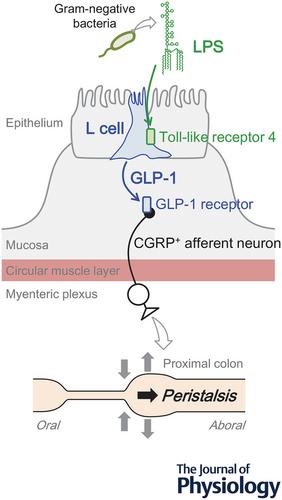
Upon epithelial barrier dysfunction, lipopolysaccharide (LPS) stimulates glucagon-like peptide-1 (GLP-1) secretion from enteroendocrine L cells by activating Toll-like receptor 4 (TLR4). Because GLP-1 accelerates peristalsis in the proximal colon, the present study aimed to explore whether LPS facilitates colonic peristalsis by stimulating L cell-derived GLP-1 release. In isolated segments of rat proximal colon that were serosally perfused with physiological salt solution and luminally perfused with 0.9% saline, peristaltic wall motion was video recorded and converted into spatio-temporal maps. Fluorescence immunohistochemistry was also carried out. Intraluminal administration of LPS (100 or 1 µg mL−1 but not 100 ng mL−1) increased the frequency of oro-aboral propagating peristaltic contractions. The LPS-induced acceleration of colonic peristalsis was blocked by TAK-242 (the TLR4 antagonist), exendin-3 (the GLP-1 receptor antagonist) or BIBN4096 (the calcitonin gene-related peptide receptor antagonist). GLP-1-positive epithelial cells co-expressed TLR4 immunoreactivity. In aspirin-pretreated preparations where epithelial barrier function had been impaired, a lower dose of LPS (100 ng mL−1) became capable of accelerating peristalsis. By contrast, luminally applied dimethyl sulphoxide, a reactive oxygen species scavenger that protects epithelial integrity, attenuated the prokinetic effects of a higher dose of LPS (100 µg mL−1). In colonic segments of a stress rat model leading to a leaky gut, LPS induced more pronounced prokinetic effects. Colonic L cells may well sense luminal LPS via TLR4 triggering the release of GLP-1 that stimulates calcitonin gene-related peptide-containing neurons. The resultant acceleration of peristalsis would facilitate excretion of Gram-negative bacteria from the intestine, and thus L cells may have a protective role against intestinal bacterial infections.
Key points
Colonic epithelial cells form a barrier against bacterial invasion but also may contribute more actively to the exclusion of luminal pathogen by stimulating colonic motility.
The prokinetic effect of LPS was mediated by the secretion of glucagon-like peptide-1 from enteroendocrine L cells in which Toll-like receptor 4 was expressed.
The LPS-mediated acceleration of peristalsis depended on epithelial barrier integrity.
L cells have a defensive role against Gram-negative bacterial infections by facilitating faecal excretion, and could be a potential therapeutic target for gastrointestinal infections.
期刊介绍:
The Journal of Physiology publishes full-length original Research Papers and Techniques for Physiology, which are short papers aimed at disseminating new techniques for physiological research. Articles solicited by the Editorial Board include Perspectives, Symposium Reports and Topical Reviews, which highlight areas of special physiological interest. CrossTalk articles are short editorial-style invited articles framing a debate between experts in the field on controversial topics. Letters to the Editor and Journal Club articles are also published. All categories of papers are subjected to peer reivew.
The Journal of Physiology welcomes submitted research papers in all areas of physiology. Authors should present original work that illustrates new physiological principles or mechanisms. Papers on work at the molecular level, at the level of the cell membrane, single cells, tissues or organs and on systems physiology are all acceptable. Theoretical papers and papers that use computational models to further our understanding of physiological processes will be considered if based on experimentally derived data and if the hypothesis advanced is directly amenable to experimental testing. While emphasis is on human and mammalian physiology, work on lower vertebrate or invertebrate preparations may be suitable if it furthers the understanding of the functioning of other organisms including mammals.





 京公网安备 11010802042870号
京ICP备2023020795号-1
京公网安备 11010802042870号
京ICP备2023020795号-1

 分享
分享
 求助内容:
求助内容: 应助结果提醒方式:
 扫码关注我们
