Effect of strain engineering on the highly controllable H2 purification performance of graphenylene-like boron nitride membranes: DFT calculations and MD simulations
Wentao Guo , Qihua Hou , Zhiyong Liu , Yongliang Yong , Hongling Cui , Shaobo Huang , Xinli Li , Xiaohong Li
{"title":"Effect of strain engineering on the highly controllable H2 purification performance of graphenylene-like boron nitride membranes: DFT calculations and MD simulations","authors":"Wentao Guo , Qihua Hou , Zhiyong Liu , Yongliang Yong , Hongling Cui , Shaobo Huang , Xinli Li , Xiaohong Li","doi":"10.1016/j.surfin.2024.105112","DOIUrl":null,"url":null,"abstract":"<div><p>To obtain high-purity hydrogen for industrial applications, it is highly desirable to separate and purify hydrogen from byproduct gases in hydrogen preparation. DFT calculations and MD simulations were performed to study the hydrogen separation performance of the graphenylene-like boron nitride (p-BN) monolayer under the modification of strain engineering. The p-BN membrane is thermal stable at high temperatures of 1500 K. Without strain engineering, the p-BN monolayer cannot be used as H<sub>2</sub> separation membranes at room temperature, as no H<sub>2</sub> gas can permeate from the membrane, however, it would be potential for H<sub>2</sub> separation at high temperatures (the H<sub>2</sub> permeance of 3.415 × 10<sup>5</sup>-2.732 × 10<sup>6</sup> GPU with high selectivity above 500 K). Strain engineering can effectively enhance the H<sub>2</sub> purification properties of the p-BN monolayer. At 9 % strains, the H<sub>2</sub> permeability of the p-BN membrane is 2.357 × 10<sup>7</sup> GPU at 300 K, much higher than the industrial acceptance value, while the selectivity of H<sub>2</sub> related to other gases (N<sub>2</sub>, CO, O<sub>2</sub>, CO<sub>2</sub>, and CH<sub>4</sub>) is 14.75, 33.09, 1.002 × 10<sup>2</sup>, 8.512 × 10<sup>5</sup>, and 1.502 × 10<sup>10</sup>, respectively. Therefore, our findings indicate that the p-BN membranes are excellent candidates for highly controllable and reversible H<sub>2</sub> separation and purification under modification of strain engineering.</p></div>","PeriodicalId":22081,"journal":{"name":"Surfaces and Interfaces","volume":"54 ","pages":"Article 105112"},"PeriodicalIF":6.3000,"publicationDate":"2024-09-16","publicationTypes":"Journal Article","fieldsOfStudy":null,"isOpenAccess":false,"openAccessPdf":"","citationCount":"0","resultStr":null,"platform":"Semanticscholar","paperid":null,"PeriodicalName":"Surfaces and Interfaces","FirstCategoryId":"88","ListUrlMain":"https://www.sciencedirect.com/science/article/pii/S2468023024012689","RegionNum":2,"RegionCategory":"材料科学","ArticlePicture":[],"TitleCN":null,"AbstractTextCN":null,"PMCID":null,"EPubDate":"","PubModel":"","JCR":"Q2","JCRName":"CHEMISTRY, PHYSICAL","Score":null,"Total":0}
引用次数: 0
Abstract
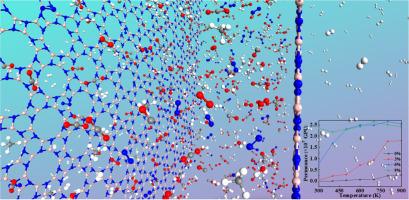
To obtain high-purity hydrogen for industrial applications, it is highly desirable to separate and purify hydrogen from byproduct gases in hydrogen preparation. DFT calculations and MD simulations were performed to study the hydrogen separation performance of the graphenylene-like boron nitride (p-BN) monolayer under the modification of strain engineering. The p-BN membrane is thermal stable at high temperatures of 1500 K. Without strain engineering, the p-BN monolayer cannot be used as H2 separation membranes at room temperature, as no H2 gas can permeate from the membrane, however, it would be potential for H2 separation at high temperatures (the H2 permeance of 3.415 × 10⁵-2.732 × 10⁶ GPU with high selectivity above 500 K). Strain engineering can effectively enhance the H2 purification properties of the p-BN monolayer. At 9 % strains, the H2 permeability of the p-BN membrane is 2.357 × 10⁷ GPU at 300 K, much higher than the industrial acceptance value, while the selectivity of H2 related to other gases (N2, CO, O2, CO2, and CH4) is 14.75, 33.09, 1.002 × 10², 8.512 × 10⁵, and 1.502 × 10¹⁰, respectively. Therefore, our findings indicate that the p-BN membranes are excellent candidates for highly controllable and reversible H2 separation and purification under modification of strain engineering.
期刊介绍:
The aim of the journal is to provide a respectful outlet for ''sound science'' papers in all research areas on surfaces and interfaces. We define sound science papers as papers that describe new and well-executed research, but that do not necessarily provide brand new insights or are merely a description of research results.
Surfaces and Interfaces publishes research papers in all fields of surface science which may not always find the right home on first submission to our Elsevier sister journals (Applied Surface, Surface and Coatings Technology, Thin Solid Films)



 京公网安备 11010802042870号
京ICP备2023020795号-1
京公网安备 11010802042870号
京ICP备2023020795号-1

 分享
分享
 求助内容:
求助内容: 应助结果提醒方式:
 扫码关注我们
