Dr. Shenglai Yao, M. Sc. Markus Stefan Budde, Dr. Xing Yang, Dr. Yun Xiong, Prof. Dr. Lili Zhao, Prof. Dr. Matthias Driess
{"title":"Disilicon-Mediated Carbon Monoxide Activation: From a 1,2,3-Trisila- to 1,3-Disilacyclopentadienes with Hypercoordinate λ4Si-λ3C Double Bonds","authors":"Dr. Shenglai Yao, M. Sc. Markus Stefan Budde, Dr. Xing Yang, Dr. Yun Xiong, Prof. Dr. Lili Zhao, Prof. Dr. Matthias Driess","doi":"10.1002/anie.202414696","DOIUrl":null,"url":null,"abstract":"<p>The facile reaction of the SiPh<sub>2</sub>-bridged bis-silylene (LSi:)<sub>2</sub>SiPh<sub>2</sub> (L=PhC(NBu<sup>t</sup>)<sub>2</sub>) with diphenylacetylene affords the unprecedented 1,2,3-trisilacyclopentadiene (LSi)<sub>2</sub>(PhC)<sub>2</sub>SiPh<sub>2</sub> <b>1</b> with a hypercoordinate λ<sup>4</sup>Si−λ<sup>3</sup>Si double bond. Compound <b>1</b> is very oxophilic and consumes three molar equivalents of inert N<sub>2</sub>O to form the bicyclic oxygenation product <b>2</b> through O-atom insertion in the Si=Si and Si−Si bonds. Strikingly, <b>1</b> can completely split the C≡O bonds of carbon monoxide under ambient conditions (1 atm, room temperature), yielding the 1,3-disilacyclopentadiene <b>3</b>, representing the first hypercoordinate example of a cyclosilene with a λ<sup>4</sup>Si-λ<sup>3</sup>C double bond. Likewise, reaction of Xyl-NC (Xyl=2,6-dimethylphenyl), an isocyanide isoelectronic with CO, with <b>1</b> furnishes the related 1,3-disilacyclopentadiene <b>4</b> but with an amidinato silylene pendent attached to the Si=C carbon ring atom.</p>","PeriodicalId":125,"journal":{"name":"Angewandte Chemie International Edition","volume":"64 2","pages":""},"PeriodicalIF":16.9000,"publicationDate":"2024-09-21","publicationTypes":"Journal Article","fieldsOfStudy":null,"isOpenAccess":false,"openAccessPdf":"https://onlinelibrary.wiley.com/doi/epdf/10.1002/anie.202414696","citationCount":"0","resultStr":null,"platform":"Semanticscholar","paperid":null,"PeriodicalName":"Angewandte Chemie International Edition","FirstCategoryId":"92","ListUrlMain":"https://onlinelibrary.wiley.com/doi/10.1002/anie.202414696","RegionNum":1,"RegionCategory":"化学","ArticlePicture":[],"TitleCN":null,"AbstractTextCN":null,"PMCID":null,"EPubDate":"","PubModel":"","JCR":"Q1","JCRName":"CHEMISTRY, MULTIDISCIPLINARY","Score":null,"Total":0}
引用次数: 0
Abstract
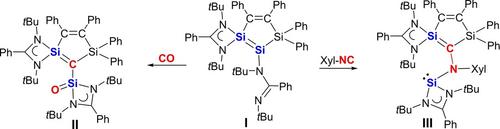
The facile reaction of the SiPh2-bridged bis-silylene (LSi:)2SiPh2 (L=PhC(NBut)2) with diphenylacetylene affords the unprecedented 1,2,3-trisilacyclopentadiene (LSi)2(PhC)2SiPh21 with a hypercoordinate λ4Si−λ3Si double bond. Compound 1 is very oxophilic and consumes three molar equivalents of inert N2O to form the bicyclic oxygenation product 2 through O-atom insertion in the Si=Si and Si−Si bonds. Strikingly, 1 can completely split the C≡O bonds of carbon monoxide under ambient conditions (1 atm, room temperature), yielding the 1,3-disilacyclopentadiene 3, representing the first hypercoordinate example of a cyclosilene with a λ4Si-λ3C double bond. Likewise, reaction of Xyl-NC (Xyl=2,6-dimethylphenyl), an isocyanide isoelectronic with CO, with 1 furnishes the related 1,3-disilacyclopentadiene 4 but with an amidinato silylene pendent attached to the Si=C carbon ring atom.
期刊介绍:
Angewandte Chemie, a journal of the German Chemical Society (GDCh), maintains a leading position among scholarly journals in general chemistry with an impressive Impact Factor of 16.6 (2022 Journal Citation Reports, Clarivate, 2023). Published weekly in a reader-friendly format, it features new articles almost every day. Established in 1887, Angewandte Chemie is a prominent chemistry journal, offering a dynamic blend of Review-type articles, Highlights, Communications, and Research Articles on a weekly basis, making it unique in the field.




 京公网安备 11010802042870号
京ICP备2023020795号-1
京公网安备 11010802042870号
京ICP备2023020795号-1

 分享
分享
 求助内容:
求助内容: 应助结果提醒方式:
 扫码关注我们
