Abdul Mueed , He Ma , Philippe Madjirebaye , Akhtar Ali , Sajjad Ali , Jingwen Yu , Jing Li , Ze-yuan Deng
{"title":"Effect of flaxseed oil cyclolinopeptides on lipid oxidation, protein oxidation, and lipid profile during in vitro digestion of high-fat beef","authors":"Abdul Mueed , He Ma , Philippe Madjirebaye , Akhtar Ali , Sajjad Ali , Jingwen Yu , Jing Li , Ze-yuan Deng","doi":"10.1016/j.foodchem.2024.141256","DOIUrl":null,"url":null,"abstract":"<div><p>This study investigated the influence of flaxseed oil cyclolinopeptides (CLs) on lipid and protein oxidation during high-fat meat digestion. Fourteen CLs were identified in flaxseed oil through UHPLC-ESI-QTOF-MS/MS, with dominant CLA, CLB, CLE, and CLM. During <em>in vitro</em> digestion, CLs inhibited lipid oxidation products (lipid hydroperoxide, Malondialdehyde, and 4-hydroxynonenal) and protein carbonylation. Compared to other groups, the lipid (16.28 ± 0.35) and protein (17.5 ± 0.6) oxidation was significantly inhibited, and antioxidant activity was remarkably increased when the CLs content reached 200 mg/kg. Through untargeted lipidomic analysis using Q-Exactive, it was observed that CLs mitigated the formation of oxidized triglycerides (OxTG) products and enhanced the hydrolysis of lipids to generate sphingolipid and polyunsaturated fatty-acids enriched glycerophospholipids imparting nutritional value to meat. Electron spin-resonance and fluorescence quenching showed that primary radicals such as alkyl and alkoxy radicals during high-fat meat digestion with flaxseed oil CLs significantly mitigate their formation. These findings collectively indicate that consuming CLs enriched flaxseed oil could reduce lipid oxidation and enhance the nutritional value of high-fat meat during digestion.</p></div>","PeriodicalId":318,"journal":{"name":"Food Chemistry","volume":"463 ","pages":"Article 141256"},"PeriodicalIF":9.8000,"publicationDate":"2025-01-15","publicationTypes":"Journal Article","fieldsOfStudy":null,"isOpenAccess":false,"openAccessPdf":"","citationCount":"0","resultStr":null,"platform":"Semanticscholar","paperid":null,"PeriodicalName":"Food Chemistry","FirstCategoryId":"97","ListUrlMain":"https://www.sciencedirect.com/science/article/pii/S0308814624029066","RegionNum":1,"RegionCategory":"农林科学","ArticlePicture":[],"TitleCN":null,"AbstractTextCN":null,"PMCID":null,"EPubDate":"2024/9/11 0:00:00","PubModel":"Epub","JCR":"Q1","JCRName":"CHEMISTRY, APPLIED","Score":null,"Total":0}
引用次数: 0
Abstract
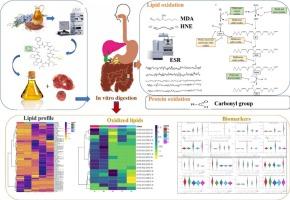
This study investigated the influence of flaxseed oil cyclolinopeptides (CLs) on lipid and protein oxidation during high-fat meat digestion. Fourteen CLs were identified in flaxseed oil through UHPLC-ESI-QTOF-MS/MS, with dominant CLA, CLB, CLE, and CLM. During in vitro digestion, CLs inhibited lipid oxidation products (lipid hydroperoxide, Malondialdehyde, and 4-hydroxynonenal) and protein carbonylation. Compared to other groups, the lipid (16.28 ± 0.35) and protein (17.5 ± 0.6) oxidation was significantly inhibited, and antioxidant activity was remarkably increased when the CLs content reached 200 mg/kg. Through untargeted lipidomic analysis using Q-Exactive, it was observed that CLs mitigated the formation of oxidized triglycerides (OxTG) products and enhanced the hydrolysis of lipids to generate sphingolipid and polyunsaturated fatty-acids enriched glycerophospholipids imparting nutritional value to meat. Electron spin-resonance and fluorescence quenching showed that primary radicals such as alkyl and alkoxy radicals during high-fat meat digestion with flaxseed oil CLs significantly mitigate their formation. These findings collectively indicate that consuming CLs enriched flaxseed oil could reduce lipid oxidation and enhance the nutritional value of high-fat meat during digestion.
期刊介绍:
Food Chemistry publishes original research papers dealing with the advancement of the chemistry and biochemistry of foods or the analytical methods/ approach used. All papers should focus on the novelty of the research carried out.



 京公网安备 11010802042870号
京ICP备2023020795号-1
京公网安备 11010802042870号
京ICP备2023020795号-1

 分享
分享
 求助内容:
求助内容: 应助结果提醒方式:
 扫码关注我们
