Phosphorus flame retardant in situ fixed on a gel polymer electrolyte for lithium metal batteries with enhanced safety and superior electrochemical performance†
Hao Yu, Su Wang, Yan Zhang, Yanrui Pan, Zhaokun Wang, Chen Li, Yue Ma, Dawei Song, Hongzhou Zhang, Xixi Shi, Chunliang Li and Lianqi Zhang
{"title":"Phosphorus flame retardant in situ fixed on a gel polymer electrolyte for lithium metal batteries with enhanced safety and superior electrochemical performance†","authors":"Hao Yu, Su Wang, Yan Zhang, Yanrui Pan, Zhaokun Wang, Chen Li, Yue Ma, Dawei Song, Hongzhou Zhang, Xixi Shi, Chunliang Li and Lianqi Zhang","doi":"10.1039/D4TA04766D","DOIUrl":null,"url":null,"abstract":"<p >Non-flammable polymer electrolytes are attractive due to their inherent potential to eliminate the fire hazards of conventional liquid electrolytes. However, the most widely used flame-retardant additives can facilely react with Li anodes and are unfavorable for the conduction of lithium ions, restricting the improvement of electrochemical performance. Herein, a flame-retardant gel polymer electrolyte (FGPE) is prepared by <em>in situ</em> copolymerization of a flame-retardant additive on a polymer backbone. The phosphorus additive 9,10-dihydro-9-oxa-10-phosphaphenanthrene 10-oxide (DOPO) presents excellent flame-retardant properties, while the abundant C<img>O/C–O groups on polyethylene glycol methyl ether methacrylate (PEGMEMA) and polyethylene glycol diacrylate (PEGDA) promote the rapid transfer of lithium ions. After the reaction between the P–H bond in the former and the unsaturated double bond in the latter, the adverse reactions between DOPO and the Li anode are suppressed, and an excellent polymer electrolyte with high safety and outstanding electrochemical performance is obtained. Given the feasibility of our strategy, a record of sustained firing for 190 s without ignition is presented. Moreover, a high ionic conductivity (1.13 mS cm<small><sup>−1</sup></small> at 25 °C) is achieved after specifically regulating the content of DOPO; the assembled LiFePO<small><sub>4</sub></small>/FGPE/Li battery shows excellent cycling performance after 300 cycles with a capacity of 165.7 mA h g<small><sup>−1</sup></small> and capacity retention of 99.7%, realizing a balance between high safety and high performance. This electrolyte design philosophy provides a promising path for high-safety and high-energy-density lithium metal batteries.</p>","PeriodicalId":82,"journal":{"name":"Journal of Materials Chemistry A","volume":" 42","pages":" 29129-29137"},"PeriodicalIF":9.5000,"publicationDate":"2024-09-23","publicationTypes":"Journal Article","fieldsOfStudy":null,"isOpenAccess":false,"openAccessPdf":"","citationCount":"0","resultStr":null,"platform":"Semanticscholar","paperid":null,"PeriodicalName":"Journal of Materials Chemistry A","FirstCategoryId":"88","ListUrlMain":"https://pubs.rsc.org/en/content/articlelanding/2024/ta/d4ta04766d","RegionNum":2,"RegionCategory":"材料科学","ArticlePicture":[],"TitleCN":null,"AbstractTextCN":null,"PMCID":null,"EPubDate":"","PubModel":"","JCR":"Q1","JCRName":"CHEMISTRY, PHYSICAL","Score":null,"Total":0}
引用次数: 0
Abstract
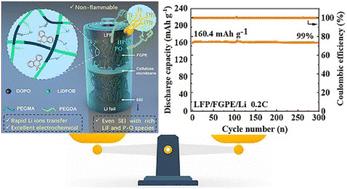
Non-flammable polymer electrolytes are attractive due to their inherent potential to eliminate the fire hazards of conventional liquid electrolytes. However, the most widely used flame-retardant additives can facilely react with Li anodes and are unfavorable for the conduction of lithium ions, restricting the improvement of electrochemical performance. Herein, a flame-retardant gel polymer electrolyte (FGPE) is prepared by in situ copolymerization of a flame-retardant additive on a polymer backbone. The phosphorus additive 9,10-dihydro-9-oxa-10-phosphaphenanthrene 10-oxide (DOPO) presents excellent flame-retardant properties, while the abundant CO/C–O groups on polyethylene glycol methyl ether methacrylate (PEGMEMA) and polyethylene glycol diacrylate (PEGDA) promote the rapid transfer of lithium ions. After the reaction between the P–H bond in the former and the unsaturated double bond in the latter, the adverse reactions between DOPO and the Li anode are suppressed, and an excellent polymer electrolyte with high safety and outstanding electrochemical performance is obtained. Given the feasibility of our strategy, a record of sustained firing for 190 s without ignition is presented. Moreover, a high ionic conductivity (1.13 mS cm−1 at 25 °C) is achieved after specifically regulating the content of DOPO; the assembled LiFePO4/FGPE/Li battery shows excellent cycling performance after 300 cycles with a capacity of 165.7 mA h g−1 and capacity retention of 99.7%, realizing a balance between high safety and high performance. This electrolyte design philosophy provides a promising path for high-safety and high-energy-density lithium metal batteries.
期刊介绍:
The Journal of Materials Chemistry A, B & C covers a wide range of high-quality studies in the field of materials chemistry, with each section focusing on specific applications of the materials studied. Journal of Materials Chemistry A emphasizes applications in energy and sustainability, including topics such as artificial photosynthesis, batteries, and fuel cells. Journal of Materials Chemistry B focuses on applications in biology and medicine, while Journal of Materials Chemistry C covers applications in optical, magnetic, and electronic devices. Example topic areas within the scope of Journal of Materials Chemistry A include catalysis, green/sustainable materials, sensors, and water treatment, among others.



 京公网安备 11010802042870号
京ICP备2023020795号-1
京公网安备 11010802042870号
京ICP备2023020795号-1

 分享
分享
 求助内容:
求助内容: 应助结果提醒方式:
 扫码关注我们
