Dandan Xu , Haojie Liao , Chao He , Ke Wang , Rui Dong , Youjun Zhang , Zhaojiang Guo , Xin Yang , Wen Xie , Neil Crickmore , Shaoli Wang
{"title":"Expression reduction and a variant of a P450 gene mediate chlorpyrifos resistance in Tetranychus urticae Koch","authors":"Dandan Xu , Haojie Liao , Chao He , Ke Wang , Rui Dong , Youjun Zhang , Zhaojiang Guo , Xin Yang , Wen Xie , Neil Crickmore , Shaoli Wang","doi":"10.1016/j.jare.2024.09.015","DOIUrl":null,"url":null,"abstract":"<div><h3>Introduction</h3><div>Understanding how insects and mites develop resistance to chlorpyrifos is crucial for effective field management. Although extensive research has demonstrated that <em>T. urticae</em> exhibits high resistance to chlorpyrifos, the specific resistance mechanism remains elusive. Investigating this mechanism could provide valuable insights for pest control strategies.</div></div><div><h3>Objectives</h3><div>This study aimed to reveal the mechanism of chlorpyrifos resistance in <em>T. urticae</em>.</div></div><div><h3>Methods</h3><div>The expression level of the <em>CYP392D8</em> gene in <em>T. urticae</em> strains were analyzed using real- time quantitative PCR and western blot techniques. Functional validation of CYP392D8 was conducted through RNAi and heterogeneous expression. The production of chlorpyrifos-oxon in both resistant and susceptible strains were quantified using LC-MS/MS. Furthermore, the metabolic capabilities of CYP392D8 variants were verified using HPLC-MS and molecular docking.</div></div><div><h3>Results</h3><div>The results showed the expression of <em>CYP392D8</em> was reduced in some Chinese resistant populations and mites with knocked down <em>CYP392D8</em> showed decreased susceptibility to chlorpyrifos. Chlorpyrifos-oxon, the active metabolite of chlorpyrifos, was generated when chlorpyrifos was incubated with recombinant CYP392D8 protein <em>in vitro</em>. And a higher efficiency of chlorpyrifos-oxon formation was observed with the CYP392D8-S variant from susceptible mites compared to the CYP392D8-R variant from resistant mites. After treatment with low doses of chlorpyrifos, susceptible mite extracts produced substantial amounts of chlorpyrifos-oxon, while resistant mites only showed trace amounts. In addition, molecular docking studies showed that CYP392D8-S had a higher binding capacity to chlorpyrifos than the CYP392D8-R variant.</div></div><div><h3>Conclusion</h3><div>This study reveals a mechanism of insecticide resistance due to the bioactivation reduction in combination with the sequence variation in a pest mite. These findings provide an important theoretical bias for management strategies of mites in the field and comprehensive control.</div></div>","PeriodicalId":14952,"journal":{"name":"Journal of Advanced Research","volume":"74 ","pages":"Pages 1-11"},"PeriodicalIF":13.0000,"publicationDate":"2024-09-17","publicationTypes":"Journal Article","fieldsOfStudy":null,"isOpenAccess":false,"openAccessPdf":"","citationCount":"0","resultStr":null,"platform":"Semanticscholar","paperid":null,"PeriodicalName":"Journal of Advanced Research","FirstCategoryId":"103","ListUrlMain":"https://www.sciencedirect.com/science/article/pii/S209012322400417X","RegionNum":1,"RegionCategory":"综合性期刊","ArticlePicture":[],"TitleCN":null,"AbstractTextCN":null,"PMCID":null,"EPubDate":"","PubModel":"","JCR":"Q1","JCRName":"MULTIDISCIPLINARY SCIENCES","Score":null,"Total":0}
引用次数: 0
Abstract
Introduction
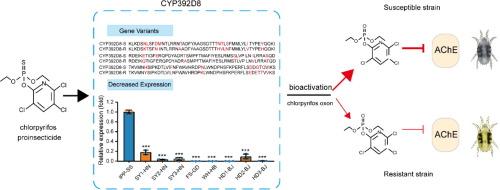
Understanding how insects and mites develop resistance to chlorpyrifos is crucial for effective field management. Although extensive research has demonstrated that T. urticae exhibits high resistance to chlorpyrifos, the specific resistance mechanism remains elusive. Investigating this mechanism could provide valuable insights for pest control strategies.
Objectives
This study aimed to reveal the mechanism of chlorpyrifos resistance in T. urticae.
Methods
The expression level of the CYP392D8 gene in T. urticae strains were analyzed using real- time quantitative PCR and western blot techniques. Functional validation of CYP392D8 was conducted through RNAi and heterogeneous expression. The production of chlorpyrifos-oxon in both resistant and susceptible strains were quantified using LC-MS/MS. Furthermore, the metabolic capabilities of CYP392D8 variants were verified using HPLC-MS and molecular docking.
Results
The results showed the expression of CYP392D8 was reduced in some Chinese resistant populations and mites with knocked down CYP392D8 showed decreased susceptibility to chlorpyrifos. Chlorpyrifos-oxon, the active metabolite of chlorpyrifos, was generated when chlorpyrifos was incubated with recombinant CYP392D8 protein in vitro. And a higher efficiency of chlorpyrifos-oxon formation was observed with the CYP392D8-S variant from susceptible mites compared to the CYP392D8-R variant from resistant mites. After treatment with low doses of chlorpyrifos, susceptible mite extracts produced substantial amounts of chlorpyrifos-oxon, while resistant mites only showed trace amounts. In addition, molecular docking studies showed that CYP392D8-S had a higher binding capacity to chlorpyrifos than the CYP392D8-R variant.
Conclusion
This study reveals a mechanism of insecticide resistance due to the bioactivation reduction in combination with the sequence variation in a pest mite. These findings provide an important theoretical bias for management strategies of mites in the field and comprehensive control.
期刊介绍:
Journal of Advanced Research (J. Adv. Res.) is an applied/natural sciences, peer-reviewed journal that focuses on interdisciplinary research. The journal aims to contribute to applied research and knowledge worldwide through the publication of original and high-quality research articles in the fields of Medicine, Pharmaceutical Sciences, Dentistry, Physical Therapy, Veterinary Medicine, and Basic and Biological Sciences.
The following abstracting and indexing services cover the Journal of Advanced Research: PubMed/Medline, Essential Science Indicators, Web of Science, Scopus, PubMed Central, PubMed, Science Citation Index Expanded, Directory of Open Access Journals (DOAJ), and INSPEC.




 京公网安备 11010802042870号
京ICP备2023020795号-1
京公网安备 11010802042870号
京ICP备2023020795号-1

 分享
分享
 求助内容:
求助内容: 应助结果提醒方式:
 扫码关注我们
