Qing Ya Wang , Yi Fan Han , Yu Han Li , Qing Yun Wang , Jin Ye Zhu , Yu Jun Dong , Wei Liu , Na Han , Han Yun Ren , Yuan Li
{"title":"A novel prognostic scoring system for AML patients undergoing allogeneic hematopoietic stem cell transplantation with real world validation","authors":"Qing Ya Wang , Yi Fan Han , Yu Han Li , Qing Yun Wang , Jin Ye Zhu , Yu Jun Dong , Wei Liu , Na Han , Han Yun Ren , Yuan Li","doi":"10.1016/j.jare.2024.09.014","DOIUrl":null,"url":null,"abstract":"<div><h3>Objectives</h3><div>This study aims to develop a robust predictive model for survival in AML patients undergoing allo-HSCT.</div></div><div><h3>Methods</h3><div>It was performed a retrospective analysis of 336 AML patients who underwent allo-HSCT at Peking University First Hospital between September 2003 and March 2023. Univariable and multivariable Cox regression analyses were conducted to determine hazard ratios (HR) for overall survival. A predictive model was developed based on multivariable analysis results. Internal validation was carried out through bootstrap resampling, and the model’s performance was assessed using the Concordance Index (C-index), Receiver Operating Characteristics (ROC) curve, calibration plots, and Decision Curve Analysis (DCA).</div></div><div><h3>Results</h3><div>Our prognostic model, which includes age, disease stage, donor/recipient gender, mononuclear cell counts, and the Hematopoietic Cell Transplantation Comorbidity Index (HCT-CI), effectively stratified patients into low-risk and high-risk groups. The two groups showed significant differences in overall survival (P<0.0001), disease-free survival (P<0.0001), non-relapse mortality (NRM) (P<0.0001), and relapse rates (P=0.08). The model achieved a C-index of 0.71. Calibration plots and DCA confirmed strong alignment between predicted and observed outcomes. Subgroup analysis revealed that overall survival was significantly lower in the high-risk group compared to the low-risk group in both measurable residual disease (MRD) negative and MRD positive subgroups (P=0.015 for both).</div></div><div><h3>Conclusion</h3><div>The developed prognostic model, which integrates comprehensive disease and patient characteristics, enhances risk stratification for AML patients undergoing allo-HSCT. This model effectively stratifies risk in both MRD-negative and MRD-positive subgroups and may facilitate more informed MRD-based treatment decisions.</div></div>","PeriodicalId":14952,"journal":{"name":"Journal of Advanced Research","volume":"73 ","pages":"Pages 671-679"},"PeriodicalIF":13.0000,"publicationDate":"2024-09-18","publicationTypes":"Journal Article","fieldsOfStudy":null,"isOpenAccess":false,"openAccessPdf":"","citationCount":"0","resultStr":null,"platform":"Semanticscholar","paperid":null,"PeriodicalName":"Journal of Advanced Research","FirstCategoryId":"103","ListUrlMain":"https://www.sciencedirect.com/science/article/pii/S2090123224004193","RegionNum":1,"RegionCategory":"综合性期刊","ArticlePicture":[],"TitleCN":null,"AbstractTextCN":null,"PMCID":null,"EPubDate":"","PubModel":"","JCR":"Q1","JCRName":"MULTIDISCIPLINARY SCIENCES","Score":null,"Total":0}
引用次数: 0
Abstract
Objectives
This study aims to develop a robust predictive model for survival in AML patients undergoing allo-HSCT.
Methods
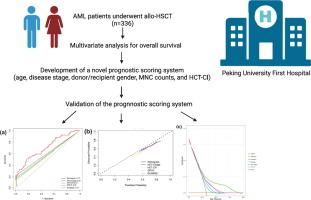
It was performed a retrospective analysis of 336 AML patients who underwent allo-HSCT at Peking University First Hospital between September 2003 and March 2023. Univariable and multivariable Cox regression analyses were conducted to determine hazard ratios (HR) for overall survival. A predictive model was developed based on multivariable analysis results. Internal validation was carried out through bootstrap resampling, and the model’s performance was assessed using the Concordance Index (C-index), Receiver Operating Characteristics (ROC) curve, calibration plots, and Decision Curve Analysis (DCA).
Results
Our prognostic model, which includes age, disease stage, donor/recipient gender, mononuclear cell counts, and the Hematopoietic Cell Transplantation Comorbidity Index (HCT-CI), effectively stratified patients into low-risk and high-risk groups. The two groups showed significant differences in overall survival (P<0.0001), disease-free survival (P<0.0001), non-relapse mortality (NRM) (P<0.0001), and relapse rates (P=0.08). The model achieved a C-index of 0.71. Calibration plots and DCA confirmed strong alignment between predicted and observed outcomes. Subgroup analysis revealed that overall survival was significantly lower in the high-risk group compared to the low-risk group in both measurable residual disease (MRD) negative and MRD positive subgroups (P=0.015 for both).
Conclusion
The developed prognostic model, which integrates comprehensive disease and patient characteristics, enhances risk stratification for AML patients undergoing allo-HSCT. This model effectively stratifies risk in both MRD-negative and MRD-positive subgroups and may facilitate more informed MRD-based treatment decisions.
期刊介绍:
Journal of Advanced Research (J. Adv. Res.) is an applied/natural sciences, peer-reviewed journal that focuses on interdisciplinary research. The journal aims to contribute to applied research and knowledge worldwide through the publication of original and high-quality research articles in the fields of Medicine, Pharmaceutical Sciences, Dentistry, Physical Therapy, Veterinary Medicine, and Basic and Biological Sciences.
The following abstracting and indexing services cover the Journal of Advanced Research: PubMed/Medline, Essential Science Indicators, Web of Science, Scopus, PubMed Central, PubMed, Science Citation Index Expanded, Directory of Open Access Journals (DOAJ), and INSPEC.




 京公网安备 11010802042870号
京ICP备2023020795号-1
京公网安备 11010802042870号
京ICP备2023020795号-1

 分享
分享
 求助内容:
求助内容: 应助结果提醒方式:
 扫码关注我们
