Yuting Wang, Nan Zhang, Weilong Shang, Huagang Peng, Zhen Hu, Yi Yang, Li Tan, Li Zhang, Fengtian He, Xiancai Rao
{"title":"Dexamethasone Inhibits the Growth of B-Lymphoma Cells by Downregulating DOT1L","authors":"Yuting Wang, Nan Zhang, Weilong Shang, Huagang Peng, Zhen Hu, Yi Yang, Li Tan, Li Zhang, Fengtian He, Xiancai Rao","doi":"10.1002/cnr2.2150","DOIUrl":null,"url":null,"abstract":"<div>\n \n \n <section>\n \n <h3> Background</h3>\n \n <p>Dexamethasone (Dex), a synthetic glucocorticoid that acts by binding to the glucocorticoid receptor (GR), has been widely applied to treat leukemia and lymphoma; however, the precise mechanism underlying Dex action is still not well elucidated. DOT1L, a histone H3-lysine79 (H3K79) methyltransferase, has been linked to multiple cancer types, particularly mixed lineage leukemia (MLL) gene rearranged leukemia, but its contribution to lymphoma is yet to be delineated. Analysis from the TCGA database displayed that DOT1L was highly expressed in lymphoma and leukemia.</p>\n </section>\n \n <section>\n \n <h3> Results</h3>\n \n <p>We initially demonstrated that DOT1L served as a new target gene controlled by GR, and the downregulation of DOT1L was critical for the killing of B-lymphoma cells by Dex. Further study revealed that Dex had no impact on the transcriptional activity of the DOT1L promoter, rather it reduced the mRNA level of DOT1L at the posttranscriptional level. In addition, knockdown of DOT1L remarkably inhibited the B-lymphoma cell growth.</p>\n </section>\n \n <section>\n \n <h3> Conclusions</h3>\n \n <p>Overall, our findings indicated that DOT1L may serve as a potential drug target and a promising biomarker of Dex sensitivity when it comes to treating B lymphoma.</p>\n </section>\n </div>","PeriodicalId":9440,"journal":{"name":"Cancer reports","volume":"7 9","pages":""},"PeriodicalIF":1.9000,"publicationDate":"2024-09-22","publicationTypes":"Journal Article","fieldsOfStudy":null,"isOpenAccess":false,"openAccessPdf":"https://onlinelibrary.wiley.com/doi/epdf/10.1002/cnr2.2150","citationCount":"0","resultStr":null,"platform":"Semanticscholar","paperid":null,"PeriodicalName":"Cancer reports","FirstCategoryId":"1085","ListUrlMain":"https://onlinelibrary.wiley.com/doi/10.1002/cnr2.2150","RegionNum":0,"RegionCategory":null,"ArticlePicture":[],"TitleCN":null,"AbstractTextCN":null,"PMCID":null,"EPubDate":"","PubModel":"","JCR":"Q4","JCRName":"ONCOLOGY","Score":null,"Total":0}
引用次数: 0
Abstract
Background
Dexamethasone (Dex), a synthetic glucocorticoid that acts by binding to the glucocorticoid receptor (GR), has been widely applied to treat leukemia and lymphoma; however, the precise mechanism underlying Dex action is still not well elucidated. DOT1L, a histone H3-lysine79 (H3K79) methyltransferase, has been linked to multiple cancer types, particularly mixed lineage leukemia (MLL) gene rearranged leukemia, but its contribution to lymphoma is yet to be delineated. Analysis from the TCGA database displayed that DOT1L was highly expressed in lymphoma and leukemia.
Results
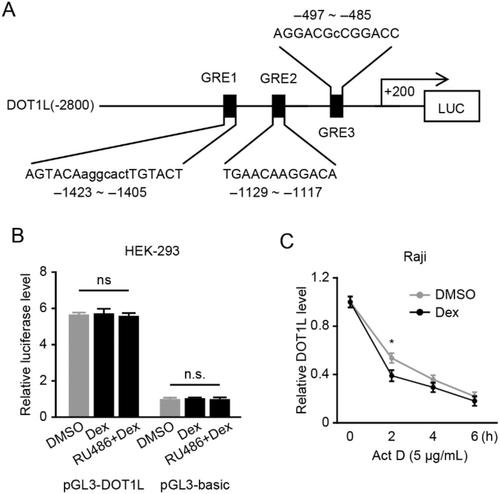
We initially demonstrated that DOT1L served as a new target gene controlled by GR, and the downregulation of DOT1L was critical for the killing of B-lymphoma cells by Dex. Further study revealed that Dex had no impact on the transcriptional activity of the DOT1L promoter, rather it reduced the mRNA level of DOT1L at the posttranscriptional level. In addition, knockdown of DOT1L remarkably inhibited the B-lymphoma cell growth.
Conclusions
Overall, our findings indicated that DOT1L may serve as a potential drug target and a promising biomarker of Dex sensitivity when it comes to treating B lymphoma.




 京公网安备 11010802042870号
京ICP备2023020795号-1
京公网安备 11010802042870号
京ICP备2023020795号-1

 分享
分享
 求助内容:
求助内容: 应助结果提醒方式:
 扫码关注我们
