Wei Huang , Kangqiao Wen , Scott T. Laughlin , Jorge Escorihuela
{"title":"Unveiling the reactivity of 2H-(thio)pyran-2-(thi)ones in cycloaddition reactions with strained alkynes through density functional theory studies†","authors":"Wei Huang , Kangqiao Wen , Scott T. Laughlin , Jorge Escorihuela","doi":"10.1039/d4ob01263a","DOIUrl":null,"url":null,"abstract":"<div><div>Over the past two decades, click chemistry transformations have revolutionized chemical and biological sciences. Among the different strain-promoted cycloadditions, the inverse electron demand Diels–Alder reaction (IEDDA) has been established as a benchmark reaction. We have theoretically investigated the IEDDA reaction of <em>endo</em>-bicyclo[6.1.0]nonyne (<em>endo</em>-BCN) with 2<em>H</em>-pyran-2-one, 2<em>H</em>-thiopyran-2-one, 2<em>H</em>-pyran-2-thione and 2<em>H</em>-thiopyran-2-thione. These 2<em>H</em>-(thio)pyran-2-(thi)ones have displayed different reactivity towards <em>endo</em>-BCN. Density functional theory (DFT) calculations show, in agreement with experiments, that <em>endo</em>-BCN reacts significantly faster with 2<em>H</em>-thiopyran-2-one compared to other 2<em>H</em>-(thio)pyran-2-(thi)one derivatives because of the lower distortion energy. Experimentally determined second-order rate constants for the reaction of a 2<em>H</em>-pyran-2-thione with different strained derivatives, including a 1-methylcyclopropene derivative and several cycloalkynes (<em>exo</em>-BCN, (1<em>R</em>,8<em>S</em>)-bicyclo[6.1.0]non-4-yne-9,9-diyl)dimethanol, dibenzocycylooctyne and a light activatable silacycloheptyne, were used to validate the computational investigations and shed light on this reaction.</div></div>","PeriodicalId":96,"journal":{"name":"Organic & Biomolecular Chemistry","volume":"22 41","pages":"Pages 8285-8292"},"PeriodicalIF":2.7000,"publicationDate":"2024-09-16","publicationTypes":"Journal Article","fieldsOfStudy":null,"isOpenAccess":false,"openAccessPdf":"","citationCount":"0","resultStr":null,"platform":"Semanticscholar","paperid":null,"PeriodicalName":"Organic & Biomolecular Chemistry","FirstCategoryId":"92","ListUrlMain":"https://www.sciencedirect.com/org/science/article/pii/S1477052024008395","RegionNum":3,"RegionCategory":"化学","ArticlePicture":[],"TitleCN":null,"AbstractTextCN":null,"PMCID":null,"EPubDate":"","PubModel":"","JCR":"Q1","JCRName":"CHEMISTRY, ORGANIC","Score":null,"Total":0}
引用次数: 0
Abstract
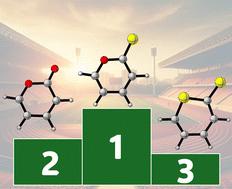
Over the past two decades, click chemistry transformations have revolutionized chemical and biological sciences. Among the different strain-promoted cycloadditions, the inverse electron demand Diels–Alder reaction (IEDDA) has been established as a benchmark reaction. We have theoretically investigated the IEDDA reaction of endo-bicyclo[6.1.0]nonyne (endo-BCN) with 2H-pyran-2-one, 2H-thiopyran-2-one, 2H-pyran-2-thione and 2H-thiopyran-2-thione. These 2H-(thio)pyran-2-(thi)ones have displayed different reactivity towards endo-BCN. Density functional theory (DFT) calculations show, in agreement with experiments, that endo-BCN reacts significantly faster with 2H-thiopyran-2-one compared to other 2H-(thio)pyran-2-(thi)one derivatives because of the lower distortion energy. Experimentally determined second-order rate constants for the reaction of a 2H-pyran-2-thione with different strained derivatives, including a 1-methylcyclopropene derivative and several cycloalkynes (exo-BCN, (1R,8S)-bicyclo[6.1.0]non-4-yne-9,9-diyl)dimethanol, dibenzocycylooctyne and a light activatable silacycloheptyne, were used to validate the computational investigations and shed light on this reaction.
期刊介绍:
Organic & Biomolecular Chemistry is an international journal using integrated research in chemistry-organic chemistry. Founded in 2003 by the Royal Society of Chemistry, the journal is published in Semimonthly issues and has been indexed by SCIE, a leading international database. The journal focuses on the key research and cutting-edge progress in the field of chemistry-organic chemistry, publishes and reports the research results in this field in a timely manner, and is committed to becoming a window and platform for rapid academic exchanges among peers in this field. The journal's impact factor in 2023 is 2.9, and its CiteScore is 5.5.



 京公网安备 11010802042870号
京ICP备2023020795号-1
京公网安备 11010802042870号
京ICP备2023020795号-1

 分享
分享
 求助内容:
求助内容: 应助结果提醒方式:
 扫码关注我们
