Atikur Hassan, Rishabh Kumar Pandey, Arnab Chakraborty, Sk Abdul Wahed, T. Rajagopala Rao and Neeladri Das
{"title":"Green synthesis of an ionic porous organic polymer for efficient capture of environmentally toxic MnO4− and I3− from water†","authors":"Atikur Hassan, Rishabh Kumar Pandey, Arnab Chakraborty, Sk Abdul Wahed, T. Rajagopala Rao and Neeladri Das","doi":"10.1039/D4SM00679H","DOIUrl":null,"url":null,"abstract":"<p >The syntheses of ionic porous organic polymers (iPOPs) <em>via</em> an ionothermal strategy or using solvents with high boiling points are not environmentally friendly approaches. Furthermore, green synthesis of an ionic porous organic polymer has not been reported to date. The azo-coupling reaction is considered a green synthetic strategy and has been used to obtain a new ionic porous organic polymer (iPOP-6) wherein water is used as a solvent. iPOP-6 turns out to be a useful adsorbent that can scavenge toxic water pollutants (MnO<small><sub>4</sub></small><small><sup>−</sup></small> and I<small><sub>3</sub></small><small><sup>−</sup></small>) in an energy efficient manner <em>via</em> an ion exchange based adsorption process. The distribution coefficients (<em>K</em><small><sub>d</sub></small>) associated with the removal of MnO<small><sub>4</sub></small><small><sup>−</sup></small> and I<small><sub>3</sub></small><small><sup>−</sup></small> are greater than 10<small><sup>5</sup></small> mL g<small><sup>−1</sup></small> – a desirable feature observed in a superior adsorbent. iPOP-6 can remove such pollutants from water samples collected from different water bodies with good capture efficiency. The removal mechanism was also ratified by theoretical studies. Overall, this work presents a new ionic POP with improved features and performance for water purification applications.</p>","PeriodicalId":103,"journal":{"name":"Soft Matter","volume":" 39","pages":" 7832-7842"},"PeriodicalIF":2.8000,"publicationDate":"2024-09-04","publicationTypes":"Journal Article","fieldsOfStudy":null,"isOpenAccess":false,"openAccessPdf":"","citationCount":"0","resultStr":null,"platform":"Semanticscholar","paperid":null,"PeriodicalName":"Soft Matter","FirstCategoryId":"92","ListUrlMain":"https://pubs.rsc.org/en/content/articlelanding/2024/sm/d4sm00679h","RegionNum":3,"RegionCategory":"化学","ArticlePicture":[],"TitleCN":null,"AbstractTextCN":null,"PMCID":null,"EPubDate":"","PubModel":"","JCR":"Q3","JCRName":"CHEMISTRY, PHYSICAL","Score":null,"Total":0}
引用次数: 0
Abstract
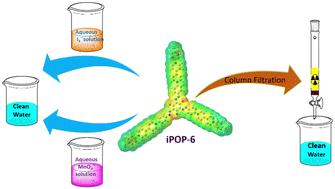
The syntheses of ionic porous organic polymers (iPOPs) via an ionothermal strategy or using solvents with high boiling points are not environmentally friendly approaches. Furthermore, green synthesis of an ionic porous organic polymer has not been reported to date. The azo-coupling reaction is considered a green synthetic strategy and has been used to obtain a new ionic porous organic polymer (iPOP-6) wherein water is used as a solvent. iPOP-6 turns out to be a useful adsorbent that can scavenge toxic water pollutants (MnO4− and I3−) in an energy efficient manner via an ion exchange based adsorption process. The distribution coefficients (Kd) associated with the removal of MnO4− and I3− are greater than 105 mL g−1 – a desirable feature observed in a superior adsorbent. iPOP-6 can remove such pollutants from water samples collected from different water bodies with good capture efficiency. The removal mechanism was also ratified by theoretical studies. Overall, this work presents a new ionic POP with improved features and performance for water purification applications.
期刊介绍:
Soft Matter is an international journal published by the Royal Society of Chemistry using Engineering-Materials Science: A Synthesis as its research focus. It publishes original research articles, review articles, and synthesis articles related to this field, reporting the latest discoveries in the relevant theoretical, practical, and applied disciplines in a timely manner, and aims to promote the rapid exchange of scientific information in this subject area. The journal is an open access journal. The journal is an open access journal and has not been placed on the alert list in the last three years.




 京公网安备 11010802042870号
京ICP备2023020795号-1
京公网安备 11010802042870号
京ICP备2023020795号-1

 分享
分享
 求助内容:
求助内容: 应助结果提醒方式:
 扫码关注我们
