Yue Zhang, Yuxi Li, Dongling Zhong, Huijing Li, Xiaobo Liu, Wenjing Tang, Yuan Chen, Dongchuan Pan, Rongjiang Jin, Juan Li
{"title":"Clinical practice guidelines and expert consensus statements on rehabilitation for patients with COVID-19: a systematic review.","authors":"Yue Zhang, Yuxi Li, Dongling Zhong, Huijing Li, Xiaobo Liu, Wenjing Tang, Yuan Chen, Dongchuan Pan, Rongjiang Jin, Juan Li","doi":"10.1136/bmjopen-2024-086301","DOIUrl":null,"url":null,"abstract":"<p><strong>Objectives: </strong>To appraise the quality of clinical practice guidelines (CPGs) and expert consensus statements on rehabilitation for patients with COVID-19, summarise recommendations of rehabilitation assessments and interventions and evaluate the heterogeneity of the recommendations.</p><p><strong>Design: </strong>Systematic review.</p><p><strong>Data sources: </strong>PubMed and Embase databases and five online guideline repositories: The National Guideline Clearinghouse, Guidelines International Network, Scottish Intercollegiate Guidelines Network, National Institute for Health and Clinical Excellence and WHO were searched from their inception to August 2024. In addition, we reviewed reference lists of eligible citations and searched the grey literature on the relevant websites.</p><p><strong>Eligibility criteria for selecting studies: </strong>We included CPGs and expert consensus statements which provided information about rehabilitation of patients with COVID-19. To be eligible, the CPGs and expert consensus statements were issued in English by a nationally or internationally recognised government authority, medical/academic society or organisation. If there were multiple versions of the guidelines, we included the latest one. The translations, interpretations and abstracts of guidelines were excluded.</p><p><strong>Data extraction and synthesis: </strong>All recommendations on rehabilitation assessments and interventions for COVID-19 were extracted and summarised. Two reviewers independently evaluated the methodological quality with the Appraisal of Guidelines for Research and Evaluation (AGREE) II instrument, and two other reviewers assessed the reporting quality using the Reporting Items for Practice Guidelines in Healthcare (RIGHT) statement of included CPGs and expert consensus statements. We used the Measurement Scale of Rate of Agreement to evaluate the heterogeneity of the recommendations in different CPGs and expert consensus statements.</p><p><strong>Results: </strong>A total of 31 CPGs and expert consensus statements were included. 14 guidelines provided recommendations for rehabilitation assessments. At the early, development, critical and recovery stages of COVID-19, the most frequently recommended were exercise therapy (25.8%, 35.5%, 25.8% and 58.1%, respectively). According to AGREE II, 17 included guidelines were assessed as low methodological quality (35%-56%), 10 guidelines were rated as moderate quality (46%- 62%) and four had high quality (69%-79%). Among 31 eligible guidelines, the reporting rate of 22 items in the RIGHT checklist ranged from 10% to 100%. The included guidelines were consistent with the reference guidelines (80%-100%). Only one guideline existed minor (60%-80%) disagreements in respiratory muscle training relative to the reference guideline.</p><p><strong>Conclusions: </strong>Rehabilitation assessments and interventions should be implemented consistently throughout the entire process of COVID-19. The recommendations should be tailored to each stage of COVID-19. The methodological and reporting qualities of several guidelines remain suboptimal. Therefore, developers should adhere strictly to the AGREE II standard and RIGHT checklist to formulate and publish CPGs and expert consensus statements with high quality.</p><p><strong>Prospero registration number: </strong>CRD42020190761.</p>","PeriodicalId":9158,"journal":{"name":"BMJ Open","volume":"14 9","pages":"e086301"},"PeriodicalIF":2.3000,"publicationDate":"2024-09-10","publicationTypes":"Journal Article","fieldsOfStudy":null,"isOpenAccess":false,"openAccessPdf":"https://www.ncbi.nlm.nih.gov/pmc/articles/PMC11409320/pdf/","citationCount":"0","resultStr":null,"platform":"Semanticscholar","paperid":null,"PeriodicalName":"BMJ Open","FirstCategoryId":"3","ListUrlMain":"https://doi.org/10.1136/bmjopen-2024-086301","RegionNum":3,"RegionCategory":"医学","ArticlePicture":[],"TitleCN":null,"AbstractTextCN":null,"PMCID":null,"EPubDate":"","PubModel":"","JCR":"Q1","JCRName":"MEDICINE, GENERAL & INTERNAL","Score":null,"Total":0}
引用次数: 0
Abstract
Objectives: To appraise the quality of clinical practice guidelines (CPGs) and expert consensus statements on rehabilitation for patients with COVID-19, summarise recommendations of rehabilitation assessments and interventions and evaluate the heterogeneity of the recommendations.
Design: Systematic review.
Data sources: PubMed and Embase databases and five online guideline repositories: The National Guideline Clearinghouse, Guidelines International Network, Scottish Intercollegiate Guidelines Network, National Institute for Health and Clinical Excellence and WHO were searched from their inception to August 2024. In addition, we reviewed reference lists of eligible citations and searched the grey literature on the relevant websites.
Eligibility criteria for selecting studies: We included CPGs and expert consensus statements which provided information about rehabilitation of patients with COVID-19. To be eligible, the CPGs and expert consensus statements were issued in English by a nationally or internationally recognised government authority, medical/academic society or organisation. If there were multiple versions of the guidelines, we included the latest one. The translations, interpretations and abstracts of guidelines were excluded.
Data extraction and synthesis: All recommendations on rehabilitation assessments and interventions for COVID-19 were extracted and summarised. Two reviewers independently evaluated the methodological quality with the Appraisal of Guidelines for Research and Evaluation (AGREE) II instrument, and two other reviewers assessed the reporting quality using the Reporting Items for Practice Guidelines in Healthcare (RIGHT) statement of included CPGs and expert consensus statements. We used the Measurement Scale of Rate of Agreement to evaluate the heterogeneity of the recommendations in different CPGs and expert consensus statements.
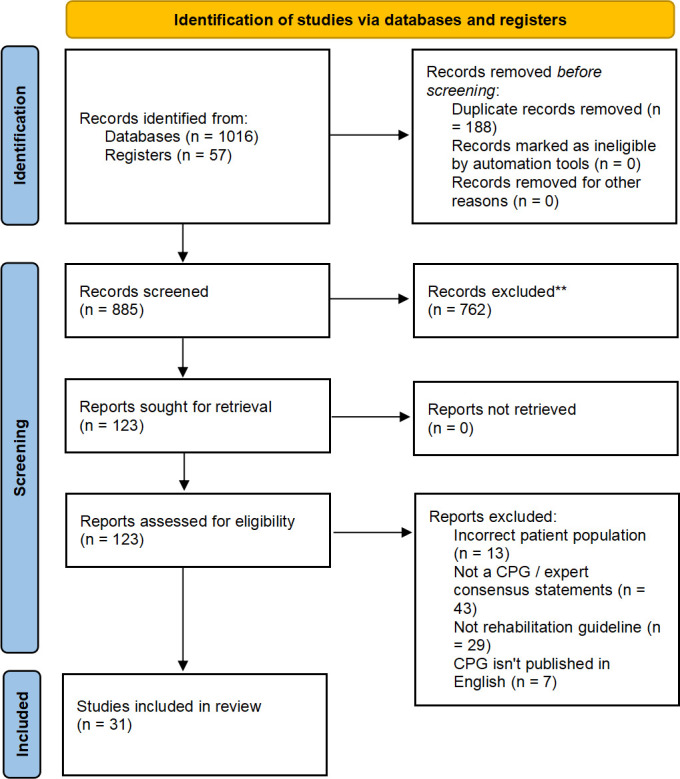
Results: A total of 31 CPGs and expert consensus statements were included. 14 guidelines provided recommendations for rehabilitation assessments. At the early, development, critical and recovery stages of COVID-19, the most frequently recommended were exercise therapy (25.8%, 35.5%, 25.8% and 58.1%, respectively). According to AGREE II, 17 included guidelines were assessed as low methodological quality (35%-56%), 10 guidelines were rated as moderate quality (46%- 62%) and four had high quality (69%-79%). Among 31 eligible guidelines, the reporting rate of 22 items in the RIGHT checklist ranged from 10% to 100%. The included guidelines were consistent with the reference guidelines (80%-100%). Only one guideline existed minor (60%-80%) disagreements in respiratory muscle training relative to the reference guideline.
Conclusions: Rehabilitation assessments and interventions should be implemented consistently throughout the entire process of COVID-19. The recommendations should be tailored to each stage of COVID-19. The methodological and reporting qualities of several guidelines remain suboptimal. Therefore, developers should adhere strictly to the AGREE II standard and RIGHT checklist to formulate and publish CPGs and expert consensus statements with high quality.
期刊介绍:
BMJ Open is an online, open access journal, dedicated to publishing medical research from all disciplines and therapeutic areas. The journal publishes all research study types, from study protocols to phase I trials to meta-analyses, including small or specialist studies. Publishing procedures are built around fully open peer review and continuous publication, publishing research online as soon as the article is ready.



 京公网安备 11010802042870号
京ICP备2023020795号-1
京公网安备 11010802042870号
京ICP备2023020795号-1

 分享
分享
 求助内容:
求助内容: 应助结果提醒方式:
 扫码关注我们
