{"title":"Interactions of contact force, impedance, and power during repeated atrial arrhythmia ablation after previous atrial fibrillation ablation","authors":"Fares-Alexander Alken MD , Katharina Scherschel PhD , Ernan Zhu MD , Bahram Wafaisade MD , Ann-Kathrin Kahle MD , Christian Meyer MD, MA, FESC, FEHRA, FHRS","doi":"10.1016/j.hrthm.2024.09.026","DOIUrl":null,"url":null,"abstract":"<div><h3>Background</h3><div>Acutely effective repeated radiofrequency catheter ablation (RFCA) after previous atrial fibrillation ablation depends on several parameters including local impedance (LI), contact force (CF), and power.</div></div><div><h3>Objective</h3><div>We aimed to investigate the relationship of LI, CF, and power to the LI drop in a repeated atrial RFCA environment.</div></div><div><h3>Methods</h3><div>Consecutive patients undergoing repeated atrial RFCA were studied. High-quality local electrograms were analyzed for morphology changes indicating effective RFCA and associated LI dynamics. The influence of baseline LI, mean CF, and power on the LI drop was analyzed. Investigated power levels included ≤25 W, 30 W, and ≥40 W.</div></div><div><h3>Results</h3><div>A total of 1390 RFCA points from 48 patients (48% female; median age, 70 years) were analyzed. Of 309 analyzed electrograms, 40.5% showed effective RFCA morphology changes with an elevated median LI drop (effective, 19.7 Ω; partially effective, 14.1 Ω; <em>P</em> < .001). CF showed the highest correlation to the LI drop within high baseline LI and when applying ≥40 W (low baseline LI, <em>R</em> = 0.39; intermediate, <em>R</em> = 0.66; high, <em>R</em> = 0.72). Within low baseline LI regions, CF levels showed a lower correlation to the LI drop (≤25 W, <em>R</em> = 0.30; 30 W, <em>R</em> = 0.35; ≥40 W, <em>R</em> = 0.39). A mean CF ≥10 g resulted in elevated LI drops with higher power compared with lower power within all baseline LI tertiles (<em>P</em> < .001 each).</div></div><div><h3>Conclusion</h3><div>Within high baseline LI regions, CF plays a greater role for the maximum LI drop when higher power is chosen. A mean CF ≥10 g ensures elevated LI drops with increasing power levels.</div></div>","PeriodicalId":12886,"journal":{"name":"Heart rhythm","volume":"22 6","pages":"Pages 1411-1420"},"PeriodicalIF":5.7000,"publicationDate":"2025-06-01","publicationTypes":"Journal Article","fieldsOfStudy":null,"isOpenAccess":false,"openAccessPdf":"","citationCount":"0","resultStr":null,"platform":"Semanticscholar","paperid":null,"PeriodicalName":"Heart rhythm","FirstCategoryId":"3","ListUrlMain":"https://www.sciencedirect.com/science/article/pii/S154752712403323X","RegionNum":2,"RegionCategory":"医学","ArticlePicture":[],"TitleCN":null,"AbstractTextCN":null,"PMCID":null,"EPubDate":"","PubModel":"","JCR":"Q1","JCRName":"CARDIAC & CARDIOVASCULAR SYSTEMS","Score":null,"Total":0}
引用次数: 0
Abstract
Background
Acutely effective repeated radiofrequency catheter ablation (RFCA) after previous atrial fibrillation ablation depends on several parameters including local impedance (LI), contact force (CF), and power.
Objective
We aimed to investigate the relationship of LI, CF, and power to the LI drop in a repeated atrial RFCA environment.
Methods
Consecutive patients undergoing repeated atrial RFCA were studied. High-quality local electrograms were analyzed for morphology changes indicating effective RFCA and associated LI dynamics. The influence of baseline LI, mean CF, and power on the LI drop was analyzed. Investigated power levels included ≤25 W, 30 W, and ≥40 W.
Results
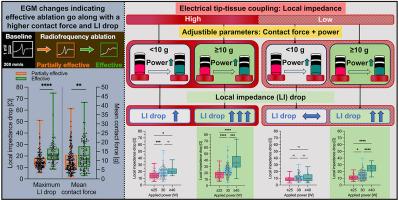
A total of 1390 RFCA points from 48 patients (48% female; median age, 70 years) were analyzed. Of 309 analyzed electrograms, 40.5% showed effective RFCA morphology changes with an elevated median LI drop (effective, 19.7 Ω; partially effective, 14.1 Ω; P < .001). CF showed the highest correlation to the LI drop within high baseline LI and when applying ≥40 W (low baseline LI, R = 0.39; intermediate, R = 0.66; high, R = 0.72). Within low baseline LI regions, CF levels showed a lower correlation to the LI drop (≤25 W, R = 0.30; 30 W, R = 0.35; ≥40 W, R = 0.39). A mean CF ≥10 g resulted in elevated LI drops with higher power compared with lower power within all baseline LI tertiles (P < .001 each).
Conclusion
Within high baseline LI regions, CF plays a greater role for the maximum LI drop when higher power is chosen. A mean CF ≥10 g ensures elevated LI drops with increasing power levels.
期刊介绍:
HeartRhythm, the official Journal of the Heart Rhythm Society and the Cardiac Electrophysiology Society, is a unique journal for fundamental discovery and clinical applicability.
HeartRhythm integrates the entire cardiac electrophysiology (EP) community from basic and clinical academic researchers, private practitioners, engineers, allied professionals, industry, and trainees, all of whom are vital and interdependent members of our EP community.
The Heart Rhythm Society is the international leader in science, education, and advocacy for cardiac arrhythmia professionals and patients, and the primary information resource on heart rhythm disorders. Its mission is to improve the care of patients by promoting research, education, and optimal health care policies and standards.



 京公网安备 11010802042870号
京ICP备2023020795号-1
京公网安备 11010802042870号
京ICP备2023020795号-1

 分享
分享
 求助内容:
求助内容: 应助结果提醒方式:
 扫码关注我们
