Haran Yogasundaram MD , Muralidhar Reddy Papireddy MD , Saman Nazarian MD, PhD, FHRS , Gustavo S. Guandalini MD , Timothy M. Markman MD , Robert D. Schaller DO, FHRS , Michael P. Riley MD, PhD , David Lin MD, FHRS , Sanjay Dixit MD, FHRS , Benjamin D’Souza MD, FHRS , Ramanan Kumareswaran MD , David J. Callans MD, FHRS, CCDS , David S. Frankel MD, FHRS , Fermin C. Garcia MD , Erica Zado PAC, FHRS , Rajat Deo MD , Andrew E. Epstein MD, FHRS , Gregory E. Supple MD , Francis E. Marchlinski MD, FHRS , Matthew C. Hyman MD, PhD
{"title":"Long-term risk of right coronary artery injury after catheter ablation of cavotricuspid isthmus–dependent flutter","authors":"Haran Yogasundaram MD , Muralidhar Reddy Papireddy MD , Saman Nazarian MD, PhD, FHRS , Gustavo S. Guandalini MD , Timothy M. Markman MD , Robert D. Schaller DO, FHRS , Michael P. Riley MD, PhD , David Lin MD, FHRS , Sanjay Dixit MD, FHRS , Benjamin D’Souza MD, FHRS , Ramanan Kumareswaran MD , David J. Callans MD, FHRS, CCDS , David S. Frankel MD, FHRS , Fermin C. Garcia MD , Erica Zado PAC, FHRS , Rajat Deo MD , Andrew E. Epstein MD, FHRS , Gregory E. Supple MD , Francis E. Marchlinski MD, FHRS , Matthew C. Hyman MD, PhD","doi":"10.1016/j.hrthm.2024.09.029","DOIUrl":null,"url":null,"abstract":"<div><h3>Background</h3><div>Radiofrequency ablation (RFA) of cavotricuspid isthmus (CTI)–dependent atrial flutter requires ablation of the tricuspid annulus overlying the right coronary artery (RCA). Although it is considered safe, reports of acute and subacute RCA injury in human and animal studies raise the possibility of late RCA stenosis.</div></div><div><h3>Objective</h3><div>The objective of this study was to compare the incidence and severity of angiographic RCA stenoses in patients who have undergone CTI RFA with a control group to assess the long-term risk of RCA damage.</div></div><div><h3>Methods</h3><div>A 2-center retrospective case-cohort study was performed including all patients from 2002 to 2018 undergoing atrial fibrillation (AF) with CTI ablation (CTI + AF) or AF ablation alone with subsequent coronary angiography (CAG). The AF alone group served as controls because of anticipated similarity of baseline characteristics. Coronary arteries that are anatomically remote to the CTI were examined as prespecified falsification end points. CAG was scored by a blinded observer.</div></div><div><h3>Results</h3><div>There were 156 patients who underwent pulmonary vein isolation with subsequent CAG (CTI + AF, n = 81; AF alone, n = 75) with no difference in baseline characteristics including age, sex, comorbidities, and medications. Mean time from ablation to CAG was similar (CTI + AF, 5.0 ± 3.7 years; AF alone, 5.4 ± 3.9 years; <em>P</em> = .5). The mid and distal RCA showed no difference in the average number of angiographic stenoses or lesion severity. In regression analysis, CTI ablation was not a predictor of RCA stenosis severity (<em>P</em> = .6). There was no difference in coronary disease at sites remote to the CTI ablation (<em>P</em> = NS for all).</div></div><div><h3>Conclusion</h3><div>There was no observed relationship between CTI RFA and the number or severity of angiographically apparent RCA stenoses in long-term follow-up.</div></div>","PeriodicalId":12886,"journal":{"name":"Heart rhythm","volume":"22 7","pages":"Pages 1675-1681"},"PeriodicalIF":5.7000,"publicationDate":"2025-07-01","publicationTypes":"Journal Article","fieldsOfStudy":null,"isOpenAccess":false,"openAccessPdf":"","citationCount":"0","resultStr":null,"platform":"Semanticscholar","paperid":null,"PeriodicalName":"Heart rhythm","FirstCategoryId":"3","ListUrlMain":"https://www.sciencedirect.com/science/article/pii/S1547527124033290","RegionNum":2,"RegionCategory":"医学","ArticlePicture":[],"TitleCN":null,"AbstractTextCN":null,"PMCID":null,"EPubDate":"","PubModel":"","JCR":"Q1","JCRName":"CARDIAC & CARDIOVASCULAR SYSTEMS","Score":null,"Total":0}
引用次数: 0
Abstract
Background
Radiofrequency ablation (RFA) of cavotricuspid isthmus (CTI)–dependent atrial flutter requires ablation of the tricuspid annulus overlying the right coronary artery (RCA). Although it is considered safe, reports of acute and subacute RCA injury in human and animal studies raise the possibility of late RCA stenosis.
Objective
The objective of this study was to compare the incidence and severity of angiographic RCA stenoses in patients who have undergone CTI RFA with a control group to assess the long-term risk of RCA damage.
Methods
A 2-center retrospective case-cohort study was performed including all patients from 2002 to 2018 undergoing atrial fibrillation (AF) with CTI ablation (CTI + AF) or AF ablation alone with subsequent coronary angiography (CAG). The AF alone group served as controls because of anticipated similarity of baseline characteristics. Coronary arteries that are anatomically remote to the CTI were examined as prespecified falsification end points. CAG was scored by a blinded observer.
Results
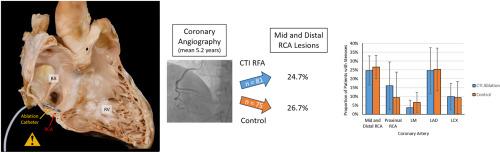
There were 156 patients who underwent pulmonary vein isolation with subsequent CAG (CTI + AF, n = 81; AF alone, n = 75) with no difference in baseline characteristics including age, sex, comorbidities, and medications. Mean time from ablation to CAG was similar (CTI + AF, 5.0 ± 3.7 years; AF alone, 5.4 ± 3.9 years; P = .5). The mid and distal RCA showed no difference in the average number of angiographic stenoses or lesion severity. In regression analysis, CTI ablation was not a predictor of RCA stenosis severity (P = .6). There was no difference in coronary disease at sites remote to the CTI ablation (P = NS for all).
Conclusion
There was no observed relationship between CTI RFA and the number or severity of angiographically apparent RCA stenoses in long-term follow-up.
期刊介绍:
HeartRhythm, the official Journal of the Heart Rhythm Society and the Cardiac Electrophysiology Society, is a unique journal for fundamental discovery and clinical applicability.
HeartRhythm integrates the entire cardiac electrophysiology (EP) community from basic and clinical academic researchers, private practitioners, engineers, allied professionals, industry, and trainees, all of whom are vital and interdependent members of our EP community.
The Heart Rhythm Society is the international leader in science, education, and advocacy for cardiac arrhythmia professionals and patients, and the primary information resource on heart rhythm disorders. Its mission is to improve the care of patients by promoting research, education, and optimal health care policies and standards.



 京公网安备 11010802042870号
京ICP备2023020795号-1
京公网安备 11010802042870号
京ICP备2023020795号-1

 分享
分享
 求助内容:
求助内容: 应助结果提醒方式:
 扫码关注我们
