Roger Y Kim, Clarisa Yee, Sana Zeb, Jennifer Steltz, Andrew J Vickers, Katharine A Rendle, Nandita Mitra, Lyndsey C Pickup, David M DiBardino, Anil Vachani
{"title":"Clinical utility of an artificial intelligence radiomics-based tool for risk stratification of pulmonary nodules.","authors":"Roger Y Kim, Clarisa Yee, Sana Zeb, Jennifer Steltz, Andrew J Vickers, Katharine A Rendle, Nandita Mitra, Lyndsey C Pickup, David M DiBardino, Anil Vachani","doi":"10.1093/jncics/pkae086","DOIUrl":null,"url":null,"abstract":"<p><strong>Background: </strong>Clinical utility data on pulmonary nodule (PN) risk stratification biomarkers are lacking. We aimed to determine the incremental predictive value and clinical utility of using an artificial intelligence (AI) radiomics-based computer-aided diagnosis (CAD) tool in addition to routine clinical information to risk stratify PNs among real-world patients.</p><p><strong>Methods: </strong>We performed a retrospective cohort study of patients with PNs who underwent lung biopsy. We collected clinical data and used a commercially available AI radiomics-based CAD tool to calculate a Lung Cancer Prediction (LCP) score. We developed logistic regression models to evaluate a well-validated clinical risk prediction model (the Mayo Clinic model) with and without the LCP score (Mayo vs Mayo + LCP) using area under the curve (AUC), risk stratification table, and standardized net benefit analyses.</p><p><strong>Results: </strong>Among the 134 patients undergoing PN biopsy, cancer prevalence was 61%. Addition of the radiomics-based LCP score to the Mayo model was associated with increased predictive accuracy (likelihood ratio test, P = .012). The AUCs for the Mayo and Mayo + LCP models were 0.58 (95% CI = 0.48 to 0.69) and 0.65 (95% CI = 0.56 to 0.75), respectively. At the 65% risk threshold, the Mayo + LCP model was associated with increased sensitivity (56% vs 38%; P = .019), similar false positive rate (33% vs 35%; P = .8), and increased standardized net benefit (18% vs -3.3%) compared with the Mayo model.</p><p><strong>Conclusions: </strong>Use of a commercially available AI radiomics-based CAD tool as a supplement to clinical information improved PN cancer risk prediction and may result in clinically meaningful changes in risk stratification.</p>","PeriodicalId":14681,"journal":{"name":"JNCI Cancer Spectrum","volume":" ","pages":""},"PeriodicalIF":4.1000,"publicationDate":"2024-09-02","publicationTypes":"Journal Article","fieldsOfStudy":null,"isOpenAccess":false,"openAccessPdf":"https://www.ncbi.nlm.nih.gov/pmc/articles/PMC11521375/pdf/","citationCount":"0","resultStr":null,"platform":"Semanticscholar","paperid":null,"PeriodicalName":"JNCI Cancer Spectrum","FirstCategoryId":"1085","ListUrlMain":"https://doi.org/10.1093/jncics/pkae086","RegionNum":0,"RegionCategory":null,"ArticlePicture":[],"TitleCN":null,"AbstractTextCN":null,"PMCID":null,"EPubDate":"","PubModel":"","JCR":"Q2","JCRName":"ONCOLOGY","Score":null,"Total":0}
引用次数: 0
Abstract
Background: Clinical utility data on pulmonary nodule (PN) risk stratification biomarkers are lacking. We aimed to determine the incremental predictive value and clinical utility of using an artificial intelligence (AI) radiomics-based computer-aided diagnosis (CAD) tool in addition to routine clinical information to risk stratify PNs among real-world patients.
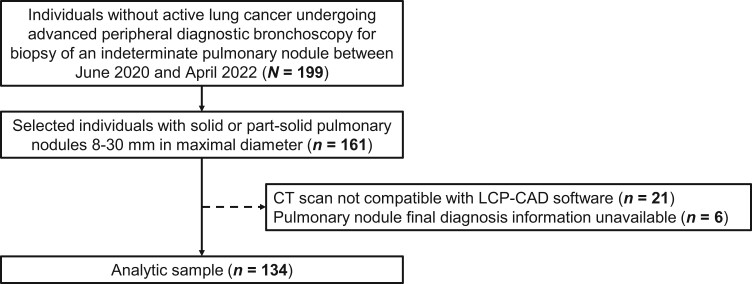
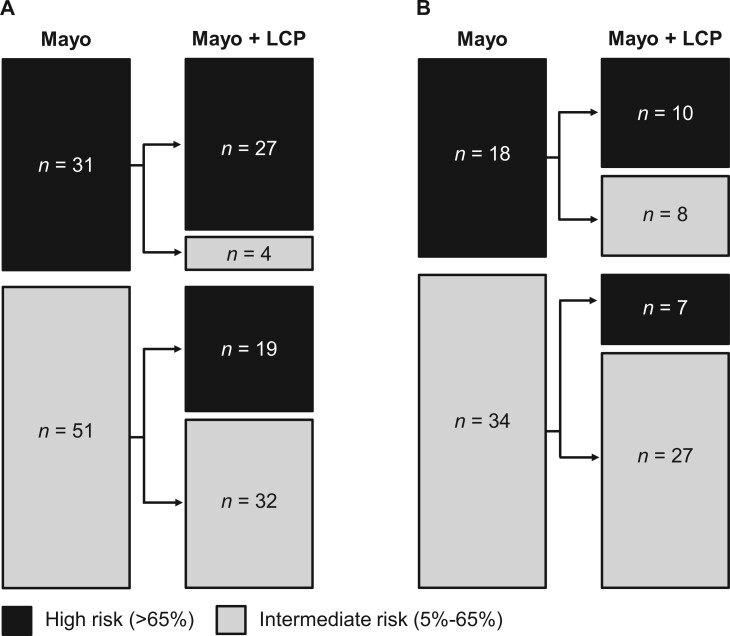
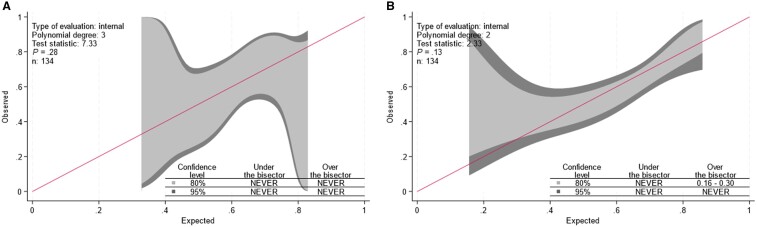
Methods: We performed a retrospective cohort study of patients with PNs who underwent lung biopsy. We collected clinical data and used a commercially available AI radiomics-based CAD tool to calculate a Lung Cancer Prediction (LCP) score. We developed logistic regression models to evaluate a well-validated clinical risk prediction model (the Mayo Clinic model) with and without the LCP score (Mayo vs Mayo + LCP) using area under the curve (AUC), risk stratification table, and standardized net benefit analyses.
Results: Among the 134 patients undergoing PN biopsy, cancer prevalence was 61%. Addition of the radiomics-based LCP score to the Mayo model was associated with increased predictive accuracy (likelihood ratio test, P = .012). The AUCs for the Mayo and Mayo + LCP models were 0.58 (95% CI = 0.48 to 0.69) and 0.65 (95% CI = 0.56 to 0.75), respectively. At the 65% risk threshold, the Mayo + LCP model was associated with increased sensitivity (56% vs 38%; P = .019), similar false positive rate (33% vs 35%; P = .8), and increased standardized net benefit (18% vs -3.3%) compared with the Mayo model.
Conclusions: Use of a commercially available AI radiomics-based CAD tool as a supplement to clinical information improved PN cancer risk prediction and may result in clinically meaningful changes in risk stratification.




 京公网安备 11010802042870号
京ICP备2023020795号-1
京公网安备 11010802042870号
京ICP备2023020795号-1

 分享
分享
 求助内容:
求助内容: 应助结果提醒方式:
 扫码关注我们
