Shuai Shao, Dan Tian, Mingyang Li, Shanshan Wu, Dong Zhang
{"title":"Survival prediction in sigmoid colon cancer patients with liver metastasis: a prospective cohort study.","authors":"Shuai Shao, Dan Tian, Mingyang Li, Shanshan Wu, Dong Zhang","doi":"10.1093/jncics/pkae080","DOIUrl":null,"url":null,"abstract":"<p><strong>Background: </strong>Sigmoid colon cancer is a common type of colorectal cancer, frequently leading to liver metastasis. Predicting cause-specific survival and overall survival in patients with sigmoid colon cancer metastasis to liver is challenging because of the lack of suitable models.</p><p><strong>Methods: </strong>Patients with sigmoid colon cancer metastasis to liver (2010-2017) in the Surveillance, Epidemiology, and End Results (SEER) Program were recruited. Patients were split into training and validation groups (7:3). Prognostic factors were identified using competing risk and Cox proportional hazards models, and nomograms for cause-specific survival and overall survival were developed. Model performance was evaluated with the concordance index and calibration curves, with a 2-sided P value less than .05 considered statistically significant.</p><p><strong>Results: </strong>A total of 4981 sigmoid colon cancer with liver metastasis patients were included, with a median follow-up of 20 months (interquartile range [IQR] = 9-33 months). During follow-up, 72.25% of patients died (68.44% from sigmoid colon cancer, 3.81% from other causes). Age, race, grade, T stage, N stage, surgery, chemotherapy, carcinoembryonic antigen, tumor deposits, lung metastasis, and tumor size were prognostic factors for cause-specific survival and overall survival. The models demonstrated good discrimination and calibration performance, with C index values of 0.79 (95% confidence interval [CI] = 0.78 to 0.80) for cause-specific survival and 0.74 (95% CI = 0.73 to 0.75) for overall survival. A web-based application for real-time cause-specific survival predictions was created, accessible at https://shuaishao.shinyapps.io/SCCLM/.</p><p><strong>Conclusion: </strong>Prognostic factors for sigmoid colon cancer with liver metastasis patients were identified based on the SEER database, and nomograms for cause-specific survival and overall survival showed good performance. A web-based application was developed to predict sigmoid colon cancer with liver metastasis-specific survival, aiding in survival risk stratification.</p>","PeriodicalId":14681,"journal":{"name":"JNCI Cancer Spectrum","volume":" ","pages":""},"PeriodicalIF":4.1000,"publicationDate":"2024-09-02","publicationTypes":"Journal Article","fieldsOfStudy":null,"isOpenAccess":false,"openAccessPdf":"https://www.ncbi.nlm.nih.gov/pmc/articles/PMC11476935/pdf/","citationCount":"0","resultStr":null,"platform":"Semanticscholar","paperid":null,"PeriodicalName":"JNCI Cancer Spectrum","FirstCategoryId":"1085","ListUrlMain":"https://doi.org/10.1093/jncics/pkae080","RegionNum":0,"RegionCategory":null,"ArticlePicture":[],"TitleCN":null,"AbstractTextCN":null,"PMCID":null,"EPubDate":"","PubModel":"","JCR":"Q2","JCRName":"ONCOLOGY","Score":null,"Total":0}
引用次数: 0
Abstract
Background: Sigmoid colon cancer is a common type of colorectal cancer, frequently leading to liver metastasis. Predicting cause-specific survival and overall survival in patients with sigmoid colon cancer metastasis to liver is challenging because of the lack of suitable models.
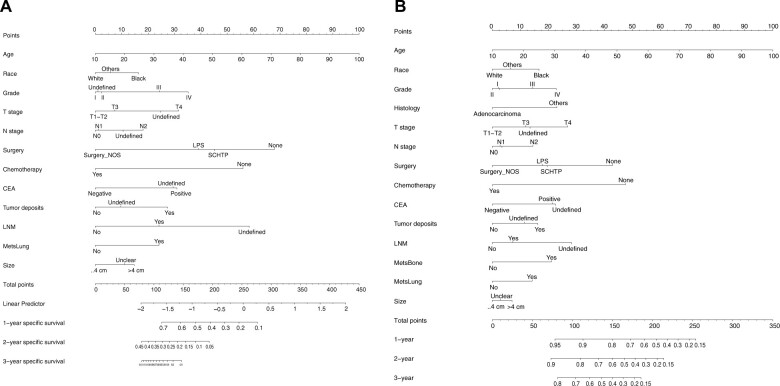
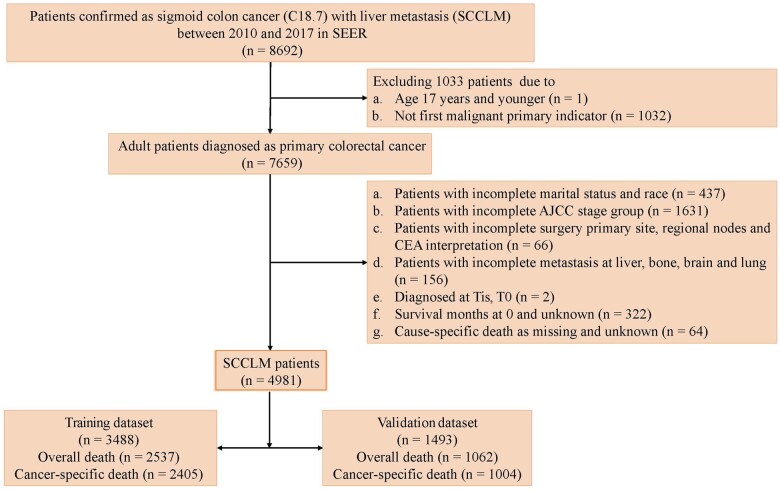
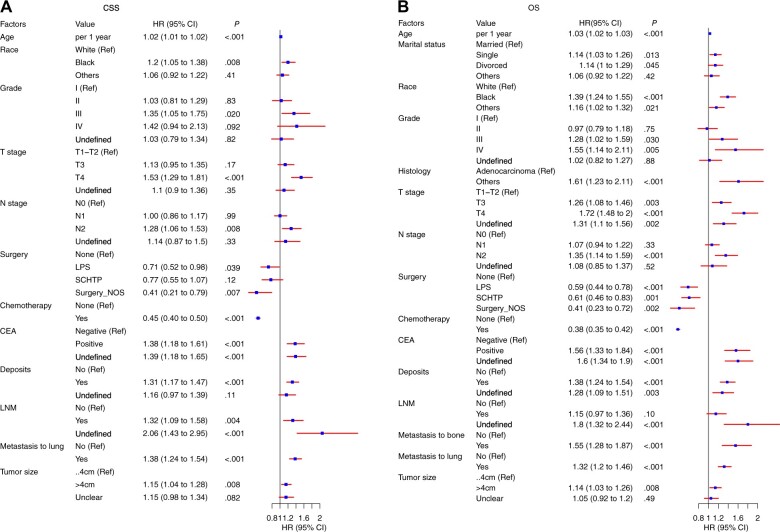
Methods: Patients with sigmoid colon cancer metastasis to liver (2010-2017) in the Surveillance, Epidemiology, and End Results (SEER) Program were recruited. Patients were split into training and validation groups (7:3). Prognostic factors were identified using competing risk and Cox proportional hazards models, and nomograms for cause-specific survival and overall survival were developed. Model performance was evaluated with the concordance index and calibration curves, with a 2-sided P value less than .05 considered statistically significant.
Results: A total of 4981 sigmoid colon cancer with liver metastasis patients were included, with a median follow-up of 20 months (interquartile range [IQR] = 9-33 months). During follow-up, 72.25% of patients died (68.44% from sigmoid colon cancer, 3.81% from other causes). Age, race, grade, T stage, N stage, surgery, chemotherapy, carcinoembryonic antigen, tumor deposits, lung metastasis, and tumor size were prognostic factors for cause-specific survival and overall survival. The models demonstrated good discrimination and calibration performance, with C index values of 0.79 (95% confidence interval [CI] = 0.78 to 0.80) for cause-specific survival and 0.74 (95% CI = 0.73 to 0.75) for overall survival. A web-based application for real-time cause-specific survival predictions was created, accessible at https://shuaishao.shinyapps.io/SCCLM/.
Conclusion: Prognostic factors for sigmoid colon cancer with liver metastasis patients were identified based on the SEER database, and nomograms for cause-specific survival and overall survival showed good performance. A web-based application was developed to predict sigmoid colon cancer with liver metastasis-specific survival, aiding in survival risk stratification.




 京公网安备 11010802042870号
京ICP备2023020795号-1
京公网安备 11010802042870号
京ICP备2023020795号-1

 分享
分享
 求助内容:
求助内容: 应助结果提醒方式:
 扫码关注我们
