Angela J Sadlowski, Abdus Sabour Shaik, Connie Y Chen, Christina Liu, Ethan Y Wu, Chin Hang Ryan Chan, Tanisa Goyal, Zhiyuan Ding, Andrew J Cohen
{"title":"Narrative patent review of penile clamp, artificial urinary sphincter, and sling innovation in the management of male stress urinary incontinence.","authors":"Angela J Sadlowski, Abdus Sabour Shaik, Connie Y Chen, Christina Liu, Ethan Y Wu, Chin Hang Ryan Chan, Tanisa Goyal, Zhiyuan Ding, Andrew J Cohen","doi":"10.21037/tau-24-115","DOIUrl":null,"url":null,"abstract":"<p><strong>Background and objective: </strong>Stress urinary incontinence (SUI) is the involuntary loss of urine affecting 1-3% of the male population. To manage leakage, patients may try a plethora of penile clamps. and may even consider artificial urinary sphincters (AUS) or sling implantation. We aimed to synthesize the evolution of the modern clamp, AUS, and sling through a comprehensive patent search.</p><p><strong>Methods: </strong>Patents were found through the databases of United States Patent and Trademark Office (USPTO), GooglePatents, and the World Intellectual Property Office Patentscope, covering patents published through January 6, 2024.</p><p><strong>Key content and findings: </strong>We found 30 different patents (10 clamps, 13 AUS, and 7 slings), including the patents pertaining to the functionalities and design of five commercially available penile clamps, the American Medical System 800 (AMS 800), the InVance, AdVance, AdVance XP, and Virtue Slings. The clamps, spanning back to 1938 with Bard Cunningham's clamp, have undergone significant refinements. For example, inventors such as Edson S. Outwin and Juan F. V. Wiesner, have modified the location of the primary pressure point. Accessibility has also improved with inventors, such as Gerald French and John W. Timmons, fastening the clamps with Velcro<sup>®</sup>, as opposed to the screw and ratchet catch closing mechanism, as in Cunningham's clamp. Similarly, the AUS has greatly evolved since Foley's 1947 \"Artificial Sphincter and Method\", which was the primary AUS precedent to Mark Polyak's AUS invention, which covered the essential elements and functionalities, such as the incorporation of a balloon reservoir, for the AMS 800. In addressing AUS limitations, inventors such as David W. Anderson and Louisa Thomas have created non-hydraulic AUSs. Likewise, the male sling has seen an evolution in the method of securement, from the use of fixed bone anchors in the InVance sling to the transobturator route used in the AdVance XP, avoiding bone complications. Additionally, innovation in sling adjustment of urethral compression allows for adjustable urethral elevation and distal compression respectively. Recent patents have claimed technological integration for clamps, AUS, and slings, especially concerning automation.</p><p><strong>Conclusions: </strong>Overall, patents have built upon the limitations of previous devices. However, there is still a need to innovate for increased clamp comfort and reduced reoperation rates for the AUS and sling.</p>","PeriodicalId":23270,"journal":{"name":"Translational andrology and urology","volume":"13 8","pages":"1602-1617"},"PeriodicalIF":1.7000,"publicationDate":"2024-08-31","publicationTypes":"Journal Article","fieldsOfStudy":null,"isOpenAccess":false,"openAccessPdf":"https://www.ncbi.nlm.nih.gov/pmc/articles/PMC11399061/pdf/","citationCount":"0","resultStr":null,"platform":"Semanticscholar","paperid":null,"PeriodicalName":"Translational andrology and urology","FirstCategoryId":"3","ListUrlMain":"https://doi.org/10.21037/tau-24-115","RegionNum":3,"RegionCategory":"医学","ArticlePicture":[],"TitleCN":null,"AbstractTextCN":null,"PMCID":null,"EPubDate":"2024/8/26 0:00:00","PubModel":"Epub","JCR":"Q4","JCRName":"ANDROLOGY","Score":null,"Total":0}
引用次数: 0
Abstract
Background and objective: Stress urinary incontinence (SUI) is the involuntary loss of urine affecting 1-3% of the male population. To manage leakage, patients may try a plethora of penile clamps. and may even consider artificial urinary sphincters (AUS) or sling implantation. We aimed to synthesize the evolution of the modern clamp, AUS, and sling through a comprehensive patent search.
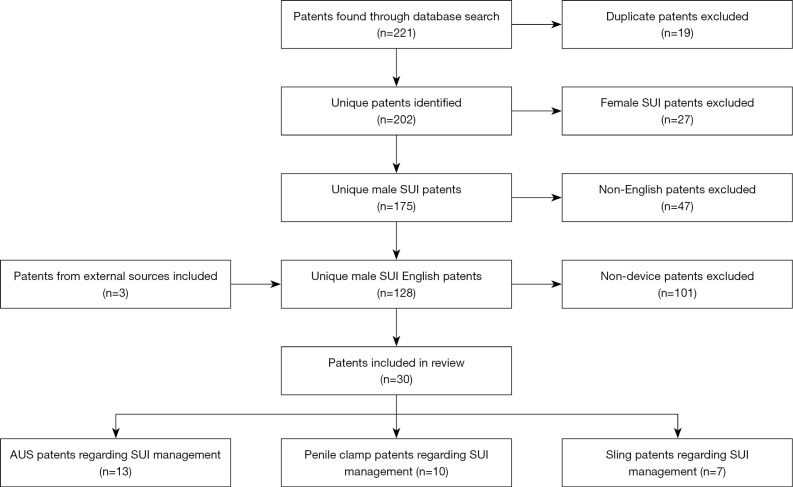
Methods: Patents were found through the databases of United States Patent and Trademark Office (USPTO), GooglePatents, and the World Intellectual Property Office Patentscope, covering patents published through January 6, 2024.
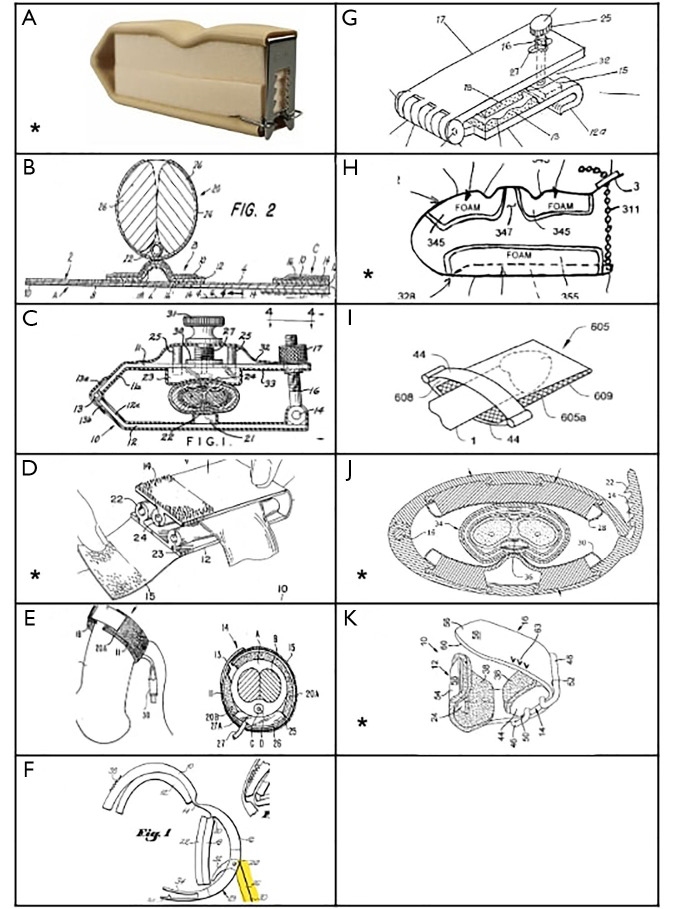
Key content and findings: We found 30 different patents (10 clamps, 13 AUS, and 7 slings), including the patents pertaining to the functionalities and design of five commercially available penile clamps, the American Medical System 800 (AMS 800), the InVance, AdVance, AdVance XP, and Virtue Slings. The clamps, spanning back to 1938 with Bard Cunningham's clamp, have undergone significant refinements. For example, inventors such as Edson S. Outwin and Juan F. V. Wiesner, have modified the location of the primary pressure point. Accessibility has also improved with inventors, such as Gerald French and John W. Timmons, fastening the clamps with Velcro®, as opposed to the screw and ratchet catch closing mechanism, as in Cunningham's clamp. Similarly, the AUS has greatly evolved since Foley's 1947 "Artificial Sphincter and Method", which was the primary AUS precedent to Mark Polyak's AUS invention, which covered the essential elements and functionalities, such as the incorporation of a balloon reservoir, for the AMS 800. In addressing AUS limitations, inventors such as David W. Anderson and Louisa Thomas have created non-hydraulic AUSs. Likewise, the male sling has seen an evolution in the method of securement, from the use of fixed bone anchors in the InVance sling to the transobturator route used in the AdVance XP, avoiding bone complications. Additionally, innovation in sling adjustment of urethral compression allows for adjustable urethral elevation and distal compression respectively. Recent patents have claimed technological integration for clamps, AUS, and slings, especially concerning automation.
Conclusions: Overall, patents have built upon the limitations of previous devices. However, there is still a need to innovate for increased clamp comfort and reduced reoperation rates for the AUS and sling.
背景和目的:压力性尿失禁(SUI)是一种不自主的尿失禁,影响着 1%-3% 的男性人口。为了控制漏尿,患者可能会尝试各种阴茎夹,甚至考虑植入人工尿道括约肌(AUS)或吊带。我们的目标是通过全面的专利检索,总结现代阴茎夹、人工尿道括约肌和吊带的演变过程:通过美国专利商标局 (USPTO)、GooglePatents 和世界知识产权组织 Patentscope 的数据库查找专利,涵盖截至 2024 年 1 月 6 日公布的专利:我们发现了 30 项不同的专利(10 项阴茎夹、13 项 AUS 和 7 项吊带),包括与五种市售阴茎夹、American Medical System 800(AMS 800)、InVance、AdVance、AdVance XP 和 Virtue Slings 的功能和设计有关的专利。这些阴茎夹可追溯到 1938 年巴德-坎宁安的阴茎夹,经过了重大改进。例如,Edson S. Outwin 和 Juan F. V. Wiesner 等发明者修改了主要压力点的位置。杰拉尔德-弗伦奇(Gerald French)和约翰-W-蒂蒙斯(John W. Timmons)等发明者用尼龙搭扣®固定夹钳,而不是像坎宁安夹钳那样使用螺钉和棘轮棘爪闭合机制,从而改善了夹钳的可及性。同样,自 Foley 于 1947 年发表 "人工括约肌和方法 "以来,AUS 也有了很大的发展,Foley 的 "人工括约肌和方法 "是 AUS 的主要先例,而 Mark Polyak 的 AUS 发明则涵盖了 AMS 800 的基本要素和功能,例如纳入了一个球囊储液器。为了解决 AUS 的局限性,大卫-W-安德森(David W. Anderson)和路易莎-托马斯(Louisa Thomas)等发明家创造了非液压 AUS。同样,男性吊衣的固定方法也发生了变化,从 InVance 吊衣使用固定骨锚到 AdVance XP 使用经尿道路径,避免了骨并发症。此外,尿道压迫吊衣调节方面的创新允许分别调节尿道抬高和远端压迫。最近的专利声称对夹钳、AUS 和吊索进行了技术整合,尤其是在自动化方面:总的来说,这些专利是在以往设备的局限性基础上发展起来的。不过,仍有必要进行创新,以提高夹钳的舒适度并降低 AUS 和吊索的再手术率。
期刊介绍:
ranslational Andrology and Urology (Print ISSN 2223-4683; Online ISSN 2223-4691; Transl Androl Urol; TAU) is an open access, peer-reviewed, bi-monthly journal (quarterly published from Mar.2012 - Dec. 2014). The main focus of the journal is to describe new findings in the field of translational research of Andrology and Urology, provides current and practical information on basic research and clinical investigations of Andrology and Urology. Specific areas of interest include, but not limited to, molecular study, pathology, biology and technical advances related to andrology and urology. Topics cover range from evaluation, prevention, diagnosis, therapy, prognosis, rehabilitation and future challenges to urology and andrology. Contributions pertinent to urology and andrology are also included from related fields such as public health, basic sciences, education, sociology, and nursing.




 京公网安备 11010802042870号
京ICP备2023020795号-1
京公网安备 11010802042870号
京ICP备2023020795号-1

 分享
分享
 求助内容:
求助内容: 应助结果提醒方式:
 扫码关注我们
