Jeissen Pyo, Shahryar K Kavoussi, Parviz K Kavoussi
{"title":"Orchialgia secondary to polyorchidism: a case report.","authors":"Jeissen Pyo, Shahryar K Kavoussi, Parviz K Kavoussi","doi":"10.21037/tau-24-179","DOIUrl":null,"url":null,"abstract":"<p><strong>Background: </strong>Polyorchidism, defined by the presence of more than two testes, is a rare congenital condition with an unclear etiology. It is hypothesized that the abnormal division of the genital ridge in the fetal embryonic period is responsible for the development of one or more supernumerary testicles. Due to the rarity of polyorchidism and its wide range of clinical presentations, the management of polyorchidism is unclear. Although up to a third of patients have reported associated scrotal pain, most cases of polyorchidism present without symptoms and are discovered incidentally during the evaluation and treatment of other conditions. When rarely reported, polyorchidism typically presents as triorchidism. Because the optimal management of polyorchidism has not yet been established, this case report aims to demonstrate the importance of an individualized treatment plan tailored to each patient's clinical presentation and goals for treatment.</p><p><strong>Case description: </strong>This case report describes an extremely rare case of chronic orchialgia secondary to polyorchidism with quadorchidism in a 30-year-old man with three separate left testicles drained by two epididymides coming off of the left spermatic cord, and a solitary right testicle. The patient's clinical presentation and desire for permanent sterilization guided his treatment plan.</p><p><strong>Conclusions: </strong>Orchiectomy of the supernumerary testes completely resolved the patient's scrotal pain, however, counseling on fertility and testosterone deficiency is indicated prior to consideration of orchiectomy.</p>","PeriodicalId":23270,"journal":{"name":"Translational andrology and urology","volume":"13 8","pages":"1767-1770"},"PeriodicalIF":1.7000,"publicationDate":"2024-08-31","publicationTypes":"Journal Article","fieldsOfStudy":null,"isOpenAccess":false,"openAccessPdf":"https://www.ncbi.nlm.nih.gov/pmc/articles/PMC11399060/pdf/","citationCount":"0","resultStr":null,"platform":"Semanticscholar","paperid":null,"PeriodicalName":"Translational andrology and urology","FirstCategoryId":"3","ListUrlMain":"https://doi.org/10.21037/tau-24-179","RegionNum":3,"RegionCategory":"医学","ArticlePicture":[],"TitleCN":null,"AbstractTextCN":null,"PMCID":null,"EPubDate":"2024/8/20 0:00:00","PubModel":"Epub","JCR":"Q4","JCRName":"ANDROLOGY","Score":null,"Total":0}
引用次数: 0
Abstract
Background: Polyorchidism, defined by the presence of more than two testes, is a rare congenital condition with an unclear etiology. It is hypothesized that the abnormal division of the genital ridge in the fetal embryonic period is responsible for the development of one or more supernumerary testicles. Due to the rarity of polyorchidism and its wide range of clinical presentations, the management of polyorchidism is unclear. Although up to a third of patients have reported associated scrotal pain, most cases of polyorchidism present without symptoms and are discovered incidentally during the evaluation and treatment of other conditions. When rarely reported, polyorchidism typically presents as triorchidism. Because the optimal management of polyorchidism has not yet been established, this case report aims to demonstrate the importance of an individualized treatment plan tailored to each patient's clinical presentation and goals for treatment.
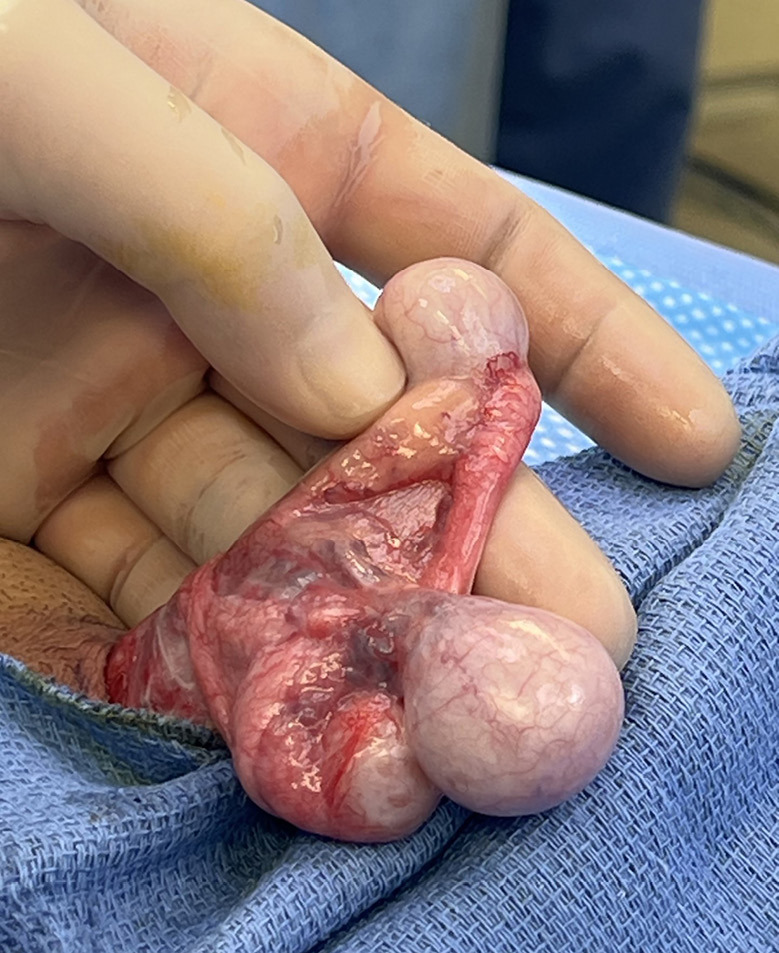
Case description: This case report describes an extremely rare case of chronic orchialgia secondary to polyorchidism with quadorchidism in a 30-year-old man with three separate left testicles drained by two epididymides coming off of the left spermatic cord, and a solitary right testicle. The patient's clinical presentation and desire for permanent sterilization guided his treatment plan.
Conclusions: Orchiectomy of the supernumerary testes completely resolved the patient's scrotal pain, however, counseling on fertility and testosterone deficiency is indicated prior to consideration of orchiectomy.
期刊介绍:
ranslational Andrology and Urology (Print ISSN 2223-4683; Online ISSN 2223-4691; Transl Androl Urol; TAU) is an open access, peer-reviewed, bi-monthly journal (quarterly published from Mar.2012 - Dec. 2014). The main focus of the journal is to describe new findings in the field of translational research of Andrology and Urology, provides current and practical information on basic research and clinical investigations of Andrology and Urology. Specific areas of interest include, but not limited to, molecular study, pathology, biology and technical advances related to andrology and urology. Topics cover range from evaluation, prevention, diagnosis, therapy, prognosis, rehabilitation and future challenges to urology and andrology. Contributions pertinent to urology and andrology are also included from related fields such as public health, basic sciences, education, sociology, and nursing.




 京公网安备 11010802042870号
京ICP备2023020795号-1
京公网安备 11010802042870号
京ICP备2023020795号-1

 分享
分享
 求助内容:
求助内容: 应助结果提醒方式:
 扫码关注我们
