{"title":"Testicular sperm extraction for fertility preservation in young patients with cancer.","authors":"Jurii Karibe, Teppei Takeshima, Shinnosuke Kuroda, Daiji Takamoto, Takashi Kawahara, Kimito Osaka, Jun-Ichi Teranishi, Mariko Murase, Kazuhide Makiyama, Hiroji Uemura, Yasushi Yumura","doi":"10.21037/tau-24-21","DOIUrl":null,"url":null,"abstract":"<p><strong>Background: </strong>Cancer survivors in the adolescent and young adult generation often experience marriage, pregnancy, and childbirth after treatment; thus, fertility preservation is very important. In male patients, testicular sperm extraction (TESE) is sometimes performed due to azoospermia. Such a procedure is called oncological TESE (onco-TESE). In the present study, we aimed to define onco-TESE as TESE for fertility preservation in cancer patients, including those receiving gonadotoxic treatment.</p><p><strong>Methods: </strong>Seventeen male patients with cancer who had undergone onco-TESE for fertility preservation at Yokohama City University Medical Center between April 2014 and March 2023 were included in the study.</p><p><strong>Results: </strong>Motile testicular sperm were acquired by TESE in 9 out of 17 cases. Among patients who had initiated chemotherapy before surgery, Motile sperm could be acquired by onco-TESE in 3 out of 9 cases. In chemotherapy-naive patients, Motile sperm were acquired by onco-TESE in 6 out of 8 cases. In the end, sperm cryopreservation was performed in 10 patients. Cryopreserved sperm were used in 2 of the 10 cases, and live birth was achieved after intracytoplasmic sperm injection in both cases.</p><p><strong>Conclusions: </strong>Before starting gonadotoxic treatment, it is important to confirm whether the patient desires to bear children. If having a baby is desired, a referral to a reproductive medicine doctor is recommended. Fertility preservation before starting gonadotoxic treatment is preferable, but fertility preservation could be considered even after such a treatment.</p>","PeriodicalId":23270,"journal":{"name":"Translational andrology and urology","volume":"13 8","pages":"1463-1471"},"PeriodicalIF":1.7000,"publicationDate":"2024-08-31","publicationTypes":"Journal Article","fieldsOfStudy":null,"isOpenAccess":false,"openAccessPdf":"https://www.ncbi.nlm.nih.gov/pmc/articles/PMC11399058/pdf/","citationCount":"0","resultStr":null,"platform":"Semanticscholar","paperid":null,"PeriodicalName":"Translational andrology and urology","FirstCategoryId":"3","ListUrlMain":"https://doi.org/10.21037/tau-24-21","RegionNum":3,"RegionCategory":"医学","ArticlePicture":[],"TitleCN":null,"AbstractTextCN":null,"PMCID":null,"EPubDate":"2024/8/26 0:00:00","PubModel":"Epub","JCR":"Q4","JCRName":"ANDROLOGY","Score":null,"Total":0}
引用次数: 0
Abstract
Background: Cancer survivors in the adolescent and young adult generation often experience marriage, pregnancy, and childbirth after treatment; thus, fertility preservation is very important. In male patients, testicular sperm extraction (TESE) is sometimes performed due to azoospermia. Such a procedure is called oncological TESE (onco-TESE). In the present study, we aimed to define onco-TESE as TESE for fertility preservation in cancer patients, including those receiving gonadotoxic treatment.
Methods: Seventeen male patients with cancer who had undergone onco-TESE for fertility preservation at Yokohama City University Medical Center between April 2014 and March 2023 were included in the study.
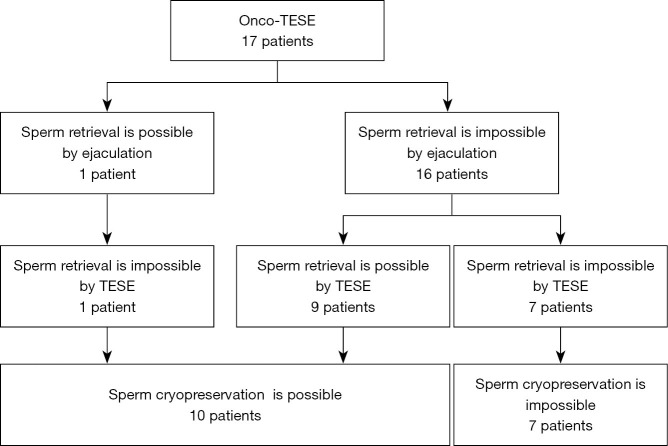
Results: Motile testicular sperm were acquired by TESE in 9 out of 17 cases. Among patients who had initiated chemotherapy before surgery, Motile sperm could be acquired by onco-TESE in 3 out of 9 cases. In chemotherapy-naive patients, Motile sperm were acquired by onco-TESE in 6 out of 8 cases. In the end, sperm cryopreservation was performed in 10 patients. Cryopreserved sperm were used in 2 of the 10 cases, and live birth was achieved after intracytoplasmic sperm injection in both cases.
Conclusions: Before starting gonadotoxic treatment, it is important to confirm whether the patient desires to bear children. If having a baby is desired, a referral to a reproductive medicine doctor is recommended. Fertility preservation before starting gonadotoxic treatment is preferable, but fertility preservation could be considered even after such a treatment.
期刊介绍:
ranslational Andrology and Urology (Print ISSN 2223-4683; Online ISSN 2223-4691; Transl Androl Urol; TAU) is an open access, peer-reviewed, bi-monthly journal (quarterly published from Mar.2012 - Dec. 2014). The main focus of the journal is to describe new findings in the field of translational research of Andrology and Urology, provides current and practical information on basic research and clinical investigations of Andrology and Urology. Specific areas of interest include, but not limited to, molecular study, pathology, biology and technical advances related to andrology and urology. Topics cover range from evaluation, prevention, diagnosis, therapy, prognosis, rehabilitation and future challenges to urology and andrology. Contributions pertinent to urology and andrology are also included from related fields such as public health, basic sciences, education, sociology, and nursing.



 京公网安备 11010802042870号
京ICP备2023020795号-1
京公网安备 11010802042870号
京ICP备2023020795号-1

 分享
分享
 求助内容:
求助内容: 应助结果提醒方式:
 扫码关注我们
