David P Way, Ashish R Panchal, Alan Price, Vita Berezina-Blackburn, Jeremy Patterson, Jillian McGrath, Douglas Danforth, Nicholas E Kman
{"title":"Learner evaluation of an immersive virtual reality mass casualty incident simulator for triage training.","authors":"David P Way, Ashish R Panchal, Alan Price, Vita Berezina-Blackburn, Jeremy Patterson, Jillian McGrath, Douglas Danforth, Nicholas E Kman","doi":"10.1186/s44247-024-00117-5","DOIUrl":null,"url":null,"abstract":"<p><strong>Background: </strong>To minimize loss of life, modern mass casualty response requires swift identification, efficient triage categorization, and rapid hemorrhage control. Current training methods remain suboptimal. Our objective was to train first responders to triage a mass casualty incident using Virtual Reality (VR) simulation and obtain their impressions of the training's quality and effectiveness.We trained subjects in a triage protocol called Sort, Assess, Lifesaving interventions, and Treatment and/or Transport (SALT) Triage then had them respond to a terrorist bombing of a subway station using a fully immersive virtual reality simulation. We gathered learner reactions to their virtual reality experience and post-encounter debriefing with a custom electronic survey. The survey was designed to gather information about participants' demographics and prior experience, including roles, triage training, and virtual reality experience. We then asked them to evaluate the training and encounter and the system's potential for training others.</p><p><strong>Results: </strong>We received 375 completed evaluation surveys from subjects who experienced the virtual reality encounter. Subjects were primarily paramedics, but also included medical learners as well as other emergency medical service (EMS) professionals. Most participants (95%) recommended the experience for other first responders and rated the simulation (95%) and virtual patients (91%) as realistic. Ninety-four percent (94%) of participants rated the virtual reality simulator as \"excellent\" or \"good.\" We observed some differences between emergency medical service and medical professionals regarding their prior experience with disaster response training and their opinions on how much the experience contributed to their learning. We observed no differences between subjects with extensive virtual reality experience and those without.</p><p><strong>Conclusions: </strong>Our virtual reality simulator is an automated, customizable, fully immersive virtual reality system for training and assessing personnel in the proper response to a mass casualty incident. Participants perceived the simulator as an adequate alternative to traditional triage and treatment training and believed that the simulator was realistic and effective for training. Prior experience with virtual reality was not a prerequisite for the use of this system.</p><p><strong>Supplementary information: </strong>The online version contains supplementary material available at 10.1186/s44247-024-00117-5.</p>","PeriodicalId":72426,"journal":{"name":"BMC digital health","volume":"2 1","pages":"56"},"PeriodicalIF":0.0000,"publicationDate":"2024-01-01","publicationTypes":"Journal Article","fieldsOfStudy":null,"isOpenAccess":false,"openAccessPdf":"https://www.ncbi.nlm.nih.gov/pmc/articles/PMC11402856/pdf/","citationCount":"0","resultStr":null,"platform":"Semanticscholar","paperid":null,"PeriodicalName":"BMC digital health","FirstCategoryId":"1085","ListUrlMain":"https://doi.org/10.1186/s44247-024-00117-5","RegionNum":0,"RegionCategory":null,"ArticlePicture":[],"TitleCN":null,"AbstractTextCN":null,"PMCID":null,"EPubDate":"2024/9/16 0:00:00","PubModel":"Epub","JCR":"","JCRName":"","Score":null,"Total":0}
引用次数: 0
Abstract
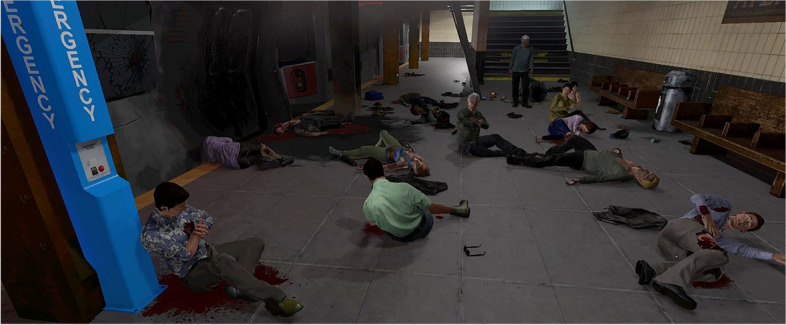
Background: To minimize loss of life, modern mass casualty response requires swift identification, efficient triage categorization, and rapid hemorrhage control. Current training methods remain suboptimal. Our objective was to train first responders to triage a mass casualty incident using Virtual Reality (VR) simulation and obtain their impressions of the training's quality and effectiveness.We trained subjects in a triage protocol called Sort, Assess, Lifesaving interventions, and Treatment and/or Transport (SALT) Triage then had them respond to a terrorist bombing of a subway station using a fully immersive virtual reality simulation. We gathered learner reactions to their virtual reality experience and post-encounter debriefing with a custom electronic survey. The survey was designed to gather information about participants' demographics and prior experience, including roles, triage training, and virtual reality experience. We then asked them to evaluate the training and encounter and the system's potential for training others.
Results: We received 375 completed evaluation surveys from subjects who experienced the virtual reality encounter. Subjects were primarily paramedics, but also included medical learners as well as other emergency medical service (EMS) professionals. Most participants (95%) recommended the experience for other first responders and rated the simulation (95%) and virtual patients (91%) as realistic. Ninety-four percent (94%) of participants rated the virtual reality simulator as "excellent" or "good." We observed some differences between emergency medical service and medical professionals regarding their prior experience with disaster response training and their opinions on how much the experience contributed to their learning. We observed no differences between subjects with extensive virtual reality experience and those without.
Conclusions: Our virtual reality simulator is an automated, customizable, fully immersive virtual reality system for training and assessing personnel in the proper response to a mass casualty incident. Participants perceived the simulator as an adequate alternative to traditional triage and treatment training and believed that the simulator was realistic and effective for training. Prior experience with virtual reality was not a prerequisite for the use of this system.
Supplementary information: The online version contains supplementary material available at 10.1186/s44247-024-00117-5.



 京公网安备 11010802042870号
京ICP备2023020795号-1
京公网安备 11010802042870号
京ICP备2023020795号-1

 分享
分享

 求助内容:
求助内容: 应助结果提醒方式:
 扫码关注我们
