‘I Can't See Myself Seeking Help’: The Influence of Clinical Placements on Nursing Students' Stigmatising Beliefs and Intentions to Seek Help for Their Own Mental Health Issues: A Prospective Cohort Study
Lorna Moxham, Michelle Roberts, Taylor Yousiph, Elissa-Kate Jay, Kelly Lewer, Georgia Robson, Peta Drury, Joanne Cordina, Suzi Villeneuve-Smith, Christopher Patterson
{"title":"‘I Can't See Myself Seeking Help’: The Influence of Clinical Placements on Nursing Students' Stigmatising Beliefs and Intentions to Seek Help for Their Own Mental Health Issues: A Prospective Cohort Study","authors":"Lorna Moxham, Michelle Roberts, Taylor Yousiph, Elissa-Kate Jay, Kelly Lewer, Georgia Robson, Peta Drury, Joanne Cordina, Suzi Villeneuve-Smith, Christopher Patterson","doi":"10.1111/inm.13429","DOIUrl":null,"url":null,"abstract":"<p>Mental health conditions such as anxiety, depression and psychosis represent a global health challenge. Stigma surrounding mental health continues to hinder help-seeking behaviours for people with mental illness and as this study demonstrates, nursing students as well. However, if student nurses are reluctant to seek help for mental health issues, how can others be expected to do so? This reluctance poses challenges in mental health nursing, impacting both care provision and nursing education. The present study seeks to explore the influence of traditional versus non-traditional mental health clinical placements on second-year nursing students' stigmatising beliefs and intentions to seek help for mental health issues. Employing a prospective cohort design using the TREND checklist, the study sampled second-year nursing students assigned to either traditional hospital-based or non-traditional recovery-focused mental health clinical placements. Using validated scales, stigmatising beliefs and help-seeking intentions were measured before and after the placements. Statistical analyses were conducted to assess changes in these variables over time and across placement settings. A significant impact of placement setting on help-seeking intentions was observed, with students in non-traditional placements showing an increased willingness to seek help. Additionally, non-traditional placements were found to significantly reduce stigmatising beliefs in all measured domains, suggesting that these settings may provide a more conducive environment for fostering positive attitudes towards mental health. Recovery-focused placements appear to offer experiences that can diminish stigma and encourage more positive perceptions and intentions related to mental health support.</p>","PeriodicalId":14007,"journal":{"name":"International Journal of Mental Health Nursing","volume":"34 1","pages":""},"PeriodicalIF":3.3000,"publicationDate":"2024-09-20","publicationTypes":"Journal Article","fieldsOfStudy":null,"isOpenAccess":false,"openAccessPdf":"https://www.ncbi.nlm.nih.gov/pmc/articles/PMC11751763/pdf/","citationCount":"0","resultStr":null,"platform":"Semanticscholar","paperid":null,"PeriodicalName":"International Journal of Mental Health Nursing","FirstCategoryId":"3","ListUrlMain":"https://onlinelibrary.wiley.com/doi/10.1111/inm.13429","RegionNum":2,"RegionCategory":"医学","ArticlePicture":[],"TitleCN":null,"AbstractTextCN":null,"PMCID":null,"EPubDate":"","PubModel":"","JCR":"Q1","JCRName":"NURSING","Score":null,"Total":0}
引用次数: 0
Abstract
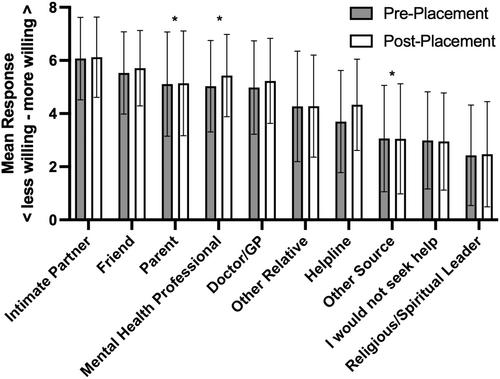
Mental health conditions such as anxiety, depression and psychosis represent a global health challenge. Stigma surrounding mental health continues to hinder help-seeking behaviours for people with mental illness and as this study demonstrates, nursing students as well. However, if student nurses are reluctant to seek help for mental health issues, how can others be expected to do so? This reluctance poses challenges in mental health nursing, impacting both care provision and nursing education. The present study seeks to explore the influence of traditional versus non-traditional mental health clinical placements on second-year nursing students' stigmatising beliefs and intentions to seek help for mental health issues. Employing a prospective cohort design using the TREND checklist, the study sampled second-year nursing students assigned to either traditional hospital-based or non-traditional recovery-focused mental health clinical placements. Using validated scales, stigmatising beliefs and help-seeking intentions were measured before and after the placements. Statistical analyses were conducted to assess changes in these variables over time and across placement settings. A significant impact of placement setting on help-seeking intentions was observed, with students in non-traditional placements showing an increased willingness to seek help. Additionally, non-traditional placements were found to significantly reduce stigmatising beliefs in all measured domains, suggesting that these settings may provide a more conducive environment for fostering positive attitudes towards mental health. Recovery-focused placements appear to offer experiences that can diminish stigma and encourage more positive perceptions and intentions related to mental health support.
期刊介绍:
The International Journal of Mental Health Nursing is the official journal of the Australian College of Mental Health Nurses Inc. It is a fully refereed journal that examines current trends and developments in mental health practice and research.
The International Journal of Mental Health Nursing provides a forum for the exchange of ideas on all issues of relevance to mental health nursing. The Journal informs you of developments in mental health nursing practice and research, directions in education and training, professional issues, management approaches, policy development, ethical questions, theoretical inquiry, and clinical issues.
The Journal publishes feature articles, review articles, clinical notes, research notes and book reviews. Contributions on any aspect of mental health nursing are welcomed.
Statements and opinions expressed in the journal reflect the views of the authors and are not necessarily endorsed by the Australian College of Mental Health Nurses Inc.




 京公网安备 11010802042870号
京ICP备2023020795号-1
京公网安备 11010802042870号
京ICP备2023020795号-1

 分享
分享
 求助内容:
求助内容: 应助结果提醒方式:
 扫码关注我们
