Nora Maulina, Indra Zachreini, Gholib Gholib, Abdulhadi Suwandi, Muslim Akmal
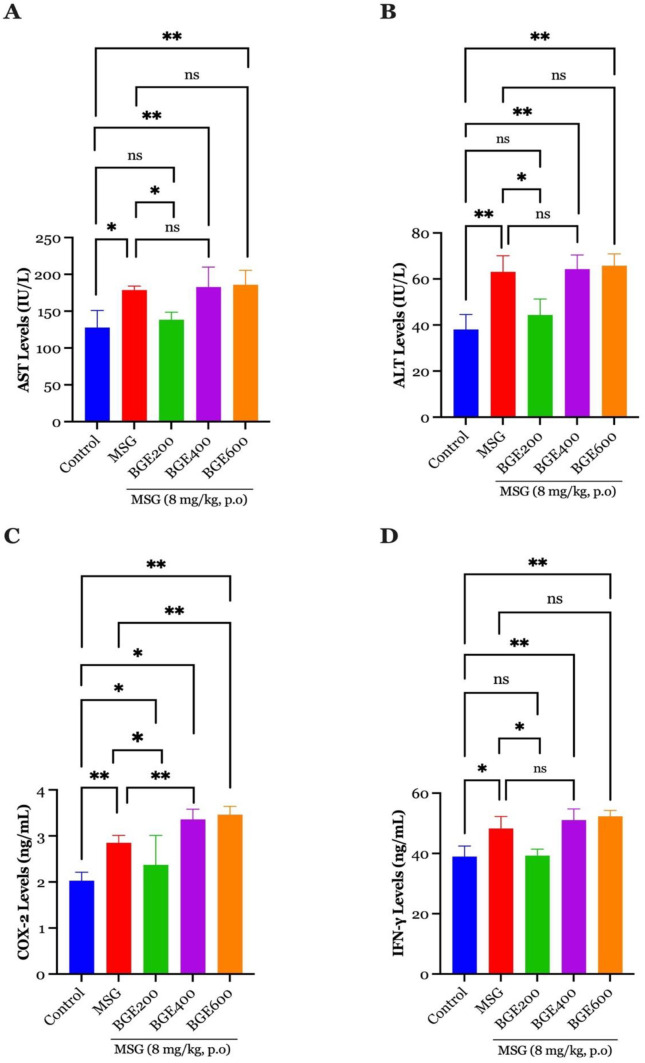
{"title":"Black garlic exhibited hepatoprotective effect against monosodium glutamate-induced hepatotoxicity in animal model.","authors":"Nora Maulina, Indra Zachreini, Gholib Gholib, Abdulhadi Suwandi, Muslim Akmal","doi":"10.52225/narra.v4i2.799","DOIUrl":null,"url":null,"abstract":"<p><p>Monosodium glutamate (MSG) is commonly used as a flavor-enhancing agent in foods, and studies have demonstrated its toxic effects in animal models. Black garlic is known for its antioxidant and anti-inflammatory properties; however, there is a lack of studies on the potential hepatoprotective effect of black garlic ethanol extract (BGE) against MSG-induced hepatotoxicity in rats. The aim of this study was to investigate the hepatoprotective effects of ethanol extract of black garlic against MSG-induced liver damage in animal model. Twenty-five male Wistar rats were randomly assigned to five groups (n=5): negative control, MSG only, and MSG with three different doses of BGE. The MSG only and MSG with BGE groups were orally administered with 8 mg/kg MSG daily. After MSG treatment, the MSG with BGE groups received BGE orally at daily doses of 200, 400, or 600 mg/kg body weight for 16 consecutive days. Subsequently, the levels of serum liver enzymes aspartate aminotransferase (AST), alanine aminotransferase (ALT), interferon-gamma (IFN-γ), and cyclooxygenase-2 (COX-2) were measured. Our data indicated that the group treated with 200 mg/kg BGE had significant lower levels of AST and ALT significantly compared to the MSG-only group. The MSG-treated group had higher levels of the inflammatory markers COX-2 and IFN-γ, which were lowered by administration of 200 mg/kg BGE. In contrast, higher doses of BGE led to greater levels of COX-2 and IFN-γ compared to those in the MSG-only group. This study suggested that BGE might have hepatoprotective effects at low dose, potentially mitigating MSG-induced liver damage. However, the higher dose of black garlic extract did not alleviate inflammation, as shown by the higher levels of COX-2 and IFN-γ.</p>","PeriodicalId":517416,"journal":{"name":"Narra J","volume":"4 2","pages":"e799"},"PeriodicalIF":0.0000,"publicationDate":"2024-08-01","publicationTypes":"Journal Article","fieldsOfStudy":null,"isOpenAccess":false,"openAccessPdf":"https://www.ncbi.nlm.nih.gov/pmc/articles/PMC11392005/pdf/","citationCount":"0","resultStr":null,"platform":"Semanticscholar","paperid":null,"PeriodicalName":"Narra J","FirstCategoryId":"1085","ListUrlMain":"https://doi.org/10.52225/narra.v4i2.799","RegionNum":0,"RegionCategory":null,"ArticlePicture":[],"TitleCN":null,"AbstractTextCN":null,"PMCID":null,"EPubDate":"2024/6/21 0:00:00","PubModel":"Epub","JCR":"","JCRName":"","Score":null,"Total":0}
引用次数: 0
Abstract
Monosodium glutamate (MSG) is commonly used as a flavor-enhancing agent in foods, and studies have demonstrated its toxic effects in animal models. Black garlic is known for its antioxidant and anti-inflammatory properties; however, there is a lack of studies on the potential hepatoprotective effect of black garlic ethanol extract (BGE) against MSG-induced hepatotoxicity in rats. The aim of this study was to investigate the hepatoprotective effects of ethanol extract of black garlic against MSG-induced liver damage in animal model. Twenty-five male Wistar rats were randomly assigned to five groups (n=5): negative control, MSG only, and MSG with three different doses of BGE. The MSG only and MSG with BGE groups were orally administered with 8 mg/kg MSG daily. After MSG treatment, the MSG with BGE groups received BGE orally at daily doses of 200, 400, or 600 mg/kg body weight for 16 consecutive days. Subsequently, the levels of serum liver enzymes aspartate aminotransferase (AST), alanine aminotransferase (ALT), interferon-gamma (IFN-γ), and cyclooxygenase-2 (COX-2) were measured. Our data indicated that the group treated with 200 mg/kg BGE had significant lower levels of AST and ALT significantly compared to the MSG-only group. The MSG-treated group had higher levels of the inflammatory markers COX-2 and IFN-γ, which were lowered by administration of 200 mg/kg BGE. In contrast, higher doses of BGE led to greater levels of COX-2 and IFN-γ compared to those in the MSG-only group. This study suggested that BGE might have hepatoprotective effects at low dose, potentially mitigating MSG-induced liver damage. However, the higher dose of black garlic extract did not alleviate inflammation, as shown by the higher levels of COX-2 and IFN-γ.




 京公网安备 11010802042870号
京ICP备2023020795号-1
京公网安备 11010802042870号
京ICP备2023020795号-1

 分享
分享

 求助内容:
求助内容: 应助结果提醒方式:
 扫码关注我们
