{"title":"Regulation of dual-atom doped porous carbon towards high-performance capacitive storage devices†","authors":"Jizhao Zou, Zhewen Deng, Jingyou Xu, Shunhong Chen, Xin Yu, Hongliang Wu and Fenglin Zhao","doi":"10.1039/D4TA02529F","DOIUrl":null,"url":null,"abstract":"<p >Zinc ion capacitors show impressive energy storage potential for well-balanced energy and power density, but exploring their implicit energy storage mechanism is crucial and still challenging. Herein, a new viewpoint is proposed for regulating nitrogen and oxygen dual-doped carbon with short-range order by sustaining the conductivity and synchronously boosting interfacial chemisorption sites. The artful nanoarchitecture engineering of a cross-linked carbon framework with a high specific surface area (2702.3 m<small><sup>2</sup></small> g<small><sup>−1</sup></small>) is beneficial for efficient electrolyte penetration and ion transfer, thus enhancing the electrode's capacitance and rate performance. Based on electrochemical capacitor properties and theoretical calculations, the optimized hetero-carbon used for zinc ion capacitors could deliver a high capacity of 241.1 mA h g<small><sup>−1</sup></small> at 0.1 A g<small><sup>−1</sup></small> and an energy density of 191.6 W h kg<small><sup>−1</sup></small>. The dynamic potential of zincate hydrated ion precipitation/dissolution behavior was explored by <em>ex situ</em> X-ray diffraction and photoelectron spectroscopy experiments. This work not only provides new perception integration with porousness and nanoarchitecture engineering in carbon materials, but also sheds light on the zinc-ion capacitor storage mechanism.</p>","PeriodicalId":82,"journal":{"name":"Journal of Materials Chemistry A","volume":" 41","pages":" 28437-28446"},"PeriodicalIF":9.5000,"publicationDate":"2024-09-24","publicationTypes":"Journal Article","fieldsOfStudy":null,"isOpenAccess":false,"openAccessPdf":"","citationCount":"0","resultStr":null,"platform":"Semanticscholar","paperid":null,"PeriodicalName":"Journal of Materials Chemistry A","FirstCategoryId":"88","ListUrlMain":"https://pubs.rsc.org/en/content/articlelanding/2024/ta/d4ta02529f","RegionNum":2,"RegionCategory":"材料科学","ArticlePicture":[],"TitleCN":null,"AbstractTextCN":null,"PMCID":null,"EPubDate":"","PubModel":"","JCR":"Q1","JCRName":"CHEMISTRY, PHYSICAL","Score":null,"Total":0}
引用次数: 0
Abstract
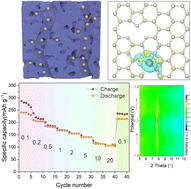
Zinc ion capacitors show impressive energy storage potential for well-balanced energy and power density, but exploring their implicit energy storage mechanism is crucial and still challenging. Herein, a new viewpoint is proposed for regulating nitrogen and oxygen dual-doped carbon with short-range order by sustaining the conductivity and synchronously boosting interfacial chemisorption sites. The artful nanoarchitecture engineering of a cross-linked carbon framework with a high specific surface area (2702.3 m2 g−1) is beneficial for efficient electrolyte penetration and ion transfer, thus enhancing the electrode's capacitance and rate performance. Based on electrochemical capacitor properties and theoretical calculations, the optimized hetero-carbon used for zinc ion capacitors could deliver a high capacity of 241.1 mA h g−1 at 0.1 A g−1 and an energy density of 191.6 W h kg−1. The dynamic potential of zincate hydrated ion precipitation/dissolution behavior was explored by ex situ X-ray diffraction and photoelectron spectroscopy experiments. This work not only provides new perception integration with porousness and nanoarchitecture engineering in carbon materials, but also sheds light on the zinc-ion capacitor storage mechanism.
期刊介绍:
The Journal of Materials Chemistry A, B & C covers a wide range of high-quality studies in the field of materials chemistry, with each section focusing on specific applications of the materials studied. Journal of Materials Chemistry A emphasizes applications in energy and sustainability, including topics such as artificial photosynthesis, batteries, and fuel cells. Journal of Materials Chemistry B focuses on applications in biology and medicine, while Journal of Materials Chemistry C covers applications in optical, magnetic, and electronic devices. Example topic areas within the scope of Journal of Materials Chemistry A include catalysis, green/sustainable materials, sensors, and water treatment, among others.




 京公网安备 11010802042870号
京ICP备2023020795号-1
京公网安备 11010802042870号
京ICP备2023020795号-1

 分享
分享
 求助内容:
求助内容: 应助结果提醒方式:
 扫码关注我们
