{"title":"Large Language Model (LLM) for Telecommunications: A Comprehensive Survey on Principles, Key Techniques, and Opportunities","authors":"Hao Zhou;Chengming Hu;Ye Yuan;Yufei Cui;Yili Jin;Can Chen;Haolun Wu;Dun Yuan;Li Jiang;Di Wu;Xue Liu;Jianzhong Zhang;Xianbin Wang;Jiangchuan Liu","doi":"10.1109/COMST.2024.3465447","DOIUrl":null,"url":null,"abstract":"Large language models (LLMs) have received considerable attention recently due to their outstanding comprehension and reasoning capabilities, leading to great progress in many fields. The advancement of LLM techniques also offers promising opportunities to automate many tasks in the telecommunication (telecom) field. After pre-training and fine-tuning, LLMs can perform diverse downstream tasks based on human instructions, paving the way to artificial general intelligence (AGI)-enabled 6G. Given the great potential of LLM technologies, this work aims to provide a comprehensive overview of LLM-enabled telecom networks. In particular, we first present LLM fundamentals, including model architecture, pre-training, fine-tuning, inference and utilization, model evaluation, and telecom deployment. Then, we introduce LLM-enabled key techniques and telecom applications in terms of generation, classification, optimization, and prediction problems. Specifically, the LLM-enabled generation applications include telecom domain knowledge, code, and network configuration generation. After that, the LLM-based classification applications involve network security, text, image, and traffic classification problems. Moreover, multiple LLM-enabled optimization techniques are introduced, such as automated reward function design for reinforcement learning and verbal reinforcement learning. Furthermore, for LLM-aided prediction problems, we discussed time-series prediction models and multi-modality prediction problems for telecom. Finally, we highlight the challenges and identify the future directions of LLM-enabled telecom networks.","PeriodicalId":55029,"journal":{"name":"IEEE Communications Surveys and Tutorials","volume":"27 3","pages":"1955-2005"},"PeriodicalIF":34.4000,"publicationDate":"2024-09-23","publicationTypes":"Journal Article","fieldsOfStudy":null,"isOpenAccess":false,"openAccessPdf":"","citationCount":"0","resultStr":null,"platform":"Semanticscholar","paperid":null,"PeriodicalName":"IEEE Communications Surveys and Tutorials","FirstCategoryId":"94","ListUrlMain":"https://ieeexplore.ieee.org/document/10685369/","RegionNum":1,"RegionCategory":"计算机科学","ArticlePicture":[],"TitleCN":null,"AbstractTextCN":null,"PMCID":null,"EPubDate":"","PubModel":"","JCR":"Q1","JCRName":"COMPUTER SCIENCE, INFORMATION SYSTEMS","Score":null,"Total":0}
引用次数: 0
Abstract
Large language models (LLMs) have received considerable attention recently due to their outstanding comprehension and reasoning capabilities, leading to great progress in many fields. The advancement of LLM techniques also offers promising opportunities to automate many tasks in the telecommunication (telecom) field. After pre-training and fine-tuning, LLMs can perform diverse downstream tasks based on human instructions, paving the way to artificial general intelligence (AGI)-enabled 6G. Given the great potential of LLM technologies, this work aims to provide a comprehensive overview of LLM-enabled telecom networks. In particular, we first present LLM fundamentals, including model architecture, pre-training, fine-tuning, inference and utilization, model evaluation, and telecom deployment. Then, we introduce LLM-enabled key techniques and telecom applications in terms of generation, classification, optimization, and prediction problems. Specifically, the LLM-enabled generation applications include telecom domain knowledge, code, and network configuration generation. After that, the LLM-based classification applications involve network security, text, image, and traffic classification problems. Moreover, multiple LLM-enabled optimization techniques are introduced, such as automated reward function design for reinforcement learning and verbal reinforcement learning. Furthermore, for LLM-aided prediction problems, we discussed time-series prediction models and multi-modality prediction problems for telecom. Finally, we highlight the challenges and identify the future directions of LLM-enabled telecom networks.
大型语言模型(Large language models, llm)由于其出色的理解和推理能力,近年来受到了广泛的关注,在许多领域都取得了很大的进展。法学硕士技术的进步也为电信领域的许多任务自动化提供了有希望的机会。经过预训练和微调,llm可以根据人类指令执行各种下游任务,为实现通用人工智能(AGI)的6G铺平道路。鉴于法学硕士技术的巨大潜力,这项工作旨在提供法学硕士支持的电信网络的全面概述。特别地,我们首先介绍了LLM的基础知识,包括模型架构、预训练、微调、推理和利用、模型评估和电信部署。然后,我们在生成、分类、优化和预测问题方面介绍了支持llm的关键技术和电信应用。具体来说,支持llm的生成应用程序包括电信领域知识、代码和网络配置生成。之后,基于llm的分类应用涉及到网络安全、文本、图像和流量分类等问题。此外,还介绍了多种支持llm的优化技术,例如用于强化学习和口头强化学习的自动奖励函数设计。此外,对于llm辅助预测问题,我们讨论了电信行业的时间序列预测模型和多模态预测问题。最后,我们强调了挑战,并确定了法学硕士支持的电信网络的未来方向。
期刊介绍:
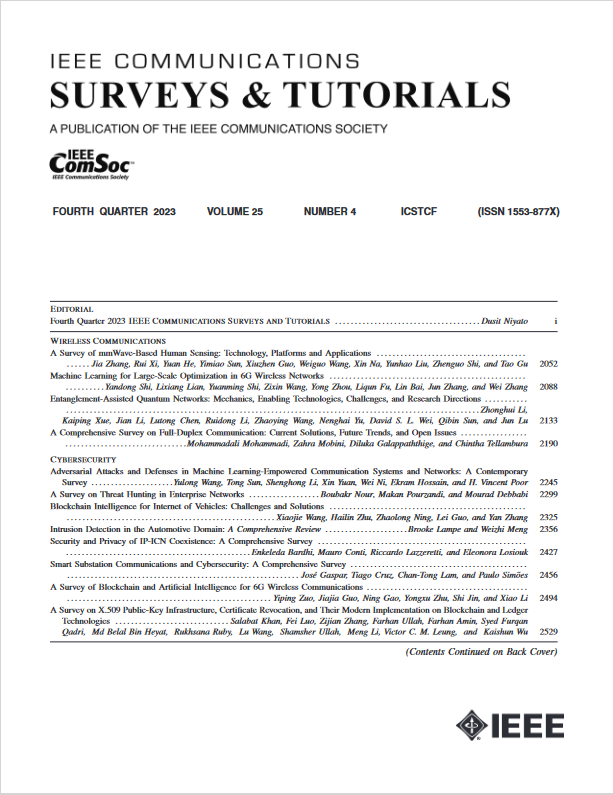
IEEE Communications Surveys & Tutorials is an online journal published by the IEEE Communications Society for tutorials and surveys covering all aspects of the communications field. Telecommunications technology is progressing at a rapid pace, and the IEEE Communications Society is committed to providing researchers and other professionals the information and tools to stay abreast. IEEE Communications Surveys and Tutorials focuses on integrating and adding understanding to the existing literature on communications, putting results in context. Whether searching for in-depth information about a familiar area or an introduction into a new area, IEEE Communications Surveys & Tutorials aims to be the premier source of peer-reviewed, comprehensive tutorials and surveys, and pointers to further sources. IEEE Communications Surveys & Tutorials publishes only articles exclusively written for IEEE Communications Surveys & Tutorials and go through a rigorous review process before their publication in the quarterly issues.
A tutorial article in the IEEE Communications Surveys & Tutorials should be designed to help the reader to become familiar with and learn something specific about a chosen topic. In contrast, the term survey, as applied here, is defined to mean a survey of the literature. A survey article in IEEE Communications Surveys & Tutorials should provide a comprehensive review of developments in a selected area, covering its development from its inception to its current state and beyond, and illustrating its development through liberal citations from the literature. Both tutorials and surveys should be tutorial in nature and should be written in a style comprehensible to readers outside the specialty of the article.




 京公网安备 11010802042870号
京ICP备2023020795号-1
京公网安备 11010802042870号
京ICP备2023020795号-1

 分享
分享
 求助内容:
求助内容: 应助结果提醒方式:
 扫码关注我们
