Hongpeng Ma , Cong Xing , Haitao Wei , Yan Li , Liyue Wang , Song Liu , Qiang Wu , Chao Sun , Guangzhi Ning
{"title":"Berberine attenuates neuronal ferroptosis via the AMPK–NRF2–HO-1-signaling pathway in spinal cord-injured rats","authors":"Hongpeng Ma , Cong Xing , Haitao Wei , Yan Li , Liyue Wang , Song Liu , Qiang Wu , Chao Sun , Guangzhi Ning","doi":"10.1016/j.intimp.2024.113227","DOIUrl":null,"url":null,"abstract":"<div><div>Ferroptosis, characterized by iron-dependent accumulation of lipid peroxides, plays an important role in spinal cord injury (SCI). Berberine (BBR), as a lipid peroxide scavenger, has been widely used in treating other diseases; however, its role in ferroptosis has not been fully elucidated. Therefore, here, to test our hypothesis that BBR can reduce the severity of SCI and promote motor function recovery by inhibiting neuronal ferroptosis, we evaluated the changes in ferroptosis-related indicators after BBR administration by establishing a cellular ferroptosis model and an SCI contusion model. We found that BBR administration significantly reduces lipid peroxidation damage, maintains normal mitochondrial function, reduces excessive accumulation of iron ions, enhances antioxidant capacity, and activates the ferroptosis defense system <em>in vivo</em> and <em>in vitro</em>. Mechanistically, BBR alleviates neuronal ferroptosis by inducing adenosine monophosphate-activated protein kinase (AMPK) phosphorylation and up-regulating nuclear factor erythroid 2-related factor 2 (NRF2) and heme oxygenase-1 (HO-1) protein expression to promote glutathione production. BBR administration also significantly improves motor function recovery in SCI rats. Meanwhile, applying the AMPK inhibitor Compound C blocks the neuroprotective and all other effects of BBR. Collectively, our findings demonstrate that BBR can attenuate neuronal ferroptosis after SCI by activating the AMPK–NRF2–HO-1 pathway.</div></div>","PeriodicalId":13859,"journal":{"name":"International immunopharmacology","volume":"142 ","pages":"Article 113227"},"PeriodicalIF":4.7000,"publicationDate":"2024-12-05","publicationTypes":"Journal Article","fieldsOfStudy":null,"isOpenAccess":false,"openAccessPdf":"","citationCount":"0","resultStr":null,"platform":"Semanticscholar","paperid":null,"PeriodicalName":"International immunopharmacology","FirstCategoryId":"3","ListUrlMain":"https://www.sciencedirect.com/science/article/pii/S1567576924017491","RegionNum":2,"RegionCategory":"医学","ArticlePicture":[],"TitleCN":null,"AbstractTextCN":null,"PMCID":null,"EPubDate":"2024/9/25 0:00:00","PubModel":"Epub","JCR":"Q2","JCRName":"IMMUNOLOGY","Score":null,"Total":0}
引用次数: 0
Abstract
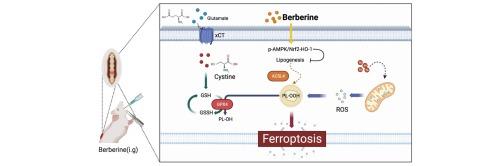
Ferroptosis, characterized by iron-dependent accumulation of lipid peroxides, plays an important role in spinal cord injury (SCI). Berberine (BBR), as a lipid peroxide scavenger, has been widely used in treating other diseases; however, its role in ferroptosis has not been fully elucidated. Therefore, here, to test our hypothesis that BBR can reduce the severity of SCI and promote motor function recovery by inhibiting neuronal ferroptosis, we evaluated the changes in ferroptosis-related indicators after BBR administration by establishing a cellular ferroptosis model and an SCI contusion model. We found that BBR administration significantly reduces lipid peroxidation damage, maintains normal mitochondrial function, reduces excessive accumulation of iron ions, enhances antioxidant capacity, and activates the ferroptosis defense system in vivo and in vitro. Mechanistically, BBR alleviates neuronal ferroptosis by inducing adenosine monophosphate-activated protein kinase (AMPK) phosphorylation and up-regulating nuclear factor erythroid 2-related factor 2 (NRF2) and heme oxygenase-1 (HO-1) protein expression to promote glutathione production. BBR administration also significantly improves motor function recovery in SCI rats. Meanwhile, applying the AMPK inhibitor Compound C blocks the neuroprotective and all other effects of BBR. Collectively, our findings demonstrate that BBR can attenuate neuronal ferroptosis after SCI by activating the AMPK–NRF2–HO-1 pathway.
期刊介绍:
International Immunopharmacology is the primary vehicle for the publication of original research papers pertinent to the overlapping areas of immunology, pharmacology, cytokine biology, immunotherapy, immunopathology and immunotoxicology. Review articles that encompass these subjects are also welcome.
The subject material appropriate for submission includes:
• Clinical studies employing immunotherapy of any type including the use of: bacterial and chemical agents; thymic hormones, interferon, lymphokines, etc., in transplantation and diseases such as cancer, immunodeficiency, chronic infection and allergic, inflammatory or autoimmune disorders.
• Studies on the mechanisms of action of these agents for specific parameters of immune competence as well as the overall clinical state.
• Pre-clinical animal studies and in vitro studies on mechanisms of action with immunopotentiators, immunomodulators, immunoadjuvants and other pharmacological agents active on cells participating in immune or allergic responses.
• Pharmacological compounds, microbial products and toxicological agents that affect the lymphoid system, and their mechanisms of action.
• Agents that activate genes or modify transcription and translation within the immune response.
• Substances activated, generated, or released through immunologic or related pathways that are pharmacologically active.
• Production, function and regulation of cytokines and their receptors.
• Classical pharmacological studies on the effects of chemokines and bioactive factors released during immunological reactions.



 京公网安备 11010802042870号
京ICP备2023020795号-1
京公网安备 11010802042870号
京ICP备2023020795号-1

 分享
分享
 求助内容:
求助内容: 应助结果提醒方式:
 扫码关注我们
