Realizing efficient broadband near-infrared emission under blue light excitation in Sb3+-doped zero-dimensional organic tin(iv)-based metal halides via coordination structure modulation†
Bao Ke, Hui Peng, Yongqi Yang, Chengzhi Yang, Shangfei Yao, Arfan Bukhtiar, Qilin Wei, Jialong Zhao and Bingsuo Zou
{"title":"Realizing efficient broadband near-infrared emission under blue light excitation in Sb3+-doped zero-dimensional organic tin(iv)-based metal halides via coordination structure modulation†","authors":"Bao Ke, Hui Peng, Yongqi Yang, Chengzhi Yang, Shangfei Yao, Arfan Bukhtiar, Qilin Wei, Jialong Zhao and Bingsuo Zou","doi":"10.1039/D4QI01904K","DOIUrl":null,"url":null,"abstract":"<p >Realizing Sb<small><sup>3+</sup></small>-activated efficient broadband near-infrared (NIR) emission under blue light excitation remains a significant challenge in lead-free metal halides. To overcome the above difficulties, a coordination structure modulation strategy was adopted, and the broadband NIR emission under blue light excitation was achieved in Sb<small><sup>3+</sup></small>-doped zero-dimensional (0D) organic tin(<small>IV</small>) bromide. Compared to the weak visible light emission with a photoluminescence quantum yield (PLQY) of 2.4% for pure (TBP)<small><sub>2</sub></small>SbBr<small><sub>5</sub></small> (TBP = tetrabutylphosphonium), Sb<small><sup>3+</sup></small>-doped (TBP)<small><sub>2</sub></small>SnBr<small><sub>6</sub></small> exhibits an efficient broadband NIR emission band at 705 nm with a PLQY of 33.2% upon 452 nm excitation, which stems from self-trapped exciton emission. Combined with experiments and theoretical calculations, we find that the large excited-state lattice distortion degree compared to the ground state and the narrow bandgap are dominant reasons for Sb<small><sup>3+</sup></small>-doped (TBP)<small><sub>2</sub></small>SnBr<small><sub>6</sub></small> showing efficient NIR emission under blue light excitation. Specifically, Sb<small><sup>3+</sup></small>-doped (TBP)<small><sub>2</sub></small>SnBr<small><sub>6</sub></small> also has excellent anti-water stability, existing stably in water for more than 4 hours while maintaining a high luminous efficiency. Based on the excellent stability and unique optical properties of Sb<small><sup>3+</sup></small>-doped (TBP)<small><sub>2</sub></small>SnBr<small><sub>6</sub></small>, a high-performance NIR light-emitting diode (LED) was fabricated by combining Sb<small><sup>3+</sup></small>-doped (TBP)<small><sub>2</sub></small>SnBr<small><sub>6</sub></small> with a commercial blue LED chip, and its application in night vision was demonstrated.</p>","PeriodicalId":79,"journal":{"name":"Inorganic Chemistry Frontiers","volume":" 22","pages":" 7979-7990"},"PeriodicalIF":6.4000,"publicationDate":"2024-09-26","publicationTypes":"Journal Article","fieldsOfStudy":null,"isOpenAccess":false,"openAccessPdf":"","citationCount":"0","resultStr":null,"platform":"Semanticscholar","paperid":null,"PeriodicalName":"Inorganic Chemistry Frontiers","FirstCategoryId":"92","ListUrlMain":"https://pubs.rsc.org/en/content/articlelanding/2024/qi/d4qi01904k","RegionNum":1,"RegionCategory":"化学","ArticlePicture":[],"TitleCN":null,"AbstractTextCN":null,"PMCID":null,"EPubDate":"","PubModel":"","JCR":"Q1","JCRName":"CHEMISTRY, INORGANIC & NUCLEAR","Score":null,"Total":0}
引用次数: 0
Abstract
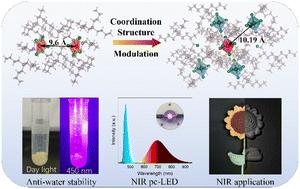
Realizing Sb3+-activated efficient broadband near-infrared (NIR) emission under blue light excitation remains a significant challenge in lead-free metal halides. To overcome the above difficulties, a coordination structure modulation strategy was adopted, and the broadband NIR emission under blue light excitation was achieved in Sb3+-doped zero-dimensional (0D) organic tin(IV) bromide. Compared to the weak visible light emission with a photoluminescence quantum yield (PLQY) of 2.4% for pure (TBP)2SbBr5 (TBP = tetrabutylphosphonium), Sb3+-doped (TBP)2SnBr6 exhibits an efficient broadband NIR emission band at 705 nm with a PLQY of 33.2% upon 452 nm excitation, which stems from self-trapped exciton emission. Combined with experiments and theoretical calculations, we find that the large excited-state lattice distortion degree compared to the ground state and the narrow bandgap are dominant reasons for Sb3+-doped (TBP)2SnBr6 showing efficient NIR emission under blue light excitation. Specifically, Sb3+-doped (TBP)2SnBr6 also has excellent anti-water stability, existing stably in water for more than 4 hours while maintaining a high luminous efficiency. Based on the excellent stability and unique optical properties of Sb3+-doped (TBP)2SnBr6, a high-performance NIR light-emitting diode (LED) was fabricated by combining Sb3+-doped (TBP)2SnBr6 with a commercial blue LED chip, and its application in night vision was demonstrated.



 京公网安备 11010802042870号
京ICP备2023020795号-1
京公网安备 11010802042870号
京ICP备2023020795号-1

 分享
分享
 求助内容:
求助内容: 应助结果提醒方式:
 扫码关注我们
