{"title":"Copper-doped Bi2MoO6 with concurrent oxygen vacancies for enhanced CO2 photoreduction†","authors":"Jiawei Liu, Xin Liu, Chunhui Dai, Chao Zeng, Sajjad Ali, Mohamed Bououdina and Yushuai Jia","doi":"10.1039/D4QI02005G","DOIUrl":null,"url":null,"abstract":"<p >Photocatalytic CO<small><sub>2</sub></small> reduction into highly valued chemical fuels holds great promise for resolving the issues related to energy shortage and mitigating greenhouse gas problems. However, the CO<small><sub>2</sub></small> conversion efficiency of current photocatalysts is hampered by their undesirable charge transfer and deficient reactive sites. Herein, we synthesized Bi<small><sub>2</sub></small>MoO<small><sub>6</sub></small> doped with monovalent Cu with accompanying O vacancies (Ov) to accelerate bulk and surface charge separation and transfer. Moreover, the Cu dopants serving as reactive sites could improve the adsorption and activation of CO<small><sub>2</sub></small> molecules on the catalyst's surface. As a result, the Cu-doped Bi<small><sub>2</sub></small>MoO<small><sub>6</sub></small> catalysts exhibit remarkedly boosted CO<small><sub>2</sub></small> reduction activity to the pristine Bi<small><sub>2</sub></small>MoO<small><sub>6</sub></small>, and the peak activity reaches at Bi<small><sub>2</sub></small>MoO<small><sub>6</sub></small>–10% Cu with a CO evolution rate of 11.40 μmol g<small><sup>−1 </sup></small>h<small><sup>−1</sup></small> under 300 W Xenon lamp irradiation, without any cocatalyst or sacrificial agent. This photoactivity surpasses that of most previously reported catalysts, and it is about 6-fold higher than that of Bi<small><sub>2</sub></small>MoO<small><sub>6</sub></small> (1.94 μmol g<small><sup>−1</sup></small> h<small><sup>−1</sup></small>). Moreover, even under natural sunlight illumination, Bi<small><sub>2</sub></small>MoO<small><sub>6</sub></small>–10% Cu exhibited considerable activity for CO<small><sub>2</sub></small> photocatalytic conversion into CO. This study may inspire an efficient strategy for designing and developing high performance photocatalysts toward CO<small><sub>2</sub></small> conversion.</p>","PeriodicalId":79,"journal":{"name":"Inorganic Chemistry Frontiers","volume":" 22","pages":" 8003-8015"},"PeriodicalIF":6.4000,"publicationDate":"2024-09-26","publicationTypes":"Journal Article","fieldsOfStudy":null,"isOpenAccess":false,"openAccessPdf":"","citationCount":"0","resultStr":null,"platform":"Semanticscholar","paperid":null,"PeriodicalName":"Inorganic Chemistry Frontiers","FirstCategoryId":"92","ListUrlMain":"https://pubs.rsc.org/en/content/articlelanding/2024/qi/d4qi02005g","RegionNum":1,"RegionCategory":"化学","ArticlePicture":[],"TitleCN":null,"AbstractTextCN":null,"PMCID":null,"EPubDate":"","PubModel":"","JCR":"Q1","JCRName":"CHEMISTRY, INORGANIC & NUCLEAR","Score":null,"Total":0}
引用次数: 0
Abstract
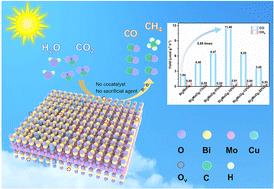
Photocatalytic CO2 reduction into highly valued chemical fuels holds great promise for resolving the issues related to energy shortage and mitigating greenhouse gas problems. However, the CO2 conversion efficiency of current photocatalysts is hampered by their undesirable charge transfer and deficient reactive sites. Herein, we synthesized Bi2MoO6 doped with monovalent Cu with accompanying O vacancies (Ov) to accelerate bulk and surface charge separation and transfer. Moreover, the Cu dopants serving as reactive sites could improve the adsorption and activation of CO2 molecules on the catalyst's surface. As a result, the Cu-doped Bi2MoO6 catalysts exhibit remarkedly boosted CO2 reduction activity to the pristine Bi2MoO6, and the peak activity reaches at Bi2MoO6–10% Cu with a CO evolution rate of 11.40 μmol g−1 h−1 under 300 W Xenon lamp irradiation, without any cocatalyst or sacrificial agent. This photoactivity surpasses that of most previously reported catalysts, and it is about 6-fold higher than that of Bi2MoO6 (1.94 μmol g−1 h−1). Moreover, even under natural sunlight illumination, Bi2MoO6–10% Cu exhibited considerable activity for CO2 photocatalytic conversion into CO. This study may inspire an efficient strategy for designing and developing high performance photocatalysts toward CO2 conversion.



 京公网安备 11010802042870号
京ICP备2023020795号-1
京公网安备 11010802042870号
京ICP备2023020795号-1

 分享
分享
 求助内容:
求助内容: 应助结果提醒方式:
 扫码关注我们
