Hao Dong, Xin Liu, Hu Wang, Zhilong Chen, Fenghua Li, Pengxiang Wang, Jie Fu and Yuchuan Shao
{"title":"An X-ray detector with an ultra-low detection limit based on bulk two-dimensional perovskite PEA2PbBr4 single crystals grown in HBr solution†","authors":"Hao Dong, Xin Liu, Hu Wang, Zhilong Chen, Fenghua Li, Pengxiang Wang, Jie Fu and Yuchuan Shao","doi":"10.1039/D4TA04726E","DOIUrl":null,"url":null,"abstract":"<p >Achieving a lower detection limit is always crucial for X-ray detectors in medical imaging. Two-dimensional (2D) perovskites are superior candidate materials for X-ray detection due to their high bulk resistivity, excellent environmental stability, and negligible ion migration under high bias. However, the reported detection limit of 2D perovskite X-ray detectors still apparently lags behind that of their 3D analogues due to the difficulty in the growth of high-quality bulk 2D perovskite single crystals (SCs). Herein, we demonstrate an X-ray detector with an ultra-low detection limit based on high-quality bulk PEA<small><sub>2</sub></small>PbBr<small><sub>4</sub></small> SCs grown in HBr solution for the first time. According to the solubility difference of reactants, a slowly varying nucleation curve for the precursor solution is designed to stabilize growth rate and reduce defect density during crystal growth. The fabricated Au/PEA<small><sub>2</sub></small>PbBr<small><sub>4</sub></small>/Au detector shows a low noise level of 10<small><sup>−5</sup></small> nA Hz<small><sup>−1/2</sup></small> and an ultra-low dark current drift of 6.6 × 10<small><sup>−7</sup></small> pA cm<small><sup>−1</sup></small> V<small><sup>−1</sup></small> s<small><sup>−1</sup></small>. Together with a commendable hole lifetime of 2.76 μs and hole mobility-lifetime product of 5.8 × 10<small><sup>−4</sup></small> cm<small><sup>2</sup></small> V<small><sup>−1</sup></small>, the produced detector exhibits a high sensitivity of 2998 μC Gy<small><sub>air</sub></small> s<small><sup>−1</sup></small> cm<small><sup>−2</sup></small> and a record-low detection limit of 0.79 nGy<small><sub>air</sub></small> s<small><sup>−1</sup></small>. The current work would be beneficial for the development of next generation medical imaging.</p>","PeriodicalId":82,"journal":{"name":"Journal of Materials Chemistry A","volume":" 43","pages":" 29785-29794"},"PeriodicalIF":9.5000,"publicationDate":"2024-09-28","publicationTypes":"Journal Article","fieldsOfStudy":null,"isOpenAccess":false,"openAccessPdf":"https://pubs.rsc.org/en/content/articlepdf/2024/ta/d4ta04726e?page=search","citationCount":"0","resultStr":null,"platform":"Semanticscholar","paperid":null,"PeriodicalName":"Journal of Materials Chemistry A","FirstCategoryId":"88","ListUrlMain":"https://pubs.rsc.org/en/content/articlelanding/2024/ta/d4ta04726e","RegionNum":2,"RegionCategory":"材料科学","ArticlePicture":[],"TitleCN":null,"AbstractTextCN":null,"PMCID":null,"EPubDate":"","PubModel":"","JCR":"Q1","JCRName":"CHEMISTRY, PHYSICAL","Score":null,"Total":0}
引用次数: 0
Abstract
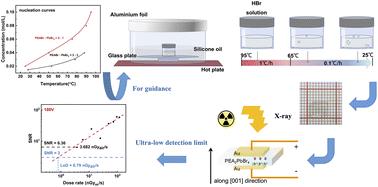
Achieving a lower detection limit is always crucial for X-ray detectors in medical imaging. Two-dimensional (2D) perovskites are superior candidate materials for X-ray detection due to their high bulk resistivity, excellent environmental stability, and negligible ion migration under high bias. However, the reported detection limit of 2D perovskite X-ray detectors still apparently lags behind that of their 3D analogues due to the difficulty in the growth of high-quality bulk 2D perovskite single crystals (SCs). Herein, we demonstrate an X-ray detector with an ultra-low detection limit based on high-quality bulk PEA2PbBr4 SCs grown in HBr solution for the first time. According to the solubility difference of reactants, a slowly varying nucleation curve for the precursor solution is designed to stabilize growth rate and reduce defect density during crystal growth. The fabricated Au/PEA2PbBr4/Au detector shows a low noise level of 10−5 nA Hz−1/2 and an ultra-low dark current drift of 6.6 × 10⁻⁷ pA cm−1 V−1 s−1. Together with a commendable hole lifetime of 2.76 μs and hole mobility-lifetime product of 5.8 × 10⁻⁴ cm2 V−1, the produced detector exhibits a high sensitivity of 2998 μC Gyair s−1 cm−2 and a record-low detection limit of 0.79 nGyair s−1. The current work would be beneficial for the development of next generation medical imaging.
期刊介绍:
The Journal of Materials Chemistry A, B & C covers a wide range of high-quality studies in the field of materials chemistry, with each section focusing on specific applications of the materials studied. Journal of Materials Chemistry A emphasizes applications in energy and sustainability, including topics such as artificial photosynthesis, batteries, and fuel cells. Journal of Materials Chemistry B focuses on applications in biology and medicine, while Journal of Materials Chemistry C covers applications in optical, magnetic, and electronic devices. Example topic areas within the scope of Journal of Materials Chemistry A include catalysis, green/sustainable materials, sensors, and water treatment, among others.



 京公网安备 11010802042870号
京ICP备2023020795号-1
京公网安备 11010802042870号
京ICP备2023020795号-1

 分享
分享
 求助内容:
求助内容: 应助结果提醒方式:
 扫码关注我们
