Insecticide risk assessment for biological control agents is essential for implementing integrated pest management (IPM) programs. Spinetoram is a naturally derived insecticide used to control a variety of agricultural sap-sucking insect pests, and Encarsia formosa Gahan (Hymenoptera: Aphelinidae) plays a key role in the biocontrol of greenhouse whiteflies. Despite its presumed safe ecotoxicological profile, the side effects of spinetoram on E. formosa are partially unknown, especially at sublethal doses. In the laboratory, we estimated the lethal concentrations (LC) of spinetoram on E. formosa by topical exposure of pupae and 48 h residual contact exposure of emerged adults. Afterwards, we assessed the impact of spinetoram LCs on the life history traits (juvenile development, adult longevity, parasitism, adult emergence) and population growth parameter (the instantaneous rate of increase, ri) of the parasitoid.
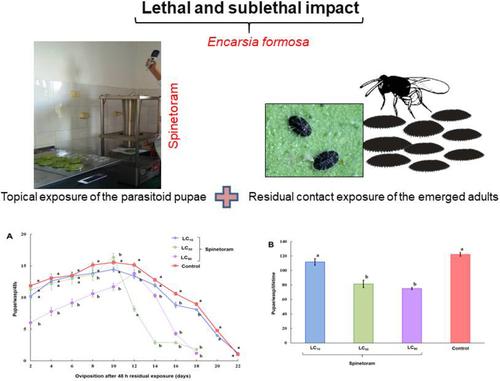
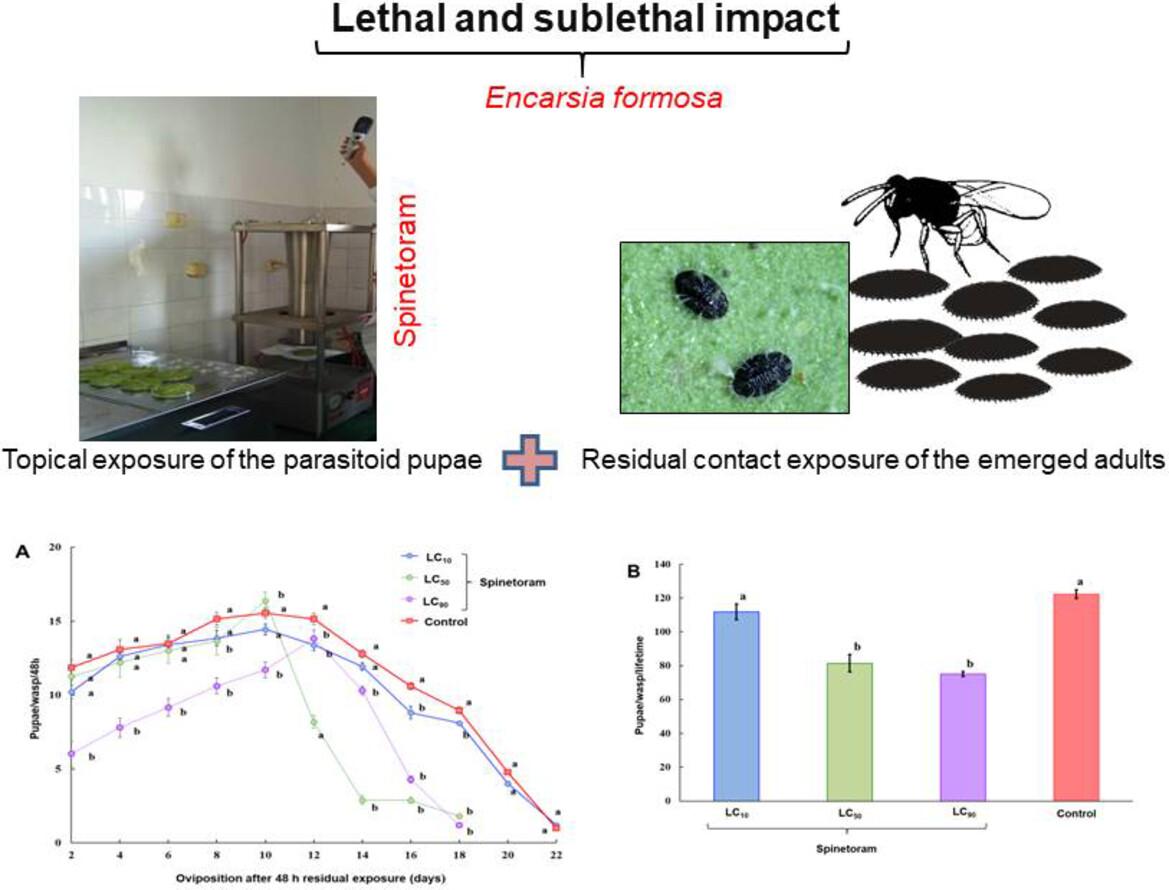
Probit analysis allowed the estimation of LC10 = 0.10 mg/L, LC50 = 0.56 mg/L, and LC90 = 3.28 mg/L. Spinetoram at LC10 had no impact on the observed parameters of E. formosa. Conversely, spinetoram at LC50 and LC90 significantly reduced adult longevity by 19.2% and 40.6%, total parasitism by 33.4% and 38.7%, and total adult emergence by 29.6% and 39.1%, respectively. Also, the ri of E. formosa was significantly affected by spinetoram LC50 and LC90 with a reduction of 8.17 and 29.83%, respectively.
Our results suggested that spinetoram significantly threatens the effectiveness of E. formosa when applied at the field recommended rate. However, further validation of spinetoram under greenhouse conditions is required for a comprehensive risk assessment for E. formosa in IPM programs. © 2024 Society of Chemical Industry.





 京公网安备 11010802042870号
京ICP备2023020795号-1
京公网安备 11010802042870号
京ICP备2023020795号-1

 分享
分享
 求助内容:
求助内容: 应助结果提醒方式:
 扫码关注我们
